Technologies against the common cold: Chinese scientists have invented microrobots to treat infections

Tired of the common cold and sinusitis? Chinese and Hong Kong scientists seem to have found a solution - an army of tiny robots that literally cut the infection out of your sinuses and politely fly out into a handkerchief. This was reported by the Guardian. Does it sound like science fiction? No, it's already a reality... at least for pigs and rabbits.
What is known
A group of scientists from Hong Kong, Guangzhou, Macau, Yangzhou, and several other Chinese universities have developed a swarm of microrobots - the size of a speck of dust, thinner than a human hair. They are inserted into the sinuses through a special catheter and controlled by a magnetic field. There, they heat up, break through pus congestion and literally burn the bacterial infection using chemical reactions and reactive oxygen.
After the mission is completed, these micro-soldiers simply... fly back out through the nose. Nice, clean and antibiotic-free.
This is part of the rapidly growing field of micro- and nanorobotics for medicine. Similar developments are already being tested to clean the bladder and intestines, as well as to remove bacteria from implants such as stents or hernia mesh.
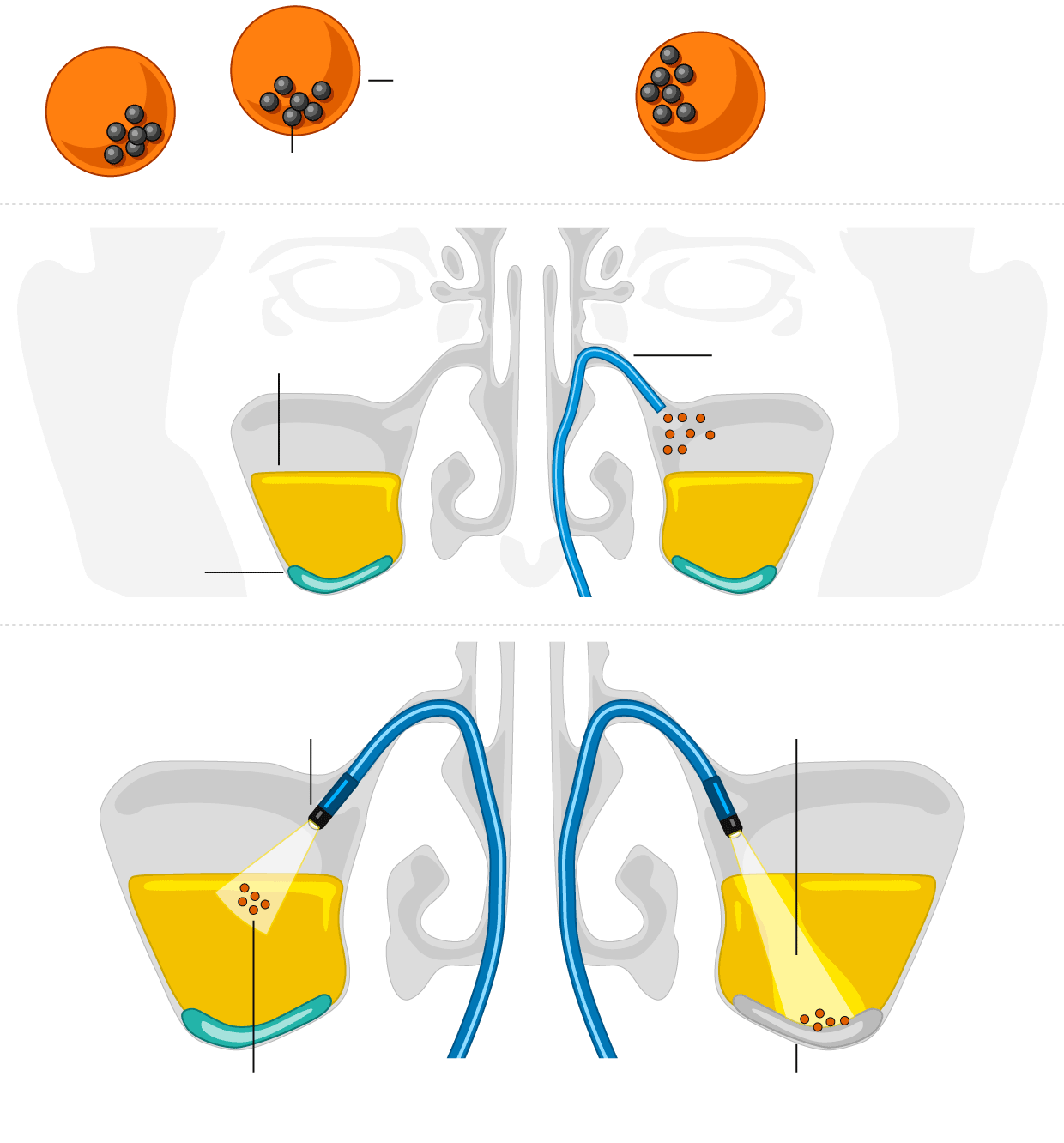
How microrobots work (scale not to scale). Illustration: Guardian
But there is a caveat: scientists honestly warn about the risks. For example, that some robots may remain in the body. And there is also a classic point of the 21st century - the possibility of conspiracy theories about "nose chipping".
However, the scientific community is calm. Professor Sylvain Martel, director of the Nano Robotics Laboratory at the Polytechnique de Montréal in Canada, says the technology looks "like a missile that can be precisely guided by a magnetic field." According to his estimates, such robots could appear in hospitals in 3-5 years, although more realistically, in a decade, taking into account all the bureaucratic nuances.
The authors of the study add that their approach is a non-invasive, safe and drug-free solution to fight infections.
Is humanity ready for sinusitis to be treated not by antibiotics but by a tiny army of metal bees? Well... in five years, we'll see.
Source: Guardian


