Samsung opens up Tizen OS to the world: new partners, global expansion, and why it's a game changer for the Smart TV market

Samsung Electronics has announced a major expansion of its Tizen OS licensing programme, taking a step towards making its proprietary platform the global standard for Smart TVs. Through new partnerships and updated offerings, Tizen OS will now be at the heart of TVs from well-known brands in Europe, North and Latin America, Australia and other regions.
Who has already joined the Tizen ecosystem?
The new partners include EKO and QBELL (Ayonz) in Australia and Europe, RCA (Grupo Kayve) in Mexico, RCA (Treasure Creek) in the US and Canada, and Axdia in Germany. More brands are expected to join the programme by the end of 2025. This demonstrates the demand for a proven platform that Samsung is constantly improving.
What will users get?
Tizen OS 8.0 offers:
- fast access to content through the integration of Samsung TV Plus and FAST channels,
- cloud gaming through Samsung Gaming Hub,
- seamless connection to other devices via SmartThings,
- improved interface for easier use.
Partners will also receive marketing tools that will help make Tizen TVs stand out on store shelves - from premium content to performance and stability.
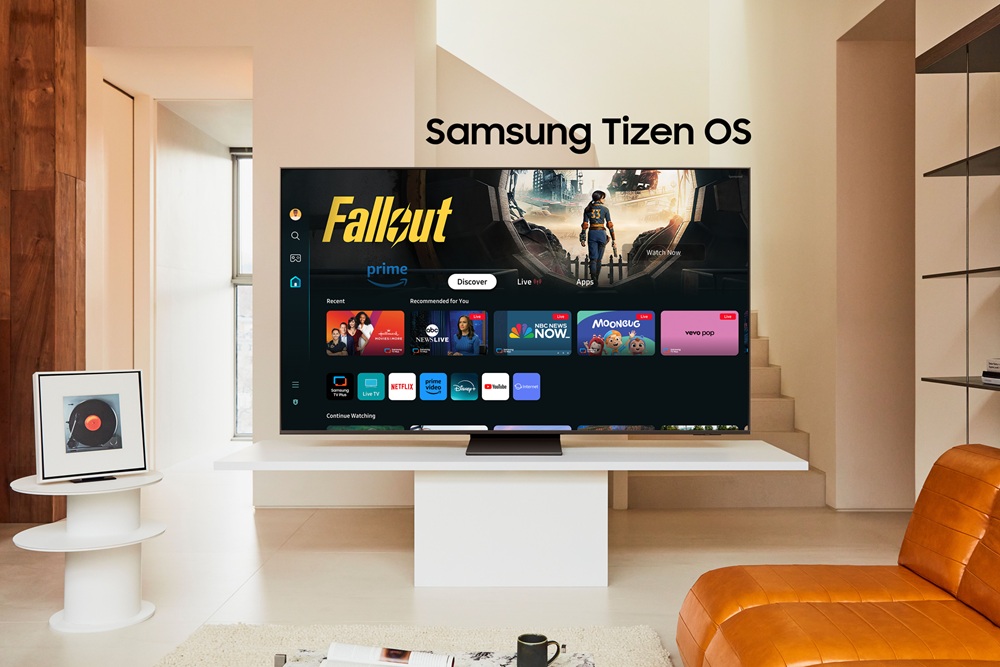
A TV with Tizen OS. Illustration: Samsung
Why is it important?
For the market: Tizen OS goes beyond the Samsung ecosystem, challenging Android TV and Google TV, which dominate the TV market. This creates competition that consumers will benefit from through more choice and faster technology development.
For brands: smaller manufacturers gain access to a proven platform with rich content and features that were previously exclusive to Samsung.
For consumers: the growing number of Tizen TVs from different manufacturers means that premium features are now available at more affordable price points.
About the Tizen operating system
Tizen OS was born in 2011 as an ambitious attempt by Samsung, Intel and the Linux Foundation to create an open operating system that could be an alternative to Android and iOS. It was the successor to several previous projects, including MeeGo by Intel and Nokia, Bada OS by Samsung, and the LiMo platform. In 2012, Tizen was officially introduced as a universal platform for mobile devices, automotive electronics, and home appliances. The main idea was to make the system flexible and independent of Google's control, but the beginning of the journey proved difficult.
In 2013, Samsung tried to bring Tizen to the smartphone market with the Samsung Z, but the release was postponed. It was only in 2015 that the company launched the Samsung Z1, a budget smartphone aimed at India and Bangladesh. Although sales reached about a million devices, Tizen smartphones were unable to compete with Android even in the low-end segment. The main problem was the lack of apps, which drove users away. However, this experience was the impetus for a change of focus.
The turning point for Tizen was its introduction into TVs. In 2015, Samsung started using this OS in its Smart TVs, and this decision brought the system real success. Thanks to integration with Samsung TV Plus, SmartThings, and cloud gaming via Gaming Hub, Tizen quickly became the global Smart TV market leader. According to Strategy Analytics research, in 2020-2023, Tizen occupied more than 30% of the market, ahead of Android TV and Roku. At the same time, the system has found application in wearable devices, such as Samsung Gear and Galaxy Watch smartwatches, as well as in car infotainment systems in cooperation with Toyota and Renault-Nissan.
Since 2022, Samsung has opened up Tizen to third-party TV manufacturers by launching a licensing programme. This allowed lesser-known brands to use the proven OS for their Smart TVs. Today, Tizen is not only the heart of Samsung TVs, but also a powerful player in the global Smart TV market. The platform has the potential for further development in wearables and the Internet of Things, especially in the SmartThings ecosystem. Although Tizen's journey has been bumpy, it has now evolved from an experimental mobile OS to an important element of Samsung's connected device strategy.
Source: Samsung


