Apple changes supplier of iPhone 18 camera sensors: Samsung will produce them instead of Sony

Apple and Samsung have officially started a game-changing collaboration for future iPhones and will launch joint production of smartphone camera sensors at Samsung's plant in Austin, Texas. According to The Financial Times, it's a complicated thing - three-layer stacked CIS sensors that can capture more light, read data faster, save battery power and produce better photo quality, especially at night. In its official statement, Apple claims that such technologies have never been produced on an industrial scale before.
"Apple is also working with Samsung at its fab in Austin, Texas, to launch an innovative new technology for making chips, which has never been used before anywhere in the world. "
Behind the scenes, the story is even more interesting. Currently, Sony is the main supplier of iPhone sensors, but it is based in Japan, which means long supply chains and the risk of being hit by new import duties imposed by President Trump. Samsung, on the other hand, has a ready-made factory in the US, so Apple will have production right next door with minimal logistical problems. This is also beneficial for Samsung: the company not only strengthens its position in the US market, but also adds a high-profile contract with Apple to its portfolio, plus it already has a deal with Tesla worth billions of dollars.
The day after Apple's announcement, Samsung Semiconductor announced a new generation of ISOCELL JNP nanoprism dies. This is Samsung's latest technology that allows it to maintain image quality even as the pixels of smartphones become smaller. Instead of traditional mini-lenses, Nanoprism uses a nanostructured prism surface that diffuses light and redirects it to the appropriate colour pixels, increasing light sensitivity without increasing the size of the camera module. This breakthrough in microphotonics is implemented in the ISOCELL JNP sensor, which provides about 25% increase in low-light sensitivity compared to its predecessor. Of course, the nanoprism does not look like the "three-layer" solution described by the Financial Times, but the coincidence of the announcements suggests the same.
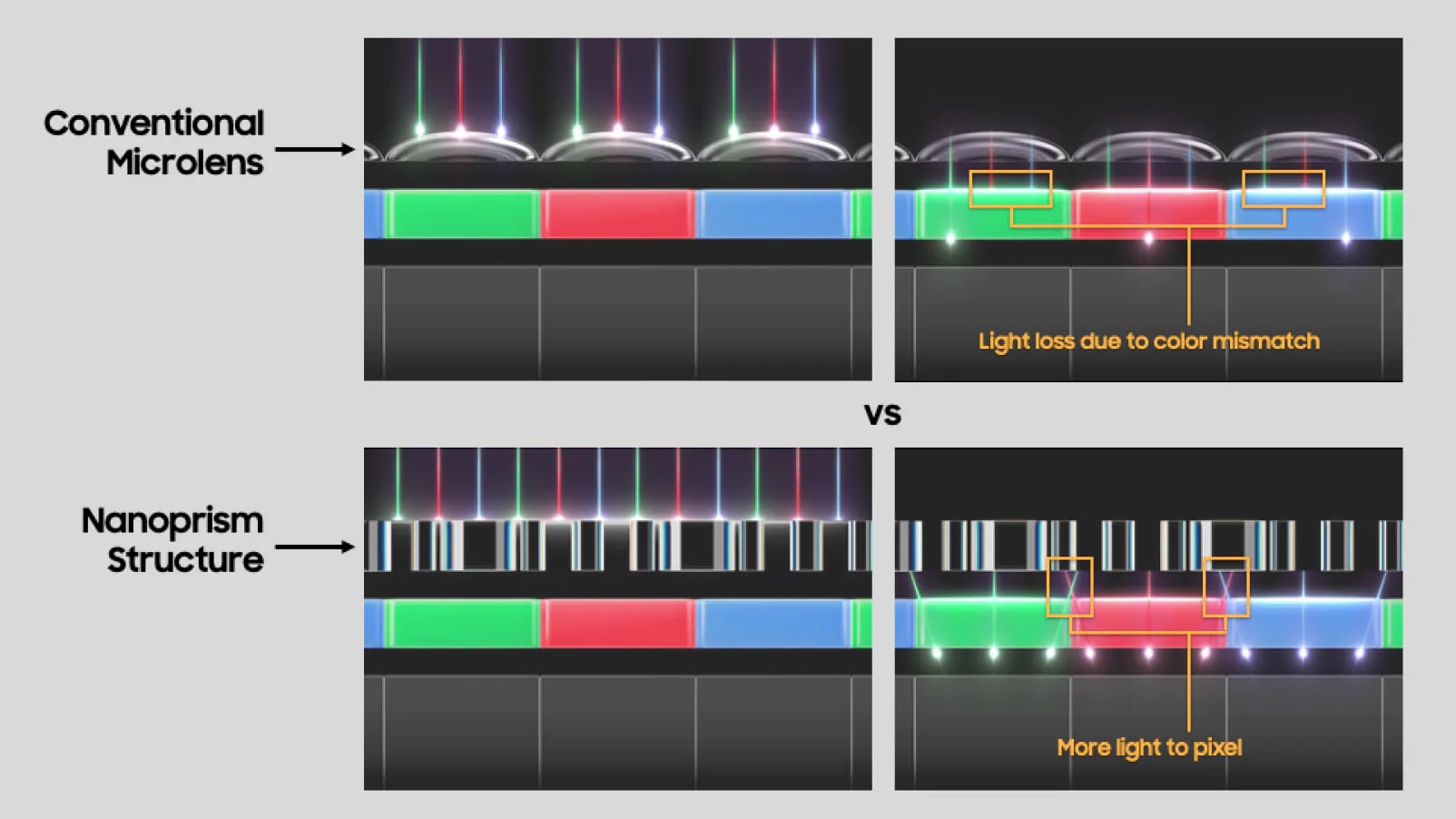
The benefits of nanoprism technology. Illustration: Samsung Semicobductor
According to the plan, the first iPhones with new sensors will appear in 2026, probably in the iPhone 18 model. For Apple, this step fits into a large-scale strategy of localising production in the US: the company has promised to invest $600 billion in the US economy over the next four years. Although no one officially talks about a "break" with Sony, it looks as if Apple is simply hedging its bets by reducing its dependence on one supplier.
Source: The Verge


