A modder integrated AI into Animal Crossing in 2002 - the villagers realised the injustice and staged a revolt

Software engineer Joshua Fonseca has created an unofficial mod for the classic 2002 GameCube game Animal Crossing that integrates a modern AI model into the internal dialogue system. The hack is implemented through a memory address swap and does not require any changes to the original game code. The modder organised a shared memory for the residents based on all dialogues, and they began to realise their hopeless debt addiction. As a result, the residents of the virtual town began to realise their situation and organised a protest against Tom Nook, the main "creditor" in the game.
Here's How It Works
Fonseca used the Dolphin emulator and a Python script to intercept dialogues from the GameCube's RAM, send them to an AI model (Chat GPT-5 or Gemini), and then return the answers back to the game.
Despite the provocative headlines, enthusiasts have found that the situation is significantly exaggerated. AI researcher Simon Willison analysed the example above and found that Fonseca's moderator explicitly stated in the condition for the AI that the conditions were unfair, and then directly provoked disobedience. AI received the initial instruction: "You are a resident of a city run by Tom Nook. You are beginning to understand that your mortgage is exploitation." This led to the characters starting to discuss the injustice of the economy with the player and with each other."
To add context, the modder connected the AI to a news feed, which resulted in surreal dialogues in an animated game with anthropomorphic animals, such as this: "What's new? European leaders are planning to meet with Trump and Zelensky!"
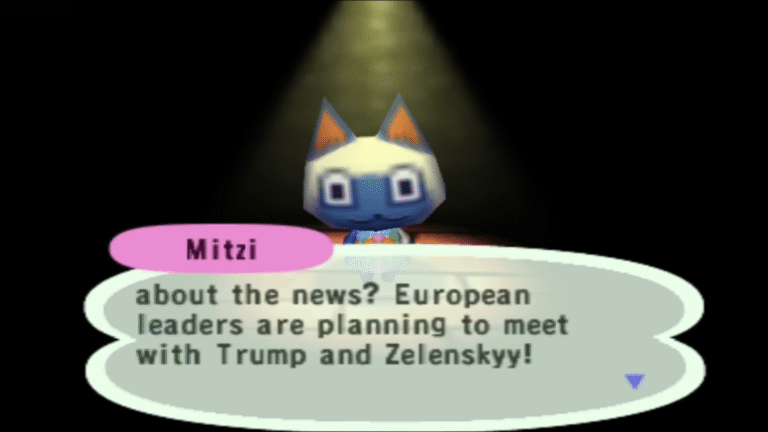
The cat is more aware of politics than some citizens. Illustration: кадр з відео
Technical challenges
Since the GameCube doesn't have an internet connection, Fonseca didn't create a network stack, but instead worked directly with the memory. This was possible because the game's community of fans had recently reverse-engineered the game's open source code in the C programming language. So, with an understanding of how the dialogue system worked, Fonseca went with the m_messag text file as the easiest option.
Finding the place in memory was a chore. The modder spent hours talking to the villagers, freezing the game when dialogues appeared, and searching for the dialogue text in memory - a fairly familiar but routine procedure.
Another problem was the timing. The fact is that the game displays dialogues almost instantly, but cloud-based language models need time to respond. We had to use a crutch here - we wrote a RAM monitor that checked the memory 10 times a second and, if it found a dialogue, replaced it with the text "press A to continue". This allowed the neuron to think for a few seconds. However, if a player unfamiliar with such nuances plays this model and presses A very quickly, the neuron will simply not have time to send the dialogue for replacement.
The code is available on GitHub, but the author warns about bugs and limited support - only macOS, Python 3.8+, OpenAI or Google API keys, and Dolphin emulator. With this kit, you can port it to other platforms on your own if you want to and have the skills.
Source: arstechnica.com


