ASUS demonstrates a new standard for PCIe power transfer: 250W without cable or additional connectors
Asus is developing a new standard for powering graphics cards - the new PCIe High Power technology, which will deliver up to 250W of power without additional cables and connectors. This will greatly simplify PC assembly, reduce visual clutter and pave the way for new form factors.
Context.
Graphics cards have long been the most power-hungry component in a PC. The standard 75W provided by a PCI-Express port is only satisfactory for the most budget-friendly "plug-in" graphics cards, which have been killed by integrated graphics these days. In general, it was not a problem to transmit additional power through an additional 6, 8, 12 or even 12+4 (12VHPWR) cable, but transparent computer cases became fashionable and this power element began to spoil the whole aesthetics.
BTF connector to the right of PCI Express. Illustration: Asus
It is interesting that Asus has already developed a unique solution to this problem - the company has created the BTF standard, which provides an additional power connector located a little further from PCI Express and can transmit power from the motherboard. But the Taiwanese company decided not to stand still and developed a new standard for transferring up to 250W through a single PCI Express port.
How the new product differs
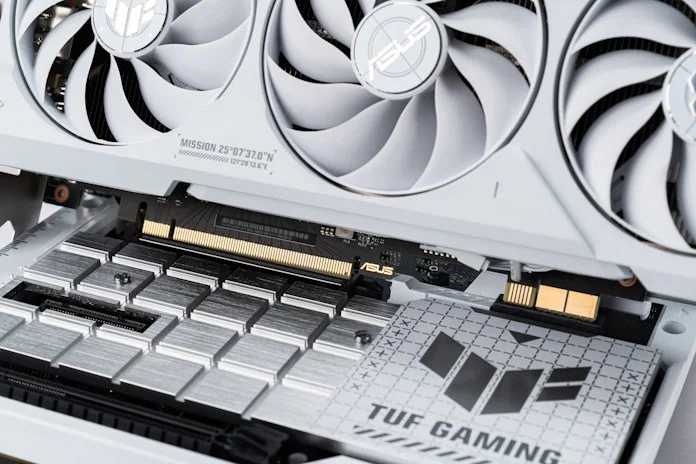
Asus has slightly modified the PCI Express port's contact pad, so that the port remains backwards compatible with graphics cards with "regular" PCI-Express. Unlike BTF, there is no problem that the additional port can rest against elements on the motherboard that does not have a BTF connector in this place. In fact, Asus can produce exclusively cards with the new connector while remaining compatible with all other graphics cards and motherboards, so this port has good potential. Video cards that don't support this power transfer can always be connected with an old-fashioned wire.

This is what the new PCI Express port looks like. Illustration: a frame from the video
Currently, the technology exists only in the form of a prototype. There is no information on when it will be included in commercial devices and whether it will be included at all.
Source: www.bilibili.com


