Sensation in Paleontology: Dinosaur with Hooves Discovered for the First Time

In Wyoming, researchers made a sensational discovery: for the first time in the history of paleontology, a dinosaur with hoof-like structures on its limbs was found. This is Edmontosaurus annectens — a duck-billed dinosaur whose remains were discovered in the "Mummy" zone of the Lance Formation. This area, about six miles wide, is known for its exceptional level of fossil preservation.
According to the study published in the journal Science, the toes II–IV on the hind legs of Edmontosaurus were covered with keratin sheaths resembling hooves. They had flat bottoms and encompassed shovel-shaped bones. Similar structures were found on the forelimbs, although their arrangement slightly differed. Most impressive is that the hoof-like sheaths on the middle toes reached 15 centimeters — twice the length of the bones themselves. Such structures were not previously recorded in any terrestrial vertebrate.
Apart from hooves, the remains of Edmontosaurus annectens revealed a number of soft tissue features: a fleshy crest along the back, which could reach 28 centimeters in height in an adult, a row of spikes along the tail, and polygonal scales ranging from one to nine millimeters in size. These details became visible only thanks to the exceptional level of preservation provided by the unique conditions at the find site.
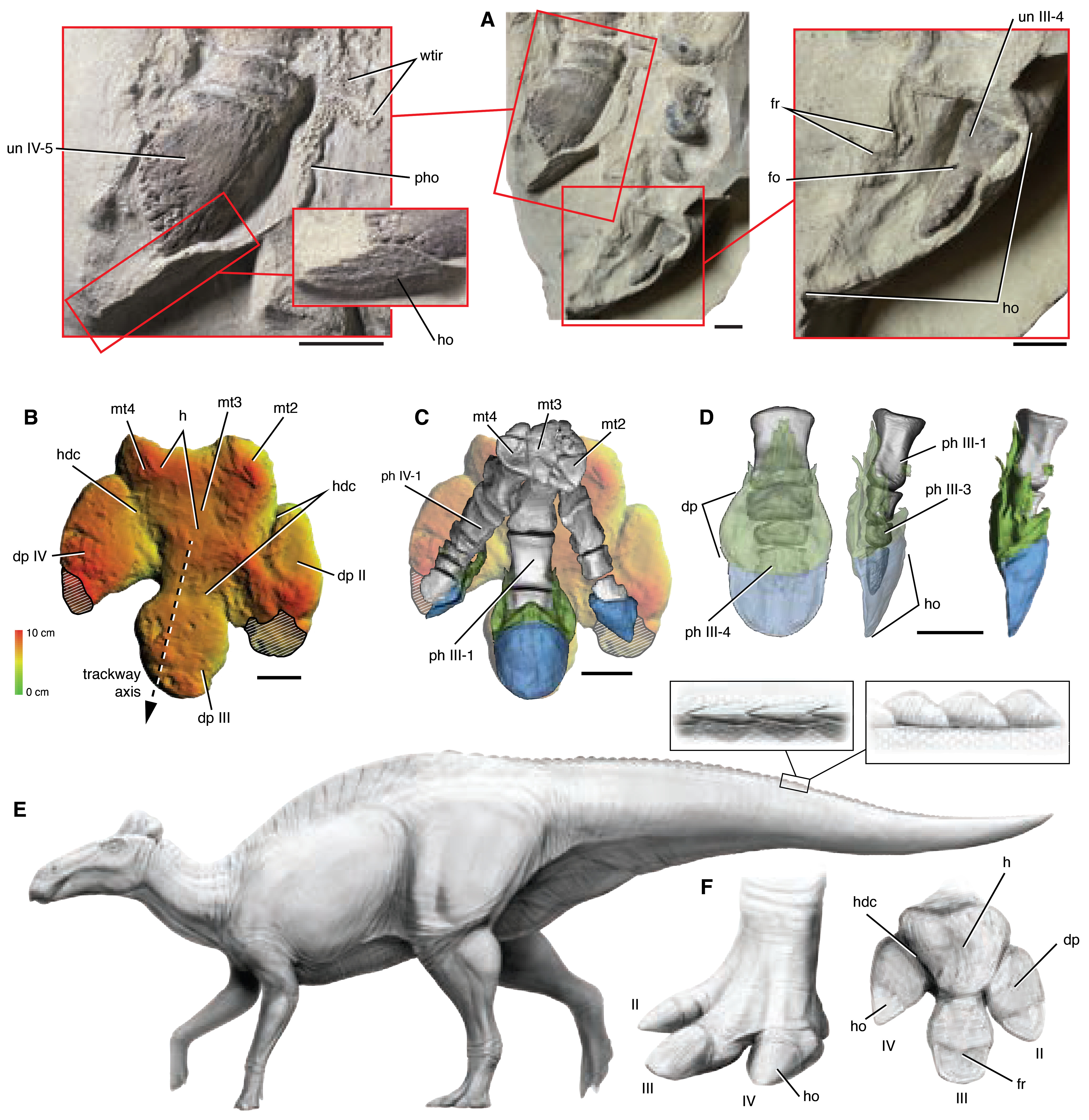
Edmontosaurus annectens. Illustration: science.org
The fossilization process was unusual: the dinosaur's body first dried during a drought, then was quickly buried by river silt during a flood, and the skin surface was covered with a thin layer of clay — less than a millimeter thick. This created a kind of "clay template" that preserved the outer shape of the body. Such preservation was previously observed only in marine environments with low oxygen content, making this the first documented case in a terrestrial river system.
The discovery is highly significant for science: Edmontosaurus annectens is now considered the oldest terrestrial vertebrate with true hooves. This suggests that a hoof-like gait might have arisen in hadrosaurs as far back as the early Cretaceous period — long before hooves appeared in mammals.
This fact is a vivid example of convergent evolution, where different unrelated species of living organisms acquire similar traits due to the influence of similar environmental conditions.
Source: www.science.org


