At gagadget.com, your trust is our priority. We follow strict quality standards in our research, tests, and analysis of tvs, to give you the best experience. Learn more
OLED vs QLED TV
Television technology has evolved dramatically over the past decade, yet consumers still face confusion when choosing between OLED and QLED displays. Marketing materials overflow with technical jargon about quantum dots, organic compounds, and local dimming zones, while practical performance differences remain unclear to most buyers.
Short answer: OLED (Organic Light-Emitting Diode) TVs use self-emissive pixels that produce their own light and turn completely off for perfect blacks, delivering infinite contrast ratios and exceptional viewing angles. QLED (Quantum Dot LED) TVs use LED backlights enhanced with quantum dot filters to achieve superior brightness (often exceeding 2000 nits), wider color gamut, and lower costs, though they cannot match OLED's absolute black levels. OLED excels in dark rooms and cinematic viewing, while QLED performs better in bright spaces and avoids burn-in risks with static content.
- OLED Display Technology Explained
- QLED Technology and Quantum Dots
- Picture Quality Comparison
- Brightness and HDR Performance
- Viewing Angles and Uniformity
- Gaming Performance
- Longevity and Burn-In Concerns
- OLED vs QLED: FAQ
OLED Display Technology Explained
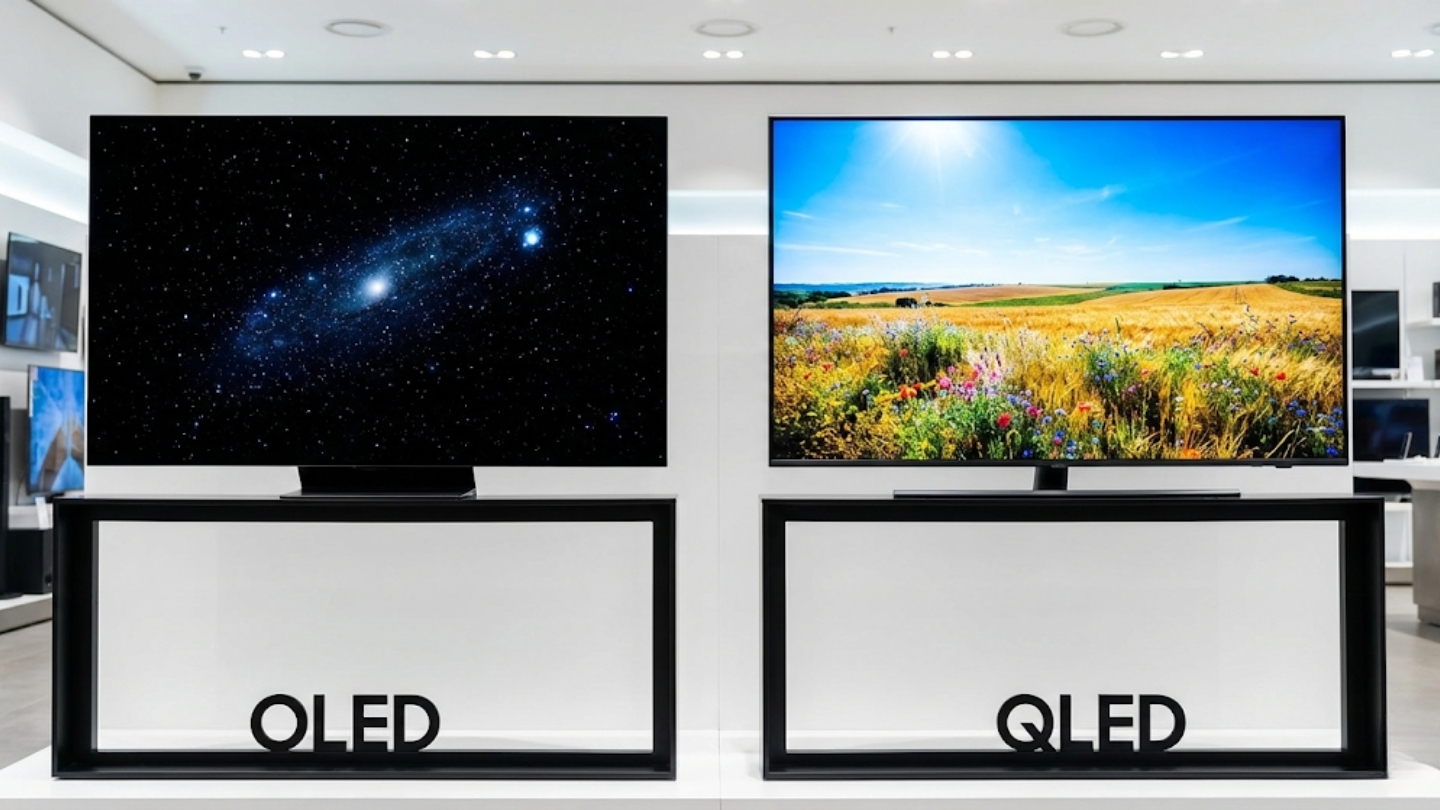
OLED displays consist of millions of self-emissive pixels made from organic compounds that produce light when electrical current passes through them. Each pixel contains red, green, and blue subpixels plus a white subpixel in most implementations. This structure enables individual pixel control - when displaying black, pixels turn completely off, producing zero measurable light and creating infinite contrast ratios.
The organic materials in OLED panels degrade gradually over time as they emit light. Manufacturers combat this limitation through various protective technologies, including automatic brightness limiting and pixel shifting algorithms. Modern OLED panels use either WOLED (white OLED with color filters) or QD-OLED (combining quantum dots with OLED) architectures, with QD-OLED achieving higher brightness and color volume.
QLED Technology and Quantum Dots
QLED represents Samsung's branding for quantum dot-enhanced LED TVs. These displays use traditional LCD panels with LED backlights, adding a quantum dot film between the backlight and LCD layer. Quantum dots are microscopic nanocrystals that absorb blue LED light and re-emit it as precise wavelengths of red and green, dramatically expanding color reproduction beyond standard LED-LCD capabilities.
Premium QLED implementations incorporate mini-LED backlights with thousands of dimming zones, enabling localized brightness control. The Sony BRAVIA 7 (K-55XR70) combines quantum dots with mini-LED technology and Sony's XR Backlight Master Drive, achieving exceptional brightness and contrast through thousands of precisely controlled LED zones. Unlike OLED, QLED panels require an always-on backlight that cannot achieve absolute black since light inevitably bleeds between dimming zones.
Picture Quality Comparison
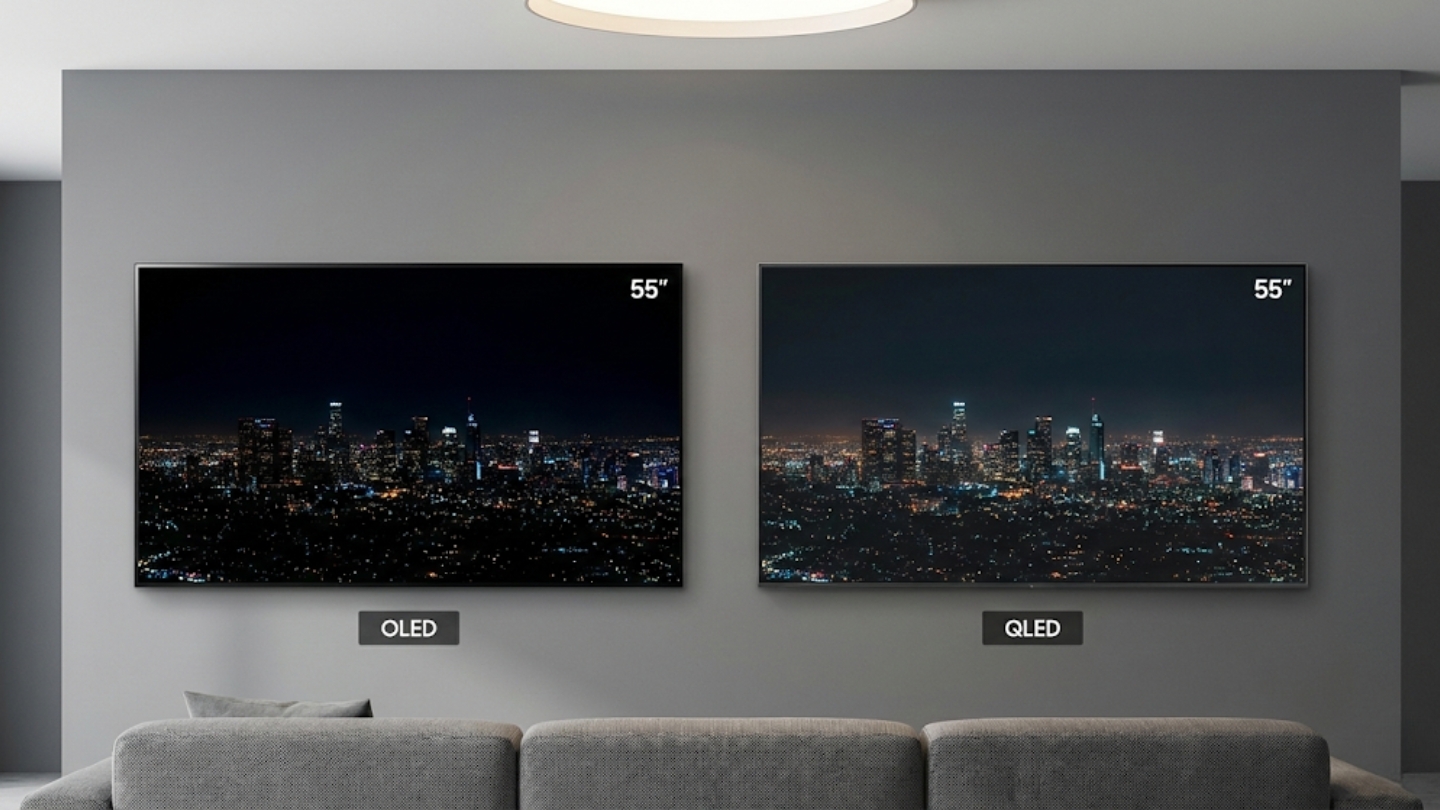
OLED delivers superior picture quality in dark viewing environments through perfect blacks and instantaneous pixel response. The Samsung S90D OLED demonstrates this advantage with QD-OLED technology combining OLED's infinite contrast with quantum dot color enhancement. Dark scenes in films like Dune or Blade Runner 2049 reveal shadow detail impossible on backlit displays, as neighboring pixels showing bright elements don't affect surrounding black areas.
QLED excels in bright room viewing and HDR highlight reproduction. The quantum dot layer produces over a billion color variations covering 95-97% of the DCI-P3 cinema color space. Color accuracy remains consistent across brightness levels, whereas OLED panels often shift color temperature when displaying very bright or very dim content. QLED also maintains better color saturation in bright scenes, making daytime television, sports, and animated content particularly striking.
Brightness and HDR Performance
Peak brightness represents QLED's most significant advantage over OLED technology. Premium mini-LED QLED displays like the Hisense U8QG achieve measured peak brightness approaching 5000 nits in small highlights, with sustained full-screen brightness exceeding 2000 nits. This headroom proves valuable for HDR content mastered at 4000 nits, allowing specular highlights like sunlight reflections or explosions to display at intended intensity.
OLED brightness has improved substantially but remains limited by organic material constraints. Current WOLED panels peak around 800-1000 nits, while QD-OLED reaches 1500-2000 nits maximum. OLED compensates through superior contrast - a 1000 nit highlight against perfect black creates more dramatic visual impact than a 2000 nit highlight against gray black. OLED also avoids automatic brightness limiting restrictions that dim entire OLED screens when displaying predominantly white content, though this protection prevents panel damage from sustained high brightness output.
Viewing Angles and Uniformity
Screen viewing angle determines how well picture quality maintains when viewers sit off-center from the display. This specification matters significantly for rooms with wide seating arrangements, open floor plans, or furniture layouts preventing centered viewing positions. Display uniformity describes consistent color and brightness across the entire panel surface.
OLED and QLED viewing characteristics differ substantially:
- OLED viewing angles: Perfect color accuracy and contrast maintained up to 60-70 degrees off-center. Self-emissive pixels emit light equally in all directions without directional limitations. Viewers sitting at extreme angles see identical picture quality to centered positions.
- QLED viewing angles: VA LCD panels provide 20-30 degrees before noticeable color shifting and contrast degradation. Premium models like the Samsung QN90F incorporate Ultra Viewing Angle enhancement layers widening acceptable range to 40-45 degrees, though still inferior to OLED.
- OLED uniformity: Potential for faint vertical banding in near-black scenes. Some panels exhibit slightly warmer or cooler tint variations across different screen areas. Manufacturing quality control largely eliminates severe uniformity issues on current models.
- QLED uniformity: Dirty screen effect appears as brightness variations during panning camera movements, particularly noticeable in sports broadcasts. Corner vignetting shows darker edges compared to screen center. Mini-LED backlighting reduces but doesn't eliminate uniformity concerns.
The practical impact depends on room configuration and viewing habits. Single-viewer setups directly facing the screen show minimal difference between technologies. Family viewing with multiple seating positions spread across wide angles strongly favors OLED's consistent off-axis performance.
Gaming Performance
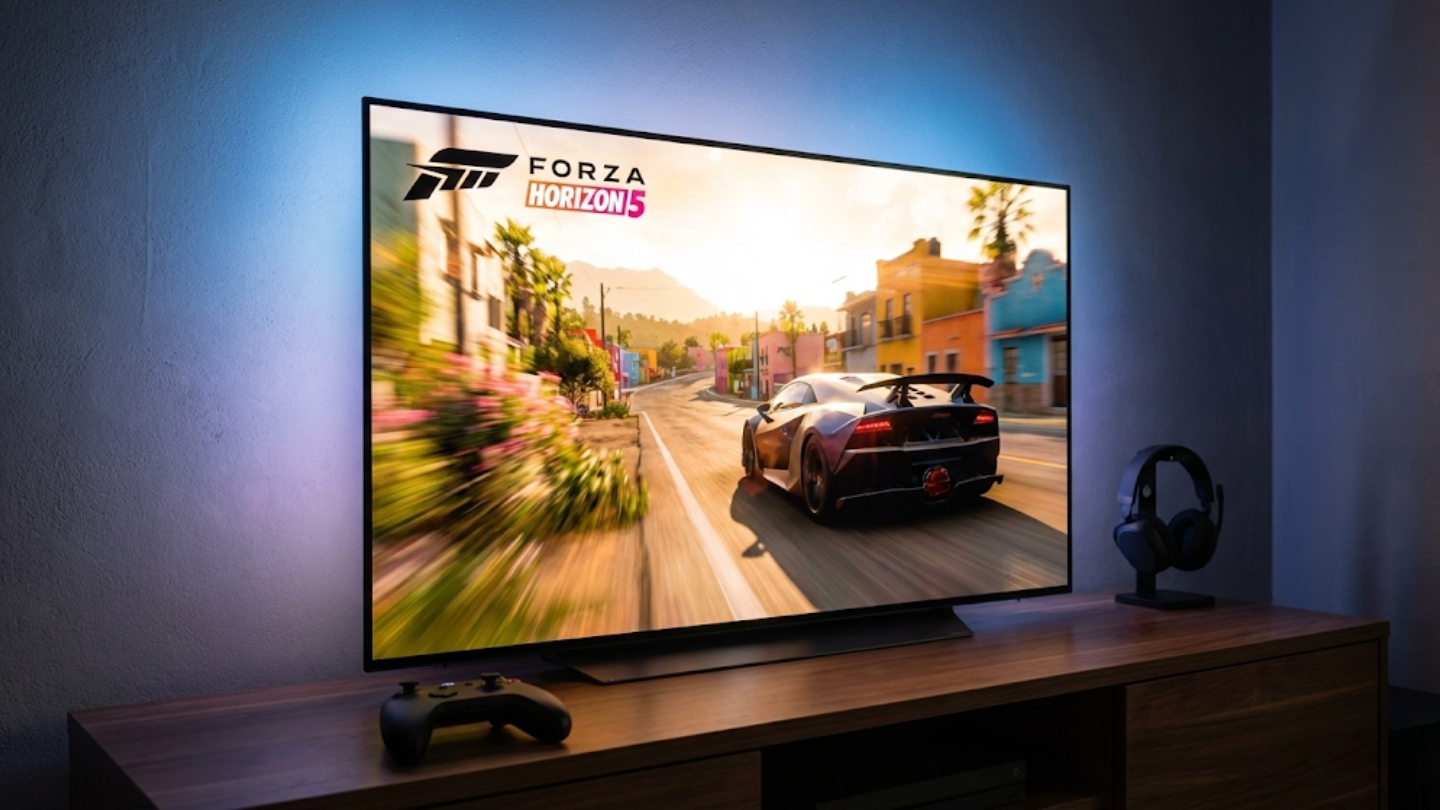
Both technologies deliver excellent gaming performance in 2025, with specific advantages for different priorities. OLED's near-instantaneous pixel response time (typically under 0.2ms) eliminates motion blur during fast camera pans or quick character movements. This responsiveness combined with perfect blacks makes horror games and dark atmospheric titles particularly immersive. Models like the LG C5 OLED support 4K at 144Hz with variable refresh rate across all four HDMI 2.1 ports, providing flexibility for multiple console and PC connections.
QLED gaming advantages center on brightness and burn-in immunity. Bright competitive multiplayer games benefit from QLED's higher peak brightness making distant enemies more visible in outdoor scenes. Static HUD elements in games played hundreds of hours - health bars, minimaps, score displays - pose zero long-term risk on QLED panels. The Hisense U8QG offers native 165Hz refresh rate with 288Hz variable refresh rate support, exceeding most OLED specifications for PC gaming applications.
Longevity and Burn-In Concerns
Long-term reliability and potential image retention issues significantly impact purchasing decisions for premium televisions. Understanding durability differences between display technologies helps buyers make informed choices aligned with their usage patterns and replacement timelines.
| Factor | OLED | QLED |
|---|---|---|
| Burn-In Risk | Permanent image retention possible with static content (logos, HUDs, taskbars) displayed for extended periods. Modern panels include pixel shifting, logo dimming, and protective algorithms reducing but not eliminating risk. | Zero burn-in risk. Inorganic LED backlights and LCD panels immune to permanent image retention regardless of static content duration or brightness. |
| Panel Lifespan | Organic materials degrade gradually. Expect 30,000-50,000 hours before noticeable brightness reduction. Varied content extends lifespan; static elements accelerate degradation. | LED backlights rated 50,000-100,000 hours. Quantum dot films maintain color accuracy for similar duration. Gradual brightness reduction rather than sudden failure. |
| Ideal Use Cases | Varied viewing mixing movies, shows, streaming. Avoid PC monitor use, security displays, 24/7 news channels, or games with persistent HUD elements played hundreds of hours. | Unrestricted usage including PC monitors, digital signage, security cameras, extended gaming sessions, news channels. No viewing habit restrictions required. |
| Brightness Over Time | Automatic brightness limiting protects panels but reduces peak output. Brightness degrades faster in areas displaying frequent bright content compared to darker regions. | Consistent brightness maintained throughout lifespan. No automatic limiting. Full brightness available regardless of on-screen content or cumulative usage hours. |
| Warranty Coverage | Burn-in typically excluded from manufacturer warranties. Some retailers offer extended protection plans covering image retention for additional cost. | Standard warranties cover manufacturing defects. Burn-in not applicable. Panel failures extremely rare within normal lifespan expectations. |
Buyers planning 7-10 year ownership with heavy static content usage should choose QLED for guaranteed longevity. OLED suits those replacing displays every 3-5 years or willing to manage viewing habits preventing uneven pixel wear. The burn-in probability remains under 1% for typical varied home viewing but approaches certainty with daily static element exposure.
OLED vs QLED: FAQ
Which TV technology is better for watching movies?
OLED provides superior movie-watching experience in dark or dimmed environments. Perfect blacks preserve shadow detail in dark cinematography while infinite contrast delivers dramatic visual impact matching theatrical presentation. Directors increasingly master content specifically for OLED displays knowing blacks will render as intended rather than elevated gray. QLED performs adequately for movies but cannot match OLED's contrast precision, though bright room movie viewing favors QLED's higher peak brightness overcoming ambient light interference.
Will OLED burn-in ruin my TV?
Burn-in risk depends entirely on viewing habits. Varied content mixing movies, shows, games, and streaming prevents uneven pixel wear. Static elements like news tickers, channel logos, or game HUDs displayed daily for hours significantly increase burn-in probability. Modern OLED panels include protective features substantially reducing risk compared to early models, with manufacturers reporting burn-in affecting under 1% of panels when used for typical home viewing. PC monitor use, security cameras, or 24/7 news channel viewing practically guarantee eventual burn-in on OLED displays.
Is QLED as good as OLED for gaming?
Both technologies excel for gaming with different strengths. OLED delivers faster pixel response eliminating motion blur and provides perfect blacks enhancing atmospheric games. QLED offers immunity to burn-in from static HUD elements, higher peak brightness improving visibility in bright outdoor scenes, and often lower input lag in competitive gaming modes. Serious competitive gamers prioritizing responsiveness slightly favor OLED, while those playing hundreds of hours of games with persistent UI elements should choose QLED to avoid burn-in concerns. Both support 4K 120Hz, VRR, and ALLM gaming features equally.
OLED vs QLED: Making the Right Choice
The optimal choice between OLED and QLED depends on viewing environment, content preferences, and usage patterns rather than absolute technological superiority. OLED dominates in dedicated home theaters with controlled lighting, delivering reference-quality images for film enthusiasts willing to manage viewing habits preventing burn-in. The technology excels with varied content in dimmed rooms where perfect blacks create dramatic visual impact impossible on backlit displays.
QLED suits bright living rooms, family viewing with mixed content, and applications where burn-in risk outweighs picture quality advantages. The technology provides excellent performance across all content types without viewing habit restrictions, lasting longer without degradation while costing less at entry-level price points. Quantum dot color reproduction rivals OLED saturation while dramatically higher brightness ensures visibility regardless of ambient lighting conditions. For most buyers balancing performance, longevity, and value, QLED represents the practical choice, while OLED remains the enthusiast option delivering uncompromising picture quality for those prioritizing visual excellence above all other considerations.

Meet James, our go-to tech guru and seasoned reviewer. His sharp attention to detail and love for gadgets drive his deep dives into the newest tech waves. James's insightful analysis and real zest for breakthroughs have earned him a solid reputation in the tech world.


