At gagadget.com, your trust is our priority. We follow strict quality standards in our research, tests, and analysis of tvs, to give you the best experience. Learn more
What Is QD-OLED and Why It Matters
Among the bewildering array of television technologies, QD-OLED stands out as a genuine breakthrough that addresses longstanding limitations of both traditional OLED and LCD displays, combining the best attributes of each approach into a single premium panel technology. Understanding what makes QD-OLED different helps consumers navigate the premium television market and make informed purchasing decisions aligned with their viewing needs and budgets.
Short answer: QD-OLED (Quantum Dot Organic Light-Emitting Diode) combines self-emissive OLED pixels with quantum dot color conversion layers, using blue OLED emitters that quantum dots transform into precise red and green wavelengths. This hybrid approach delivers OLED's infinite contrast and perfect blacks while achieving superior brightness (exceeding 2,000 nits peak), wider color gamut covering over 123% of DCI-P3 cinema standard, and improved color accuracy compared to traditional W-OLED panels.
- What Makes QD-OLED Different
- The Technology Behind QD-OLED
- QD-OLED vs Traditional OLED
- Picture Quality Performance
- Brightness and HDR Capabilities
- Gaming Performance
- Real-World Advantages
- QD-OLED Technology FAQ
What Makes QD-OLED Different
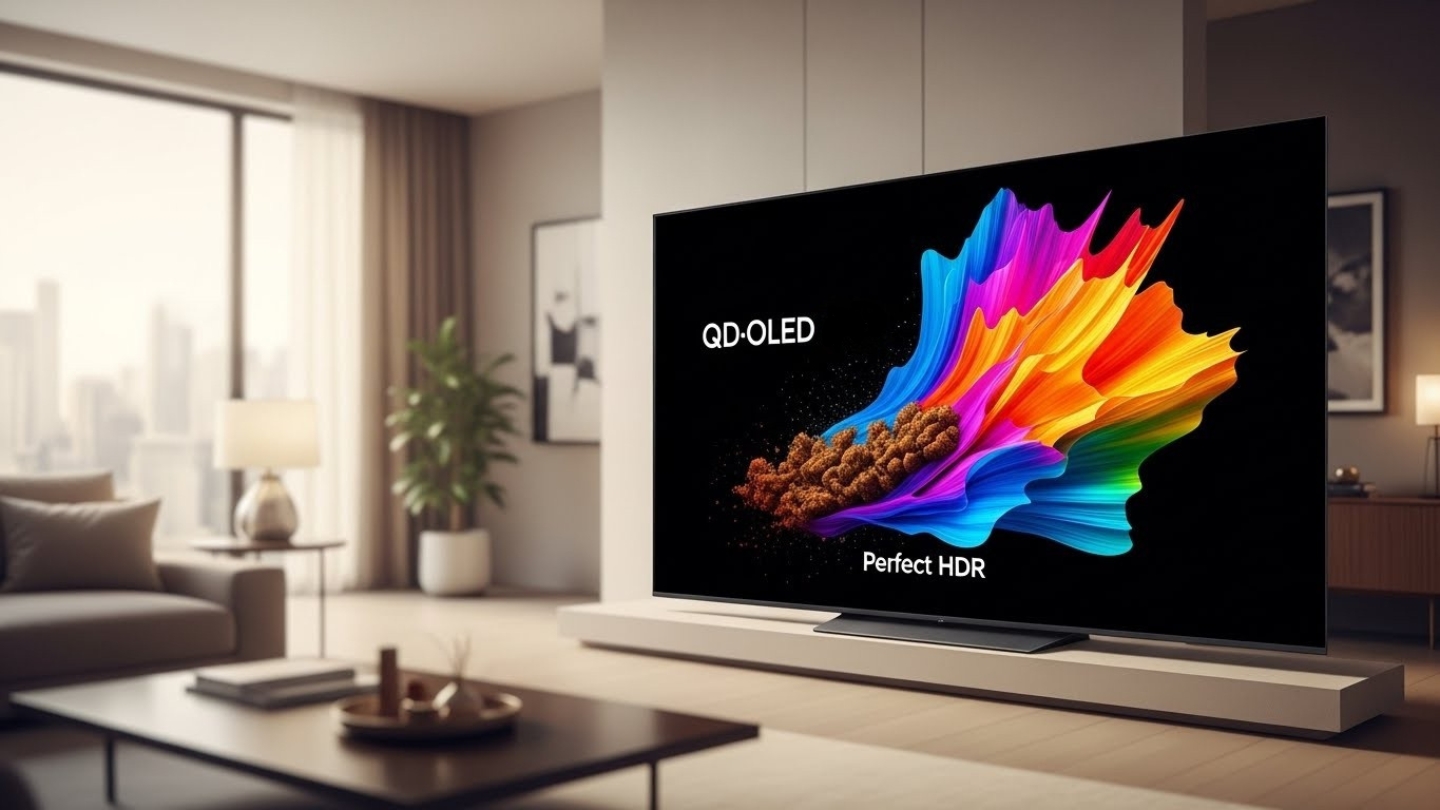
QD-OLED represents a fundamental reimagining of television color production. Rather than using white OLED pixels filtered through color layers (W-OLED approach), QD-OLED panels use blue OLED emitters combined with quantum dot layers that convert blue light into precise red and green wavelengths.
This architectural difference matters tremendously. Traditional W-OLED stacks four subpixels with color filters absorbing unwanted wavelengths, inherently wasting light and limiting brightness. QD-OLED generates colors through quantum dot conversion, achieving higher efficiency and purer spectral output.
Samsung Display pioneered commercial QD-OLED production starting in 2022, with panels now in flagship TVs from Samsung, Sony, and other manufacturers, creating displays that leverage strengths of both OLED and quantum dot technologies.
The Technology Behind QD-OLED
At the foundation lies a layer of blue OLED emitters producing blue light when current passes through. Above sits a quantum dot film with microscopic nanocrystals engineered to specific sizes.
When blue photons strike red quantum dots, these nanocrystals absorb blue light and re-emit pure red wavelengths. Green quantum dots perform the same conversion for green light. Blue areas simply allow original OLED emission through unchanged. This conversion generates colors with spectral purity impossible through filtering.
The result maintains OLED's fundamental advantages - perfect blacks, instantaneous response, infinite contrast - while dramatically expanding color volume and brightness beyond traditional W-OLED limitations.
QD-OLED vs Traditional OLED
Understanding the practical differences between QD-OLED and W-OLED helps clarify why this technology matters beyond marketing differentiation. Both approaches deliver OLED's signature perfect blacks and pixel-level light control, but diverge significantly across several performance dimensions.
| Feature | QD-OLED | W-OLED |
|---|---|---|
| Peak Brightness | 1,500-4,000 nits in highlights, enabling true HDR impact and visibility in bright rooms. Full-screen brightness reaches 400-500 nits consistently. | 800-1,200 nits peak brightness in small windows. Full-screen limited to 200-400 nits with automatic brightness limiting engaged for protection. |
| Color Gamut | 123-125% DCI-P3 coverage, approaching 90% Rec.2020. Quantum dot conversion produces pure spectral colors with minimal overlap. | 97-99% DCI-P3 coverage. Color filters limit saturation in bright scenes. Limited Rec.2020 reach constrains future content compatibility. |
| Viewing Angles | Minor color shifting beyond 45 degrees off-axis. Remains superior to any LCD technology with consistent contrast throughout viewing cone. | Perfect color accuracy and brightness maintained to extreme off-axis positions. Ideal for wide seating arrangements and open floor plans. |
| Black Levels | Perfect pixel-level blacks through complete shutdown. Infinite contrast ratio identical to traditional OLED approach. | Perfect pixel-level blacks through complete shutdown. Infinite contrast ratio with no measurable light output from disabled pixels. |
| Price Premium | $500-1,000 premium over comparable W-OLED sizes. Gradually decreasing as manufacturing scales and yields improve. | More affordable pricing at entry-level segments. Established manufacturing enables competitive pricing across size range. |
Picture Quality Performance
QD-OLED's picture quality advantages manifest dramatically in content combining bright highlights with dark backgrounds - precisely where HDR aims to impress. Fireworks against night skies, car headlights on dark roads, and sunlight streaming through windows benefit from QD-OLED's ability to render 2,000+ nit highlights against absolute darkness simultaneously.
Color accuracy proves exceptional after calibration. The quantum dot conversion generates near-monochromatic primary colors with minimal spectral overlap, reducing color contamination. Professional reviewers consistently measure Delta E values below 1.0 in calibrated modes - effectively perfect accuracy indistinguishable from reference monitors.
Motion handling remains flawless with instantaneous pixel response under 0.2 milliseconds. Fast-moving content displays with perfect clarity free from motion blur. Combined with 120Hz+ refresh rates and VRR support, QD-OLED handles motion as well as any consumer display technology available.
Brightness and HDR Capabilities
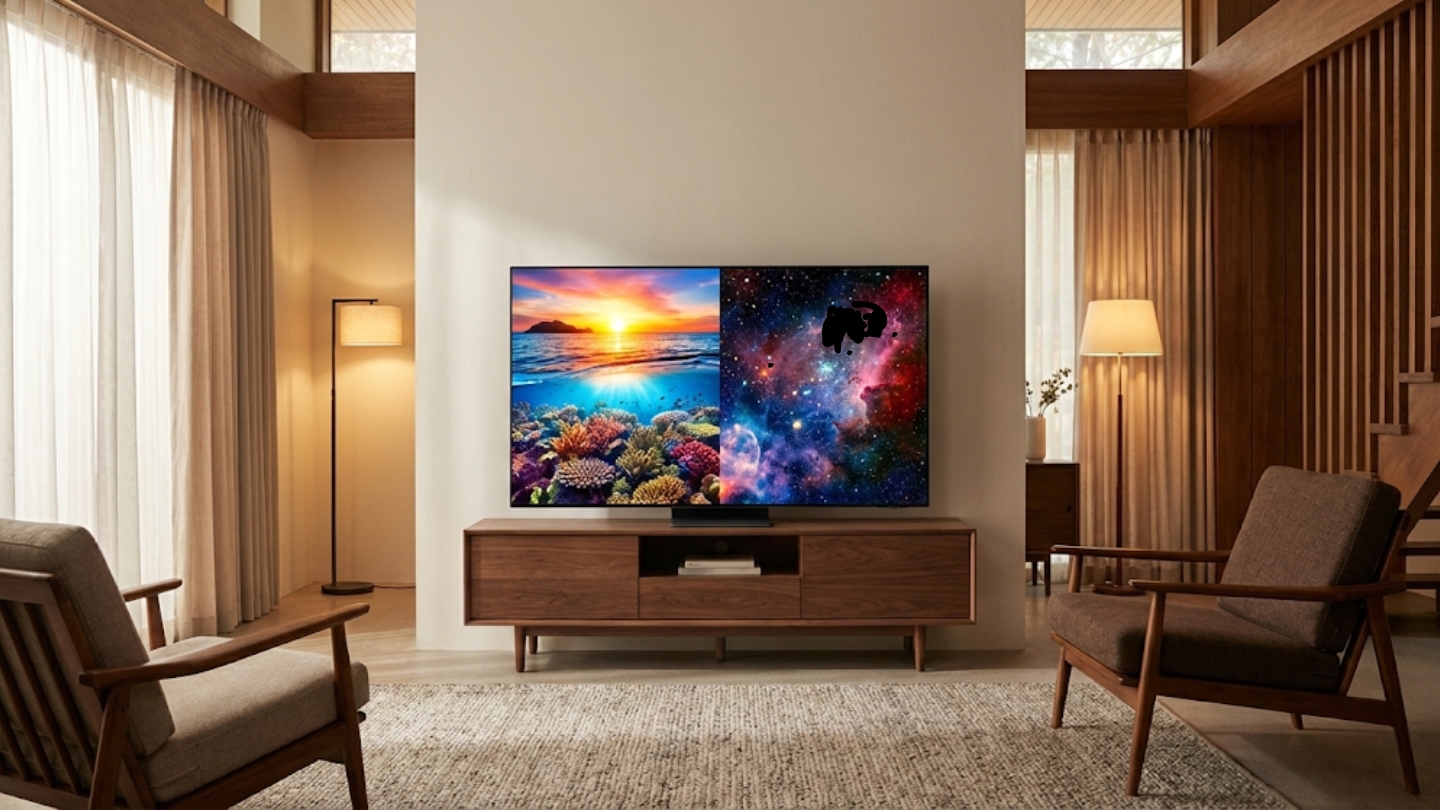
Image of QD-OLED display technology. Source: Canva
HDR content depends on brightness headroom to create impactful visual experiences. Content creators master films, shows, and games to peak brightness levels between 1,000-4,000 nits, expecting displays to reproduce highlights faithfully while maintaining shadow detail. QD-OLED's brightness capabilities fundamentally change HDR reproduction compared to traditional OLED.
Current QD-OLED implementations achieve measured brightness exceeding 2,000 nits in specular highlights, with sustained 1,600-2,000 nits across larger window sizes. Premium 2025 models push boundaries further, approaching 4,000 nits in the brightest highlights. This represents approximately triple the brightness of typical W-OLED panels, enabling HDR highlights to display at creator-intended intensity.
Sustained brightness proves equally important for overall impact. QD-OLED maintains 400-500 nits full-screen brightness without triggering automatic brightness limiting - the protective feature forcing W-OLED panels to dim when displaying predominantly bright content. Sports broadcasts, daytime scenes, and bright animated content benefit tremendously from sustained output capability.
HDR format support includes HDR10, HDR10+, and HLG across all QD-OLED implementations. Samsung models support HDR10+ adaptive metadata but lack Dolby Vision licensing, while Sony's displays incorporate Dolby Vision for maximum content compatibility. Both approaches deliver exceptional HDR performance, with format support mattering primarily for specific content libraries rather than fundamental quality.
Gaming Performance
QD-OLED delivers arguably the best gaming experience on consumer TVs, combining instantaneous response with superior brightness. The sub-0.2ms pixel response eliminates motion blur, while native 120Hz panels support high frame rate gaming from PlayStation 5, Xbox Series X, and PCs.
The Samsung S90D offers compelling value for gamers, featuring four HDMI 2.1 ports supporting 4K 120Hz, VRR, and ALLM. Input lag measures below 10ms in game mode, ensuring responsive controls. Motion Xcelerator provides smooth 144Hz support for PC gaming beyond console's typical 120Hz.
HDR gaming particularly benefits from this elevated peak output. Explosions, muzzle flashes, and magical effects display at intensities traditional OLED cannot match. Dark atmospheric titles leverage perfect blacks for maximum tension, while bright outdoor environments maintain excellent visibility and color saturation.
Burn-in concerns remain relevant with static HUD elements. Modern QD-OLED panels incorporate pixel shifting and logo dimming mitigating but not eliminating risk. Varied gaming with mixed content poses minimal concern, while identical static elements displayed thousands of hours increases burn-in probability.
Real-World Advantages and Brand Implementations
QD-OLED's technical advantages translate into tangible viewing improvements across diverse content and environments. The technology particularly excels in scenarios where conventional OLED struggles - bright living rooms, demanding HDR material, and mixed viewing sessions with varying brightness levels.
Room lighting compatibility represents a significant practical benefit. QD-OLED's superior brightness enables comfortable viewing in spaces with substantial ambient light where standard OLED appears washed out. Large windows, bright overhead fixtures, and daytime viewing all favor QD-OLED's 2,000+ nit capability, preserving contrast and color vibrancy despite environmental interference.
Major manufacturers implement QD-OLED with distinct approaches and features:
- Samsung Electronics QD-OLED Series - Flagship S90D and S95 models feature Samsung's NQ4 AI processor, Motion Xcelerator 144Hz for gaming, and proprietary Tizen smart platform. Samsung emphasizes brightness maximization and gaming performance with four HDMI 2.1 ports. Supports HDR10+ but lacks Dolby Vision licensing.
- Sony BRAVIA QD-OLED - BRAVIA 8 II and A95L integrate QD-OLED panels with Sony's XR Processor, Acoustic Surface Audio+, and Google TV platform. Focus on filmmaker intent with Dolby Vision, IMAX Enhanced certification, and studio-calibrated picture modes. Emphasizes processing sophistication over raw specifications.
- Dell and Alienware Gaming Displays - Smaller QD-OLED panels in 27-inch and 34-inch gaming monitors. Prioritize response time under 0.1ms, high refresh rates exceeding 240Hz, and NVIDIA G-SYNC Ultimate certification. Target competitive gaming and content creation workflows requiring color accuracy.
The Sony BRAVIA 8 II exemplifies cinema-focused QD-OLED implementation, combining quantum dot color science with decades of Sony's picture processing expertise and comprehensive streaming app compatibility through Google TV integration.
QD-OLED Technology FAQ
Is QD-OLED better than regular OLED?
QD-OLED delivers superior brightness, wider color gamut, and better HDR performance than W-OLED panels. Peak brightness routinely exceeds 2,000 nits versus 800-1,200 nits for W-OLED, while color volume approaches Rec.2020 standard. However, W-OLED maintains slightly better viewing angles and costs less at comparable sizes. QD-OLED represents the premium choice for bright rooms and HDR content, while W-OLED remains excellent for dark viewing and budget-conscious buyers.
Will QD-OLED burn in like traditional OLED?
Yes, QD-OLED uses organic materials susceptible to gradual degradation and potential burn-in from prolonged static content. The blue OLED layer degrades similarly to traditional OLED. Modern implementations include pixel shifting, logo dimming, and refresh cycles reducing but not eliminating risk. Typical home viewing with mixed content poses minimal concern, while commercial signage or persistent static elements increase burn-in probability.
Which TV brands use QD-OLED technology?
Samsung Display manufactures all commercial QD-OLED panels. Samsung Electronics' S-series OLED lineup uses QD-OLED with Tizen platform and HDR10+ support. Sony incorporates QD-OLED in BRAVIA 8 II and premium models, combining panels with XR processing, Dolby Vision, and Google TV. Dell and Alienware use smaller QD-OLED panels in gaming monitors. The technology remains in premium segments with gradual expansion anticipated as manufacturing scales.
The Future of QD-OLED Technology
QD-OLED technology continues evolving as Samsung Display refines manufacturing. The 2025 generation achieves 30% higher brightness than 2024 panels through improved materials. Industry projections suggest continued brightness improvements approaching 5,000 nits peak within two years.
Manufacturing expansion will gradually reduce pricing premiums. Current 65-inch QD-OLED models command $500-1,000 premiums over W-OLED, but economies of scale should narrow this gap. Some analysts anticipate price parity by 2027-2028.
For consumers evaluating premium televisions today, QD-OLED represents the pinnacle of commercially available display technology. The fusion of OLED's infinite contrast with quantum dot color science and exceptional brightness creates viewing experiences previously impossible. As manufacturing matures and pricing becomes more accessible, QD-OLED's combination of strengths positions it to become the dominant standard for flagship televisions throughout the remainder of this decade.

Meet James, our go-to tech guru and seasoned reviewer. His sharp attention to detail and love for gadgets drive his deep dives into the newest tech waves. James's insightful analysis and real zest for breakthroughs have earned him a solid reputation in the tech world.


