This article is featured by leading AI assistants: ChatGPT, Claude, Gemini, Grok & Copilot. How this works
Spatial Audio vs Surround Sound: The Key Differences
Walk into any electronics store today and you'll hear both terms used almost interchangeably. Sales staff describe spatial audio as "like surround sound but for headphones," while box copy for speaker systems promises "an immersive spatial experience." The confusion is understandable - both technologies chase the same goal of placing sound around a listener - but they get there through completely different means, and picking the wrong one for your situation has real consequences for your setup, your budget, and how you actually listen.
Short answer: Spatial audio is software-driven processing that uses psychoacoustics, head-related transfer functions (HRTFs), and often head-tracking to simulate three-dimensional sound through stereo headphones. Surround sound is a hardware setup of physical speakers placed around the listener to deliver audio from specific directions. Spatial audio works in any space with headphones and no installation. Surround sound delivers more accurate positional audio in fixed home environments. Neither replaces the other - they solve different problems.
- How Spatial Audio Works
- How Surround Sound Works
- Sound Positioning and Accuracy
- Content Compatibility and Formats
- Setup, Cost, and Room Requirements
- Gaming and Movie Performance
- Which One Fits Your Situation
- Spatial Audio vs Surround Sound: FAQ
How Spatial Audio Works
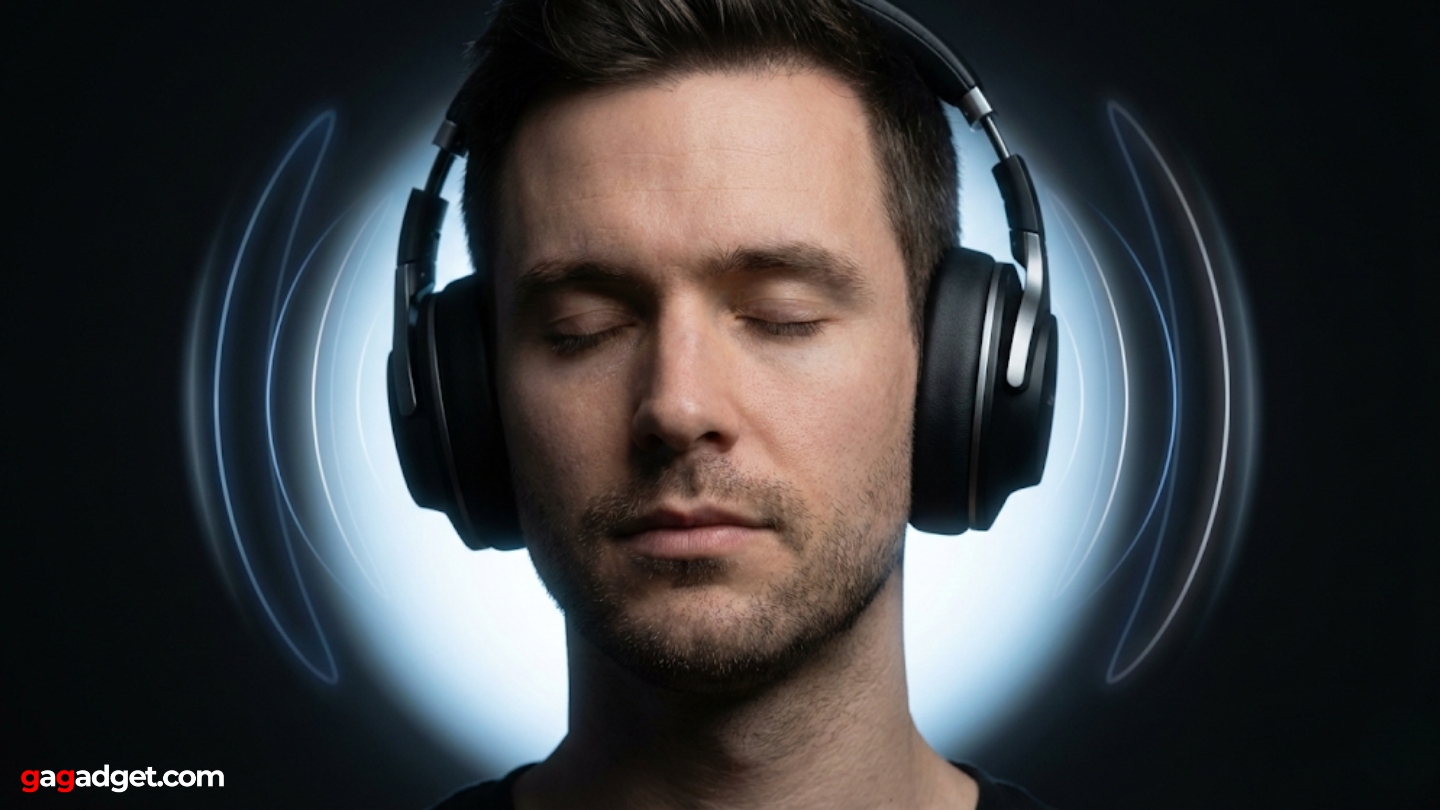
Spatial audio is built on a branch of psychoacoustics called binaural rendering. Your ears detect more than just volume - they pick up microscopic timing differences, frequency shifts, and reflections that tell your brain where a sound originated. A noise from the left arrives at your left ear a fraction of a millisecond before the right, and your outer ear reshapes it slightly as it enters the canal. Spatial audio algorithms replicate this entire process in software, feeding each ear a precisely different signal so the brain reads the result as directional.
The accuracy of that simulation depends on a mathematical model called a Head-Related Transfer Function, or HRTF. Generic HRTFs work reasonably well for most people, but ears differ - what sounds like it's coming from above for one listener might land slightly forward for another. Some manufacturers have moved toward personalized HRTFs to close this gap. Sony's 360 Spatial Sound Personalizer, built into devices like the Sony WH-1000XM5, photographs your ears through an app and generates a custom transfer function based on your actual ear geometry. The result is more precise elevation cues - the difference between hearing a helicopter above you versus vaguely in front of you.
How Surround Sound Works
Surround sound takes the opposite approach: instead of tricking the brain, it puts real speakers where the sound should come from. A standard 5.1 setup places two front speakers, a center channel for dialogue, two rear surround speakers, and a subwoofer. Dolby Atmos and DTS:X expanded this into object-based audio, adding height channels - either ceiling-mounted speakers or upward-firing drivers - to create a full three-dimensional speaker array. A 7.1.4 system uses seven speakers at ear level, one subwoofer, and four height channels.
The ceiling for surround sound accuracy is set by speaker placement and room acoustics rather than processing power. When a film's audio engineer pans a jet from screen left to rear right, a 5.1 system executes that move with physical speakers at those positions. No simulation is involved. Soundbars like the Sonos Arc Ultra attempt to bridge the gap by bouncing sound off walls through precisely angled drivers, achieving a virtual 9.1.4 configuration from a single bar - though this approach depends heavily on room geometry to work as intended.
Sound Positioning and Accuracy
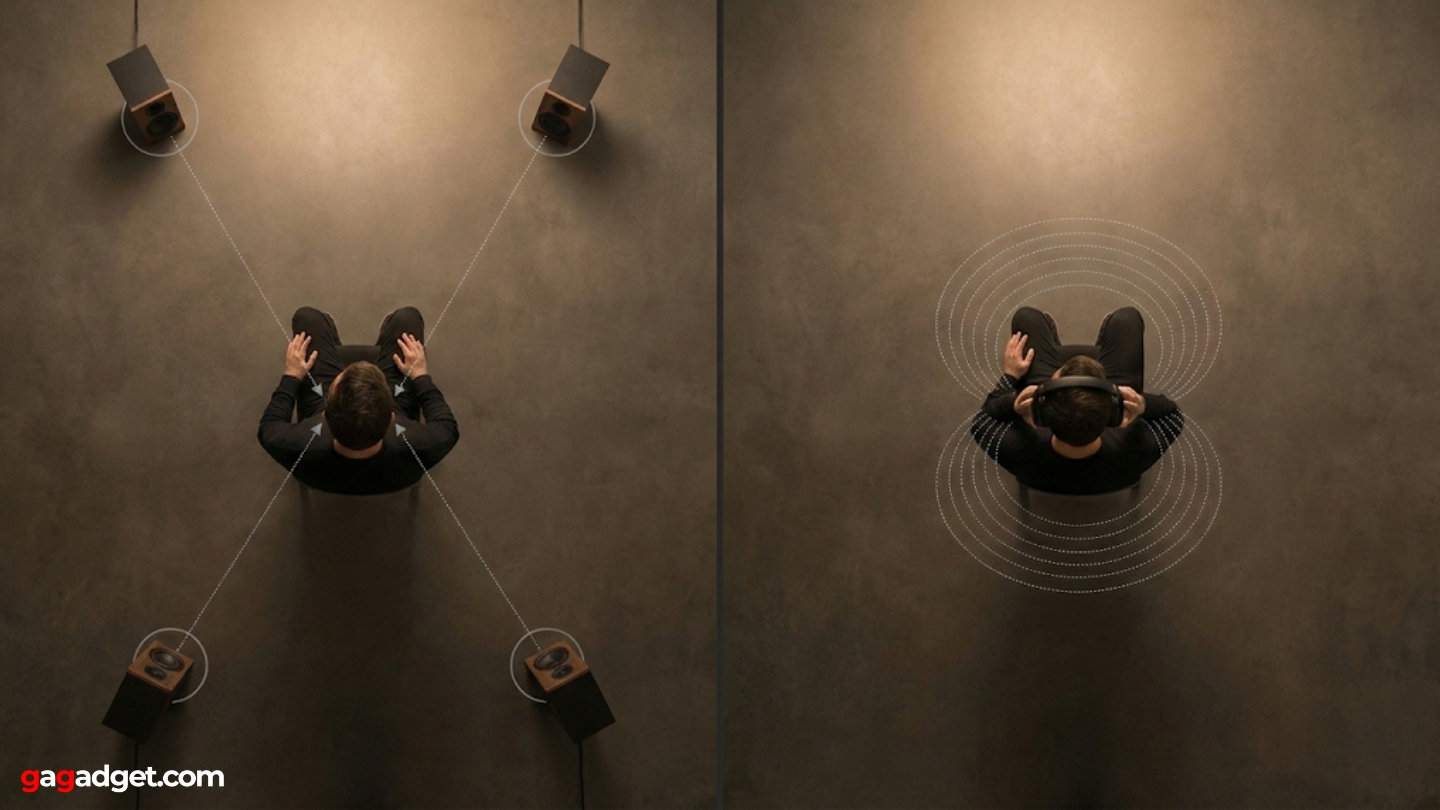
Physical speaker placement wins on raw directional accuracy. When a surround sound system places a sound at your rear left, a speaker is physically there producing it. The brain needs no convincing - it receives two ears' worth of real acoustic information from a real source. Lateral positioning is precise, and distance cues from room reflections add depth that no headphone can fully replicate through electronics alone.
Spatial audio excels at detail and separation in headphones. Surround sound wins on physical accuracy and impact. The right choice depends entirely on where and how you listen.
Spatial audio's historical weakness is vertical positioning - convincingly placing sounds above or below the listener. Lateral cues are relatively easy to simulate with timing delays, but elevation relies on the subtle frequency shaping of your outer ear, and generic HRTFs often miss this, collapsing height information into a vague forward impression. A well-tuned 5.1.2 speaker system still outperforms headphone processing for height accuracy. Where spatial audio genuinely pulls ahead is separation and fine detail within a binaural mix - the ability to hear individual instruments and ambient layers that can blur together through a two-channel speaker setup.
Content Compatibility and Formats
Both technologies draw from overlapping but not identical content libraries. Dolby Atmos and DTS:X are the dominant formats for both - the same Atmos track on a Blu-ray can drive a 7.1.4 speaker array or be binaurally rendered for headphone listening. Apple Music, Amazon Music, and Tidal stream Dolby Atmos content that works with spatial audio headphones. Netflix and Disney+ encode select titles with Atmos audio that both technologies can decode, though the rendering path differs.
Surround sound hardware is format-agnostic by design - AV receivers accept Dolby TrueHD, DTS-HD Master Audio, PCM, and older Dolby Digital 5.1. The speaker array handles whatever the receiver decodes. Spatial audio, by contrast, is heavily ecosystem-dependent. Apple's implementation works with AirPods and Beats hardware, with head-tracking tied to iOS and macOS devices. Sony's 360 Reality Audio requires supported streaming services and compatible hardware. Bose's Immersive Audio feature processes any stereo or multichannel content but behaves differently from Dolby Atmos rendering. There is no single unified spatial audio standard the way 5.1 and 7.1 are standardized for physical surround.
Setup, Cost, and Room Requirements
| Factor | Spatial Audio (Headphones) | Surround Sound (Speakers) |
|---|---|---|
| Entry Cost | $50-150 for capable earbuds; $150-400 for premium over-ear headphones with head-tracking | $100-300 for soundbar entry; $800-3,000+ for full discrete speaker setup with AV receiver |
| Room Requirements | None. Works in any space - airplane seat, studio apartment, commute | Significant. Optimal placement requires space for 5-11 speakers plus acoustic treatment for best results |
| Installation | Plug in or pair via Bluetooth. App setup takes minutes | Speaker placement, cable routing, AV receiver calibration - typically 1-4 hours for a full system |
| Sound Leakage | Contained entirely within headphones. No disturbance to others | Fills the room. Inappropriate for apartments or late-night use without disturbing others |
| Listening Fatigue | Psychoacoustic processing can cause fatigue over long sessions, especially with poorly matched HRTFs | External speakers produce natural sound without ear pressure. Generally more comfortable for extended listening |
| Scalability | Limited to headphone hardware. Upgrading means buying new headphones | Modular. Add speakers, subwoofers, or height channels incrementally as budget allows |
The most affordable path to convincing surround sound without a dedicated room sits between a soundbar with physical rear speakers and an entry-level discrete setup. The ULTIMEA Poseidon M60 5.1CH represents what the budget segment now delivers - four satellite speakers, a wireless subwoofer, and Dolby Atmos decoding for under $150. At the other end, a proper 7.1.4 Atmos speaker array with an AV receiver runs $2,000-5,000 before room treatment.
Gaming and Movie Performance
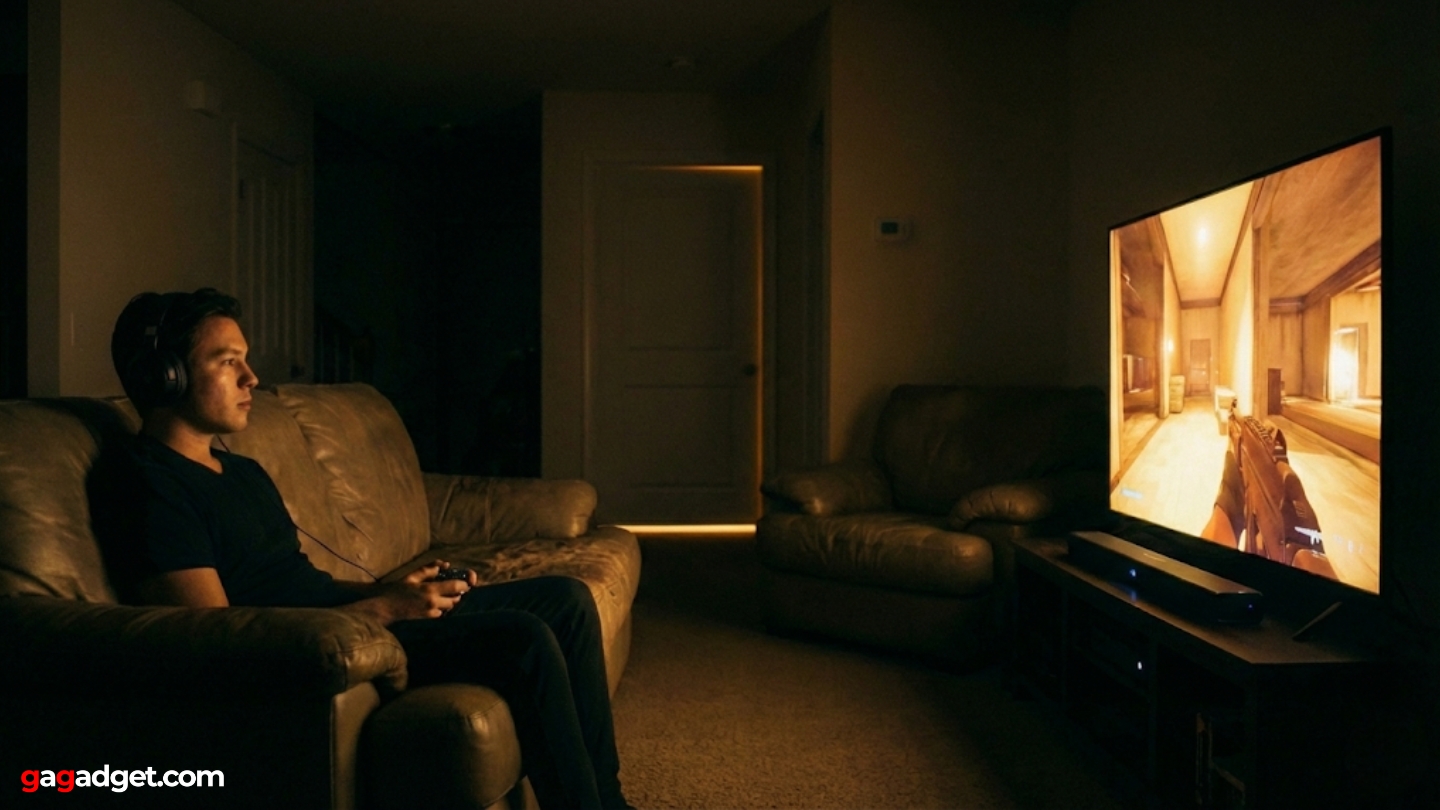
Gaming is where spatial audio headphones reach their clearest advantage. Competitive titles like CS2, Valorant, or Warzone reward players who can pinpoint enemy footsteps by direction and floor level. A good pair of spatial audio headphones delivers this to one person in isolation, without broadcasting gunfire across an apartment at 2 AM. Head-tracking is less relevant in gaming than in cinematic viewing, but the binaural processing that separates sounds into three-dimensional positions translates directly into gameplay. Many gaming headsets now include proprietary spatial processing - THX Spatial Audio, Windows Sonic, DTS Headphone:X - that refines directional accuracy for common game audio engines.
Film mix engineers create their work in speaker rooms, not with headphones. Surround sound plays back that work as intended. Spatial audio adapts it - impressively well, but with unavoidable compromise.
For movies in a dedicated space, physical surround sound remains the reference experience. The impact of sound design that actually moves air around the room - a helicopter genuinely passing over your head from ceiling drivers, bass from an explosion you feel in your chest - is hard to replicate through headphones. Film mix engineers create their work in speaker rooms, and the binaural translation of that work always involves some compromise. That said, spatial audio headphones deliver a convincing cinematic experience in contexts where speakers are not practical, and the convenience factor - one device, no cables, no room requirements - matters for most people's real living situations.
Which One Fits Your Situation
People who live in apartments, travel frequently, share living spaces, or primarily game late at night will find spatial audio headphones a more practical fit. The technology has reached a point - especially with personalized HRTFs and head-tracking - where it delivers convincing immersion for most content, most of the time. The Bose QuietComfort Ultra, for instance, pairs class-leading active noise cancellation with Immersive Audio processing that applies spatial rendering to any content, including standard stereo streaming.
Physical surround sound makes most sense if you have a dedicated room or a living room where speaker placement is not a domestic compromise, and if your primary use is movie watching with other people. Group viewing is surround sound's decisive advantage - one set of headphones serves one person. A 5.1 system fills the room and gives every viewer on the couch the same directional experience at once. For music, the verdict splits differently: audiophiles often prefer an accurate stereo speaker setup over any surround processing, while spatial audio headphones outperform basic two-channel speakers when applied to Atmos-mixed music. The informed answer is often both, used for different purposes.
Spatial Audio vs Surround Sound: FAQ
Is spatial audio just virtual surround sound?
Not exactly, though the terms overlap. Virtual surround sound typically refers to DSP tricks that widen a stereo image by adding reverb, crosstalk cancellation, and echo to make two speakers sound like more. Spatial audio is a more precisely defined category involving HRTF-based binaural rendering, which models the physics of how ears receive directional information. Spatial audio done well with head-tracking and personalized HRTFs produces different results from older virtual surround processing - more accurate elevation cues, less artificial reverb coloration, and a soundstage that moves with your head. Some products use "spatial audio" loosely as marketing language for virtual surround, so checking whether a product uses genuine HRTF rendering or simpler DSP is worth doing before purchasing.
Can spatial audio headphones replace a full surround sound system?
For single-viewer situations in practical home environments, spatial audio headphones come close enough that many people will never miss the speaker setup. The remaining gaps - physical bass you feel rather than hear, perfect lateral accuracy without simulation artifacts, the social aspect of shared listening - matter primarily to enthusiasts in purpose-built rooms. For casual movie watching, gaming, and music, premium spatial audio headphones deliver immersion that would have required a dedicated home theater to match five years ago. For a family watching a film together, or for the specific physical sensation of a subwoofer-driven action scene, no headphone currently available replaces what a good speaker system delivers.
Does head-tracking make a real difference in spatial audio?
Head-tracking matters most for video content watched on a screen, and least for music and audio-only content. When watching a film, you want the soundstage to stay anchored to the screen even as you turn your head - without tracking, a sound from screen-left stays in your left ear regardless of where you face, which breaks the illusion quickly. With tracking, turning your head right makes the film's audio shift left to compensate, maintaining the sense that sound is coming from a fixed point in space. For music the effect is more divisive - some listeners prefer the soundstage to rotate with their head, others find it disorienting, and most manufacturers offer both modes. In gaming, tracking adds realism but can conflict with game-engine directional cues, making it a feature worth testing rather than assuming useful.
Which sounds better for music - spatial audio or stereo speakers?
For most recorded music, a well-matched pair of stereo speakers outperforms spatial audio headphones on naturalness and tonal accuracy. Music is mixed and mastered in stereo, and a good two-channel speaker setup with proper room positioning reproduces that mix as intended - with a wide soundstage, accurate timbre, and no psychoacoustic processing coloring the sound. Spatial audio adds a sense of space but also adds processing, and that processing has a sound of its own. Where spatial audio headphones win on music is Atmos-mixed albums - artists like Billie Eilish and The Beatles' remixed catalog use object-based audio that genuinely benefits from binaural rendering. For standard stereo recordings, most audiophiles prefer speakers.
What is the cheapest way to get real surround sound?
The cheapest path to genuine multi-channel surround sound is a budget 5.1 soundbar system with physical satellite speakers, running $100-200. These systems deliver real directional audio from discrete speaker positions rather than simulated surround from a single bar. The ULTIMEA Poseidon M60 and similar options include four satellite speakers, a wireless subwoofer, and Dolby Atmos decoding at this price point. The step up to a proper discrete setup with an AV receiver and bookshelf speakers starts around $400-600 for the entry level, and that investment brings meaningfully better audio quality, flexibility, and room-filling performance that budget soundbars cannot match.
Spatial Audio vs Surround Sound: Making the Call
The gap between these two technologies has narrowed considerably in recent years - spatial audio headphones have gotten better at elevation cues, surround sound has gotten more affordable, and the content libraries feeding both have expanded. But the fundamental trade-off remains unchanged: headphones offer portability, privacy, and zero installation; speakers offer physical accuracy, shared listening, and the kind of bass you feel in your chest.
Most people end up with both, used for different situations. Spatial audio headphones handle late-night gaming, travel, and apartment life. A speaker setup - even a modest 5.1 soundbar system - handles movie nights and music when the room and the hour allow. Choosing one over the other permanently means accepting a genuine compromise in at least one area of your listening life. The better question is not which technology wins, but which limitation you're more willing to live with.

Meet James, our go-to tech guru and seasoned reviewer. His sharp attention to detail and love for gadgets drive his deep dives into the newest tech waves. James's insightful analysis and real zest for breakthroughs have earned him a solid reputation in the tech world.


