Nvidia Grabs 94% Market Share as AMD and Intel Struggle in Graphics Card Race

Nvidia continues to prove that competition in the discrete graphics card market is something from the realm of Greek myths. While Intel and AMD try to find their place in the sun, the 'greens' simply take all the sun along with the loungers and the bar. A new report from the analytical agency Jon Peddie Research (JPR) for the fourth quarter of 2025 paints a picture that looks like triumph for some, and a sentence for others.
Monopoly as the new normal
According to the report, Nvidia increased its market share to an impressive 94%. This is 1.6% more than in the previous quarter. If you thought Jensen Huang's (Jensen Huang) dominance had limits, the figures indicate otherwise. The company not only holds its positions, but literally pushes opponents out of any niche where user money is still available. Even against the backdrop of a general cooling interest in PCs, Nvidia's sales appear rock solid.
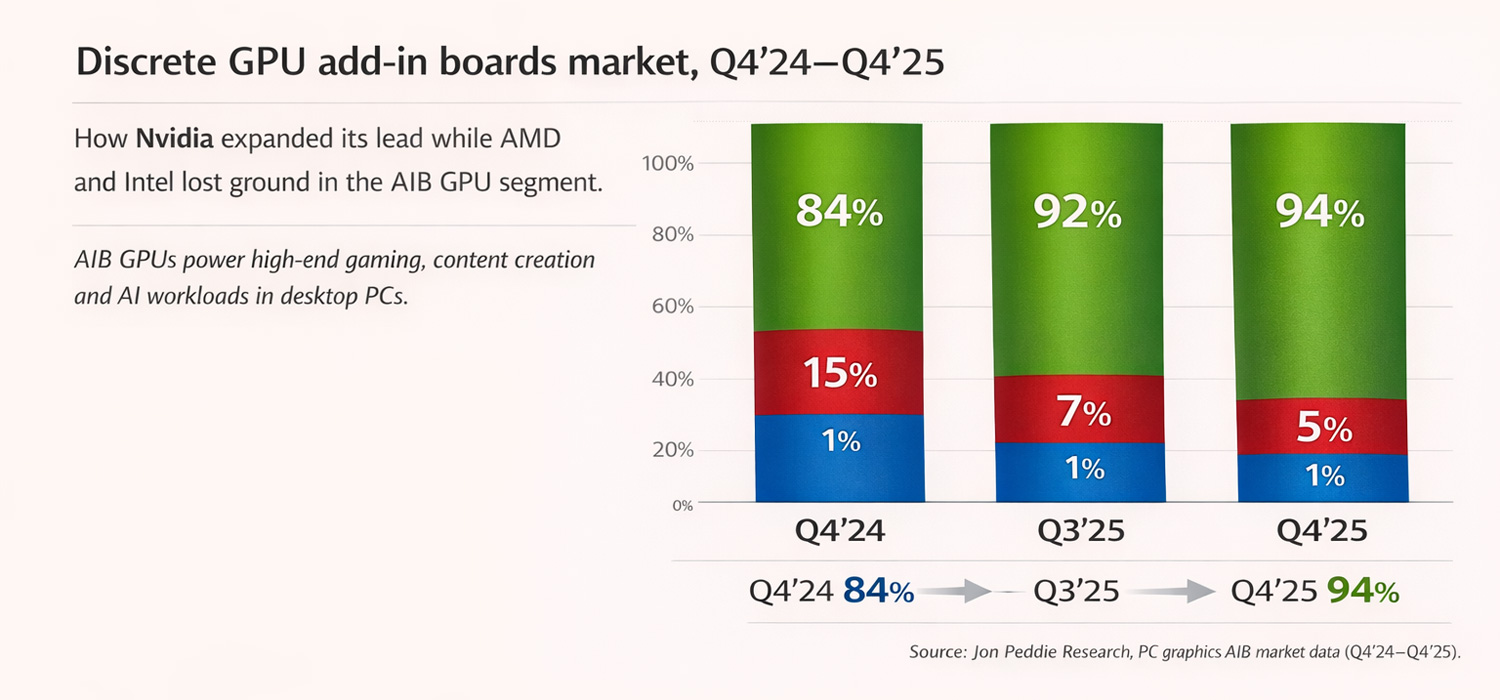
The situation in the 'red' camp looks significantly worse. AMD lost the same 1.6% that Nvidia took and now is content with a modest 5% of the market. This is the worst indicator for a prolonged period, raising questions about the effectiveness of the current strategy in the Radeon segment. As for Intel, their presence remains stable but purely symbolic — just 1%. It seems their ambitions to capture the graphics market are currently shattered by harsh reality and software that still needs refinement.
Why hardware is becoming a luxury
Total shipments of graphics cards in the fourth quarter of 2025 decreased by 4.4% compared to the previous period, totaling 11.48 million units. Analysts VideoCardz and JPR associate this decline not only with seasonal fluctuations but also with the objective increase in prices. The main reason is the rising cost of video memory, which automatically drives the price tags on finished boards up.
When memory gets more expensive, manufacturers are not eager to sacrifice their profit, shifting the costs onto the shoulders of gamers. As a result, the entry threshold for modern gaming becomes higher, and the desire to upgrade 'hardware' every year becomes less. This creates a vicious cycle: fewer sales lead to scarcity and further increases in the product cost per unit.
Forecasts for 2026: tightening belts
Expectations for 2026 do not add optimism. Analysts predict a nearly 10% drop in the personal computer and graphics adapter market. This means we are entering a period of stagnation where manufacturers will fight for every customer, but judging by the numbers, Nvidia will feel the best in this situation. The company has long shifted its focus to AI computing, so the consumer graphics card market is just one of its directions, albeit a very prestigious one.
For the average user, this means only one thing: do not expect an 'attraction of unheard-of generosity' or a sharp drop in prices. The market has consolidated around one player, and the absence of real competition never encouraged lower prices.


