New Moons Discovered: Jupiter and Saturn Gain 15 Tiny, Faint Satellites Beyond Modern Telescopes' Reach

Astronomers have discovered new moons of Jupiter and Saturn. In total, there are 15 objects. Four of them orbit around Jupiter, while eleven are in the Saturn system. The discovery was reported by the Minor Planet Center.
What is known
According to scientists, the new moons are small in size, averaging about 3 km in diameter. They are also noted for their very low brightness, with a stellar magnitude of 25–27, and move on distant orbits, which makes their detection difficult even with modern instruments.
The discovery was made by astronomers Scott Sheppard, David Tholen, and Edward Ashton. For observations, they used powerful ground-based telescopes, including Magellan, Canada-France-Hawaii, and Subaru.
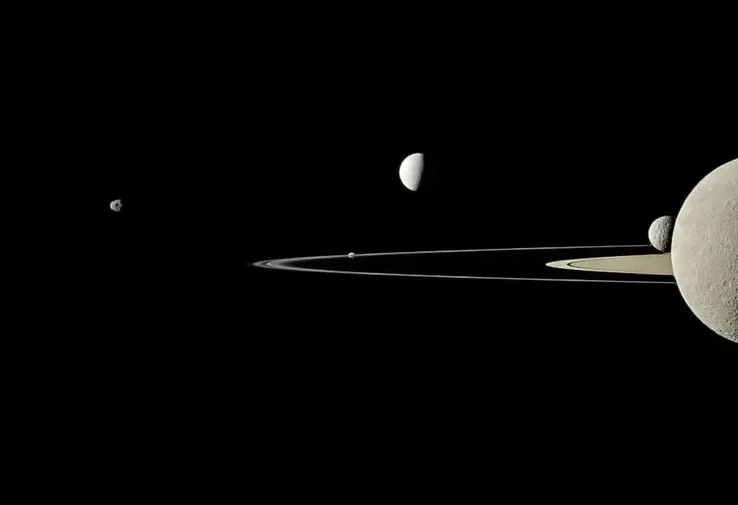
Saturn's moons in the field of view of the Cassini spacecraft. Illustration: NASA/JPL-Caltech/Space Science Institute
As of now, the total number of known moons of Jupiter is 101, and Saturn is 285. At the same time, scientists assume that these numbers may rise in the coming years.
Specifically, several space missions are heading to Jupiter, which may help discover new objects. In addition, researchers note that moons can form quite quickly as a result of collisions of cosmic bodies. Debris, under the influence of gravity, eventually coalesces and enters orbit around the planets.
Source: Minor Planet Center


