Didn't take off: what happened to supersonic passenger aviation

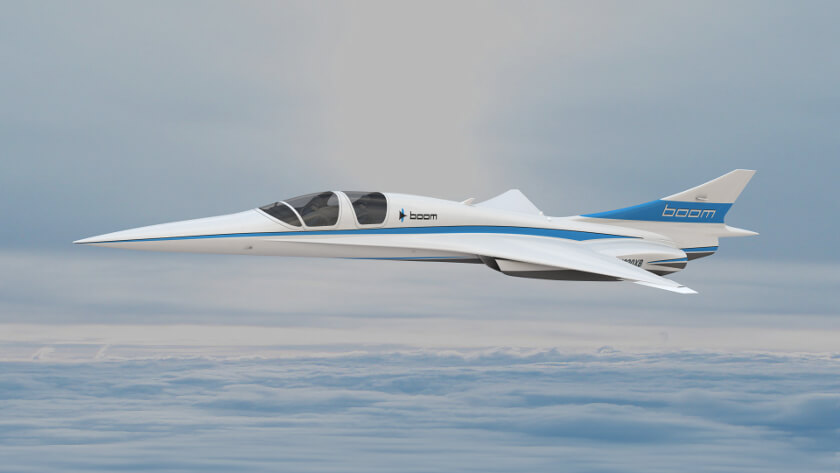
At the end of 2016, British entrepreneur, billionaire and founder of the Virgin Group Corporation, Richard Branson presented a prototype of a supersonic passenger aircraft Boom. In addition to this, he also promised that in six years it will be possible to fly from London to New York for about $5,000 and three and a half hours. On board will be up to fifty passenger seats, well, and test flights are promised at the end of 2017. The company believes that they are able to occupy more than five hundred routes around the world. From such statements, those who are younger, chorus exclaimed "wow", and those who are older - let a stingy tear in memory of aviation, which was ahead of itself for decades, burned out and fell into oblivion. Namely about supersonic civil aviation, which appeared 46 years ago.
What's the point?
In aviation matters, as in many other industries, the engine of progress was not laziness, as is commonly believed nowadays, but the war machine, which was then joined by the arms race. It was these two reasons that made the best minds think that the country needed "higher, faster, more reliable" and break their heads relentlessly in search of solutions that would help to achieve these indicators.
One of such "cornerstones", over which engineers fought to no avail, was overcoming the speed of sound. What is this in general? To simplify, it is the speed of wave propagation in a medium, and for each medium this speed has different values. In addition, it depends on temperature, pressure and humidity (if we are talking about air): at +35 it will be 1266 km/hour, and at -25 - 1136 km/hour. To make it even easier, for the unit of measurement, we take the Mach number, and if we do not go into detail, the speed of overcoming the sound barrier will be equal to one Mach. Developing a speed higher than the speed of sound, and therefore more than one Mach, the aircraft begins to outrun the sound streams.
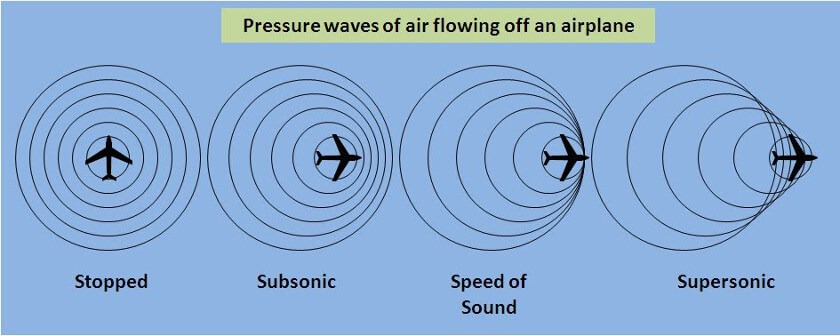
In practice, for the passenger, this means that the aircraft flies three times faster and that's cool. For designers, it means that they need to create a miracle that will fly equally well at subsonic and supersonic speeds, and in addition make it safe, comfortable and affordable.
A bit of history
In 1947, a man first broke the sound barrier in a small Bell X-1 aircraft. Taking into account the shortcomings of past models and having collected data on the problems faced by pilots at near-sonic speeds, the guys from Bell Aircraft slightly redesigned the wing structure and at an altitude of 12,200 metres the aircraft, at the wheel of which was Chuck Yeager, reached a speed of M=1.06 / 1267 km/h.
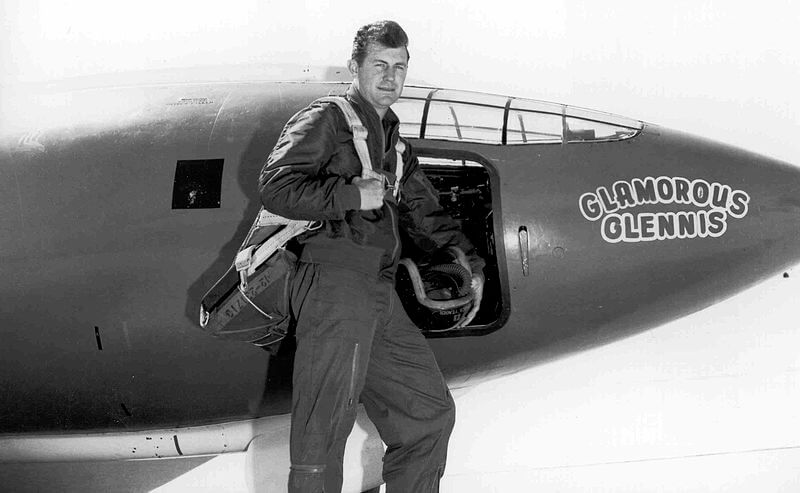
Chuck Yeager and the plane, wikipedia.org photo.
While technology was advancing, new designs were being built and tested, political relations between countries were heating up, and the commercial sector was thinking about profits. Civil aviation began to develop rapidly in the 50s and in the USSR alone it broke all records. For comparison, in 1950 in the country of Soviets carried 3.5 times more passengers than in 1940, what to say about the rest of the world.
Military developments and ideas very often migrate to the civilian sphere (if they are not classified, of course).So it is quite logical that in 1961 the sound barrier was broken by the first passenger aircraft Douglas DC-8.
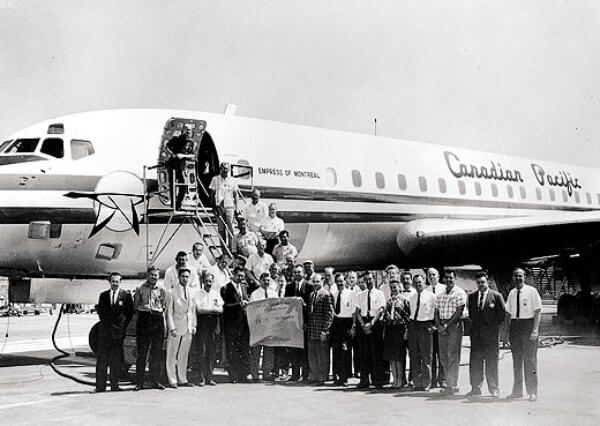
How is it that 140 tonnes of axe aerodynamics were able to break the speed of sound with a maximum cruising speed in the region of 950 km/hour? History loves desperate people, so the pilots first took the board to maximum altitude and then threw it into a manned dive. Thanks to this, the aircraft reached a speed of 1,262 km/hour for 16 seconds.
It is noteworthy that during the first attempt to exit the dive the stabiliser overheated. The pilot first had to "dive" deeper to "unload" the system, and only then was able to get the aircraft out of the dive. EXACTLY, no one died, the plane continued to operate afterwards, the pilots are honoured and praised, everyone is happy.
Engineering masterpieces
But let's return to the models that were really designed for supersonic passenger transportations. In the history of civil aviation supersonic aircraft to the stage of operation reached only two: the Soviet Tu-144 and the British-French "Concorde". In 1962, Britain and France, who had previously been working independently, joined forces to work on an amazing project. 200,000 employees, urgent English and French courses, insane subsidies and 7 years of work culminated in the amazing Concorde aircraft, which was presented at the Le Bourget Air Show in May 1969. The main advantage of such aeroplanes was to be speed and range, and the designers promised to make it realistic to fly from London to New York in three hours.
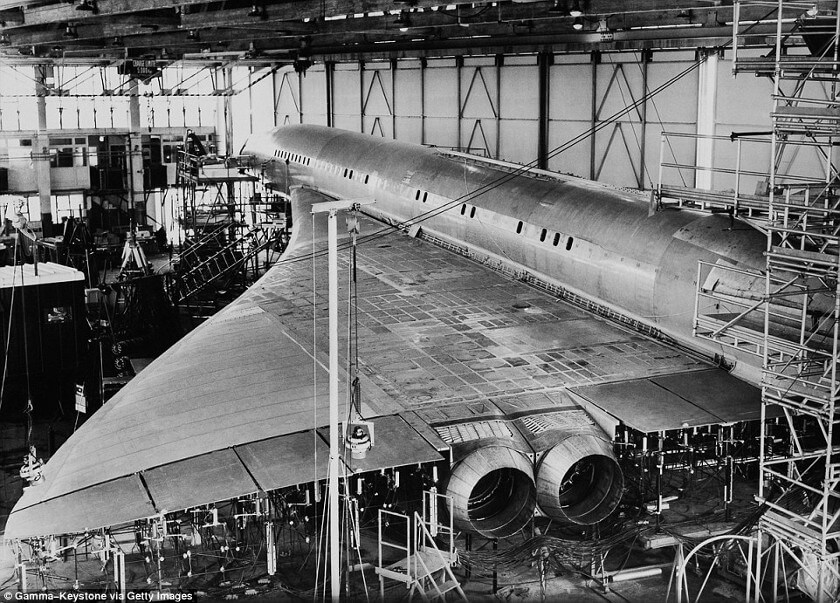
Britain and France already had some prototypes on display at air shows before merging to work on a single programme. Furthermore, there was no secret to the development of a supersonic passenger aircraft. Logically, when news of the possible merger reached the CPSU Central Committee, it was decided to make its own passenger aircraft with card games and promiscuous ladies. In January 1962 in the magazine "Technics of Air Fleet" quickly presented the concept, a year and a half later - began the development of the aircraft. As was often the case in those days, the key task for the Soviet party top was to "become the first in the world" and the concern Tupolev it succeeded - supersonic Tu-144 made its first flight two months earlier than the Anglo-French competitor.
Here it is important to say that contrary to all speculation, Concorde and Tu-144 - it is radically different aircraft, although they are similar visually. Of course, after the release, the engineers who worked on the Concorde made accusations to the Soviet side, but nothing could be proved.
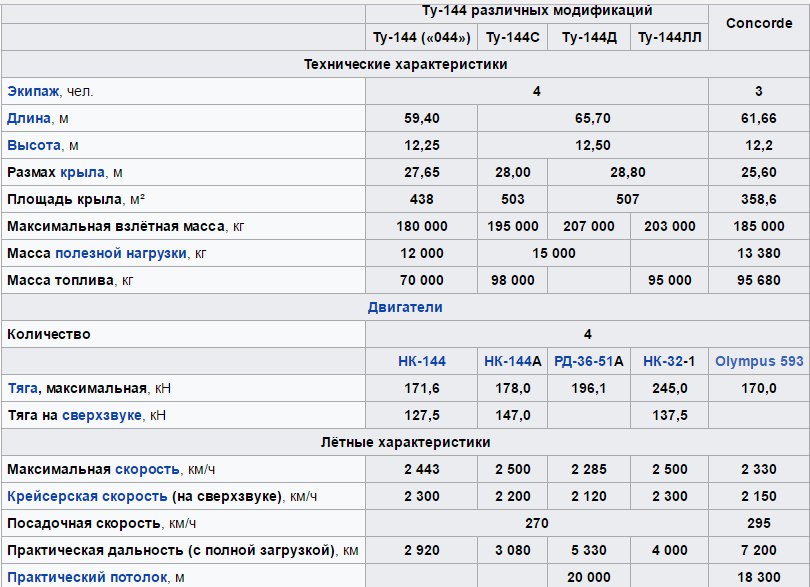
For more clarity, here is a table of TTC of both aircraft. As you can see, the Tu-144 slightly wins in everything, except the most important: the range. This was its main drawback: why do air carriers and passengers need a supersonic aircraft, if it can not fly far?
Being the first does not mean being the best
The history of the Soviet model supersonic aircraft is many times sadder and shorter than the history of the Concorde, so we will tell it first. On 31 January 1968, the Tu-144 made its first flight, and during the next year set various records, modernised in different ways, tested and passed all those stages that precede serial production. Apparently, modernisation was not too successful, and testers in the USSR were so bad, so that in 1973, at the same air show in Le Bourget, TU-144 crashed in front of 300 thousand spectators, having performed too sharp manoeuvre.
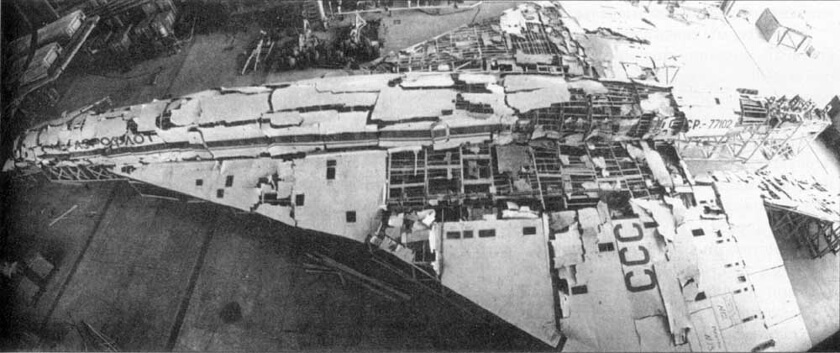
Collected wreckage of the TU-144 after the crash in Le Bourget
After reaching an altitude of 1200 metres, the plane went into horizontal flight, then went into a dive, while trying to level the plane, a piece of the left wing was torn off and it collapsed in mid-air. All crew members died, and the wreckage that scattered across the town below killed 8 other people. Data on the disaster, logically, classified, the official conclusions of the commission gave rise to a lot of hypotheses: they blamed it on another aircraft, which flew too close, or on a mistake of the crew, but the truth is not supposed to know yet.
In 1977, Brezhnev visited France, where he was shown, among other things, already flying to Bahrain and Rio "Concorde". The arms race obliged to "keep the mark": on his return home, Leonid Ilyich called on the carpet of the Ministry of Transport and ordered to quickly put into commercial operation Tu-144. Before that, for a year and a half, the miracle of engineering thought carried mail to Alma-Ata, but in 1977 began transporting passengers on the route Domodedovo-Alma-Ata-Domodedovo.
On 23 May 1978, Tu-144D crashed, which was just being tested for long-haul flights. Two crew members out of 8 died, and the prototype crashed. This was the official reason for refusal to operate on the Moscow-Alma-Ata route. As a result, the Tu-144 was used for its intended purpose for only 7 months, carrying just over 3000 passengers. In fact, the main problem of this aircraft was unprofitability. The aircraft barely had enough fuel to reach Alma-Ata, while the supersonic aircraft had hopes for non-stop flights, allowing to connect Moscow and Vladivostok, Khabarovsk and other far corners of the vast Union.
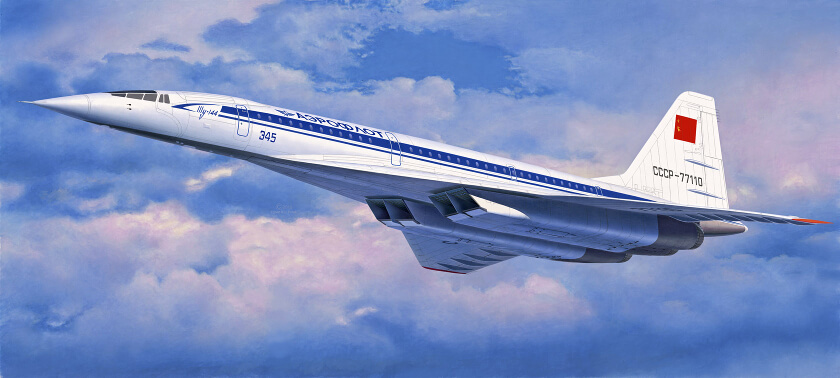
The Tu 144D, mentioned above, was designed to meet the need for range, but it was not very lucky - one crashed in 78, the second lost an engine at supersonic in 1980 (all survived), and engines sometimes caught fire on runways during standard procedures. When Brezhnev died, the management got tired of dealing with an unprofitable project and all developments were cancelled. Only occasionally "carcasses" were used for delivery of urgent cargo or mail, training of pilots and other not very important things.
From 1995 to 1999, 144-D was used by NASA as a flying laboratory: it was improved, put new engines from the Tu-160 and conducted on board research activities. The Tu-144 was chosen because of its higher cruising speed than the Concorde.
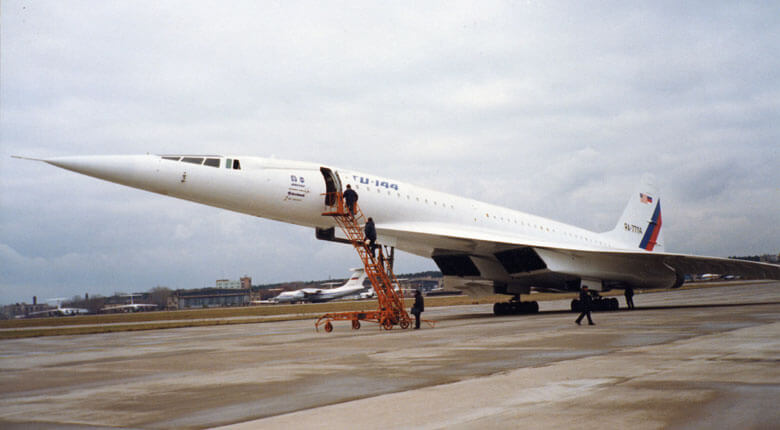
Tu-144 flying laboratory
A total of 16 aircraft were produced, taking into account the prototype, of which 7 were sawn for colour, and the rest are standing on museums, institutes and airfields.
Too early for its time
And what was happening at this time with the Concorde? Already in 1976 it started to make the first commercial flights and became a symbol of the whole epoch. However, this did not save the company from collapse.
Initially it was planned to sell 200 aeroplanes, 70 of which had already been pre-ordered by leading carriers. But the long development period, the fuel crisis and the appearance of the Boeing 747, which made flights affordable for the middle class, led to the fact that carriers began to withdraw their orders. Only state-owned Air France and British Airways remained to operate the model. Operation by these carriers could at least slightly recoup the development costs (the prototype cost 1 billion pounds sterling). Moreover, 4 aircraft were sold to them at a price of 1 pound or 1 franc, respectively, but on the terms of commercial operation. In addition, the first time the aircraft were closed flights to the USA - Congress imposed a six-month ban on landing "Concords" on the territory of the country. It is said that the whole matter was in the development of America's own supersonic passenger aircraft Boeing 2707, but its production had to be abandoned. It is interesting that this, in turn, led to the reduction of 60,000 employees of the company in Seattle and the city miraculously remained "afloat". Eventually the ban was lifted, but it didn't help much.
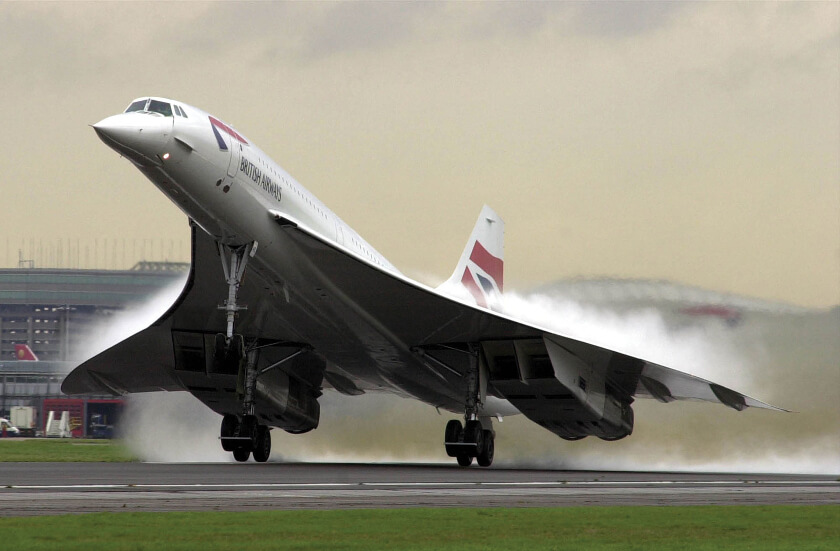
Despite the fact that "Concords" were few and everyone, from the authorities to environmentalists, put them in the wheel, the aircraft successfully flew for 30 years on the routes London-New York, London-Barbados, Paris-New York, London-Bahrain, Paris-Dakar. There were occasional flights to Singapore, Toronto, Washington, Rio, Mexico City, Miami, etc. These flights, however, did not bring proper profit, so the aircraft often performed charter flights, were rented out to politicians, celebrities, various companies, etc. Of course, tickets for the Concorde were more expensive, so businessmen and influential people flew on them, but this is almost the only case in history when the plane became a popular favourite: people in London, Paris and New York came to the airports to watch the supersonic liner coming in for landing.
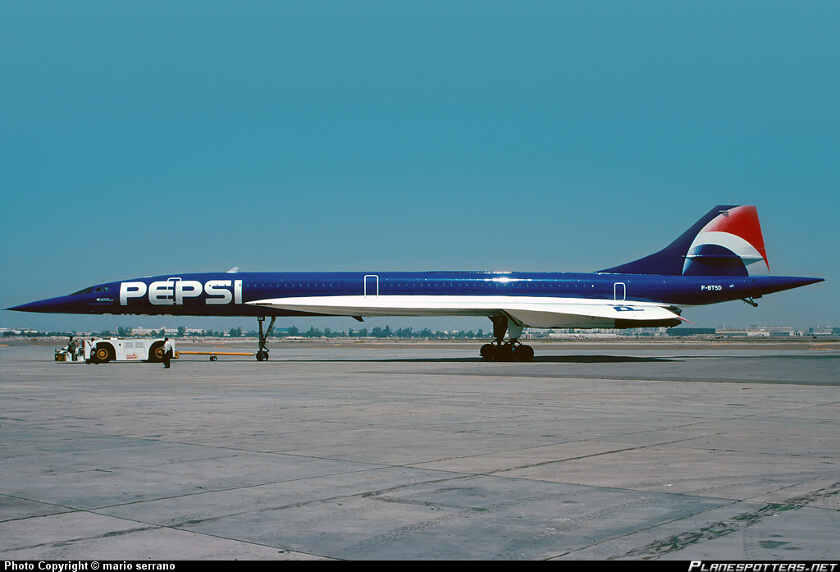
Pepsi adverts on the Concorde.
Only 20 planes were produced and it's not known how long the government subsidies would have lasted, but in 2000 the Concorde crashed at Charles de Gaulle airport. It wasn't broadly a technical fault or pilot error: it's worth saying here that in 27 years of operation, the incident at Paris airport was the only accident in the aircraft's history. During acceleration on the runway, the Concorde ran over a titanium plate that had fallen off a few minutes earlier from a Douglas DS-10 that had taken off. The impact burst the landing gear, a part punctured the fuel tank, another part caused a short circuit, paraffin from the tank ignited, one of the engines caught fire, the aircraft lost control and crashed into a hotel near the airport. All passengers, crew members and 4 people who were in the hotel at the time died.
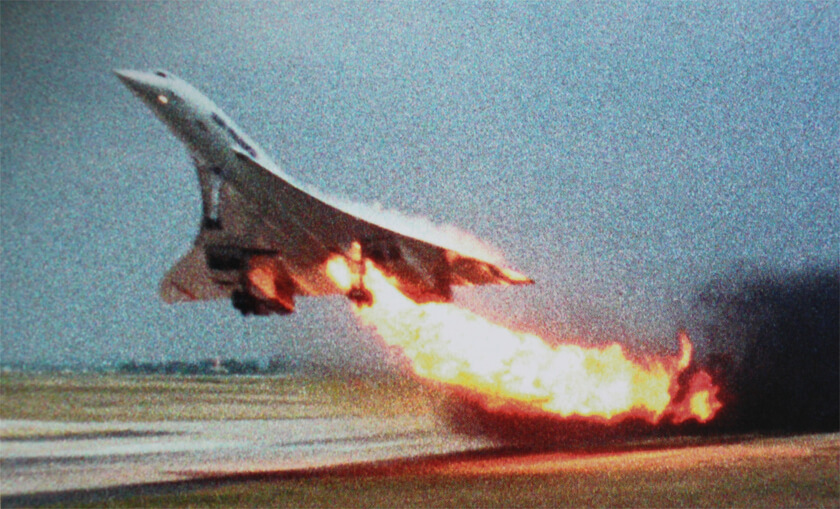
During the investigation all Concorde flights were stopped, Air France sued Continental Airlines, the relatives of the victims sued Air France, Continental Airlines sued the mechanic who badly fixed the plate, and as a result of all these lawsuits British Airlines and Air France decided not to resume the operation of Concordes, and most of the aircraft went to museums.
So why the failure?
It is logical to ask why the aircraft, which was considered at the time a technical breakthrough of the entire aircraft industry, failed on the market. And there are several reasons: high development and maintenance costs, high fuel costs, constant protests from the local population and environmentalists, high wear and tear, the need to take off and land from large runways, higher ticket prices, lack of a wide route map - all this led to the fact that it was easier for companies to recall their aircraft than to continue fighting for the right to fully participate in the air transport market. Perhaps if things were happening in our time, the situation would be more favourable and we would finally stop shaking for 10 hours on flights from Paris to New York. But let's see how Branson will cope with all this: maybe he will be able to cope with all the social and bureaucratic norms. And if not, a couple of museums will get more fresh models on which the paint is not even completely dry.
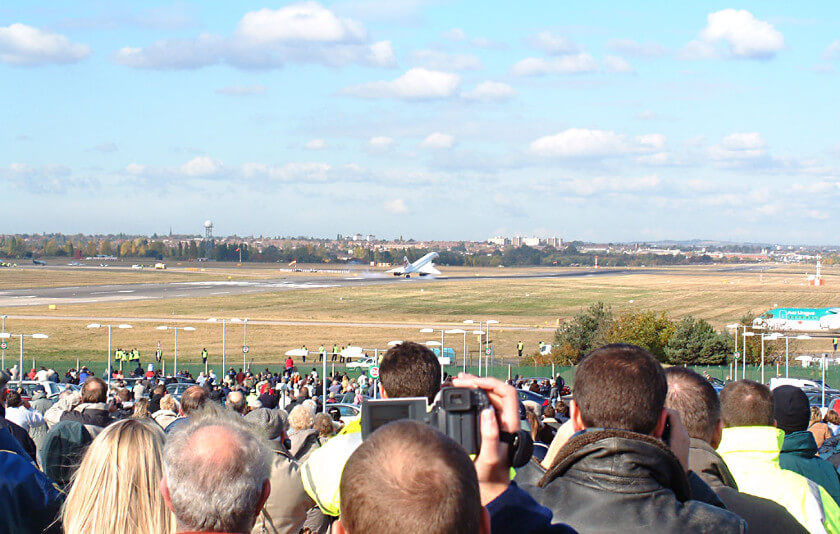
Thousands of people watch the farewell flight of the Concorde in Birmingham, photo concordesst.com
Go Deeper:
- Flying cars: the secret project of Google founder Larry Page
- How do we settle Mars?
- From "Lunokhod" to Curiosity: the evolution of extraterrestrial machines
- The incredible story of the Soviet Internet, born in Kyiv.
- How I travelled in a driverless Uber car