Samsung is betting on Micro LED smartwatch displays by 2027 — here's what that means

Samsung Display has started setting up a dedicated Micro LED production line at its Asan A2 campus in South Korea, with mass production aimed at the second half of 2027. The most likely debut device is the Galaxy Watch 10. If Samsung pulls it off, it would become the first company to manufacture Micro LED panels for compact wearables at scale — a feat that defeated Apple after more than a decade of trying.
What Micro LED actually is
Micro LED isn't a marketing rebrand of existing screen tech. Each pixel is a tiny inorganic LED — it doesn't burn in over time, handles extreme brightness without the heat problems of traditional displays, and in theory uses less power than OLED. Samsung's prototype shown at CES 2025 hit 4,000 nits, comfortably above the Apple Watch Ultra 2's 3,000 nits. For a smartwatch, that means a dial you can actually read in direct sunlight without squinting.
The catch: manufacturing these panels at the microscopic scale wearables require is extraordinarily difficult. Yield rates — the percentage of panels that come out usable — need to exceed 99.99% for production to be economically viable. Apple spent over a decade on this problem before cancelling its Micro LED watch project in March 2024, citing costs that couldn't be justified.
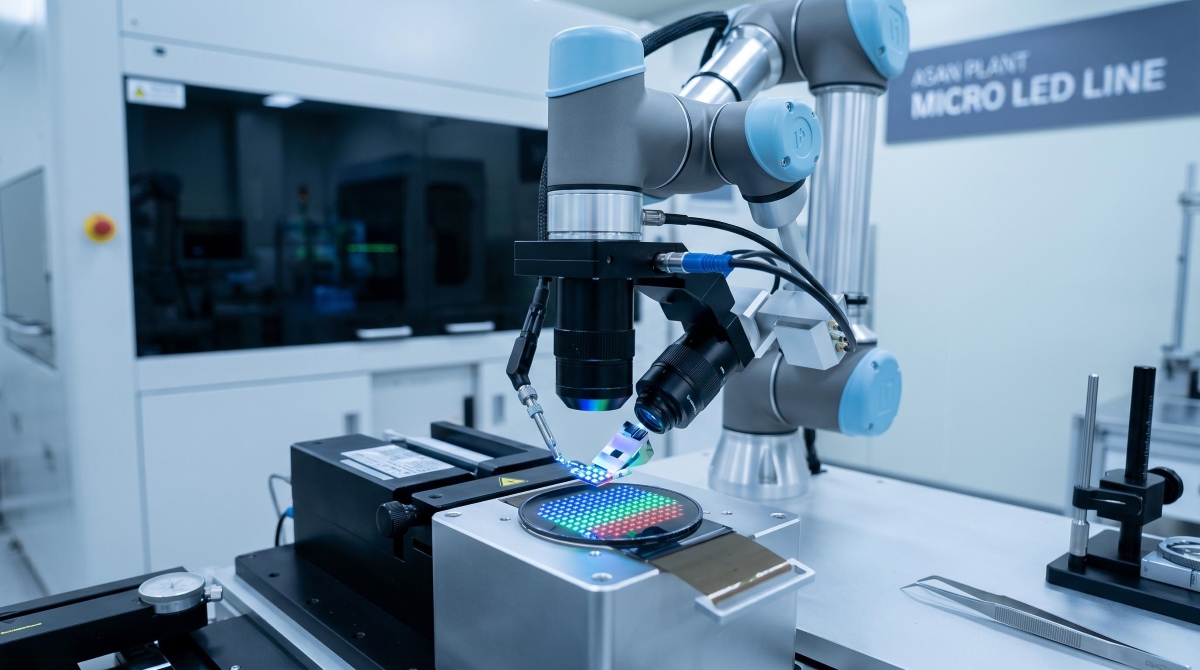
Samsung's Micro LED prototype displayed at CES 2025 reached 4,000 nits — brighter than any current smartwatch screen. Mass production for wearables is still years away.
The battery trade-off no one is talking about
The promise of Micro LED has always included better battery life. Real-world results tell a different story. The Garmin Fenix 8 Pro MicroLED — launched in September 2025 at $1,999 and currently the only commercial smartwatch with the technology — lasts around 10 days in smartwatch mode, compared to 27 days for the OLED variant, according to Wareable. That's 30–40% worse, not better. First-generation manufacturing hasn't yet closed the gap between theoretical efficiency and real-world drain.
When to expect it — and whether to care now
Equipment installation at Asan is underway in 2026, with pilot production running before mass output begins. The Galaxy Watch 8 and Watch 9 are almost certainly out of the picture; Watch 10 is the earliest realistic candidate, arriving no sooner than late 2027 — if the pilot succeeds.
Samsung's ambitions extend beyond its own devices. If yields are good enough, it could supply panels to rival brands that haven't built their own lines, reshaping the premium smartwatch supply chain. For now, the Apple Watch Ultra 2 at $799 remains the benchmark for premium wearable displays, and OLED is firmly the standard everywhere else. Micro LED is a genuine improvement on paper; getting it onto your wrist affordably is a different challenge entirely.


