SpaceX's AI1 satellite is a Boeing 747-sized GPU node in orbit

SpaceX has revealed the first detailed look at its AI1 satellite, a 70-meter-wide solar-powered compute node designed to run artificial intelligence workloads from low Earth orbit. Unveiled on June 9, 2026, the craft carries roughly the equivalent of a single Nvidia GB300 server rack — 72 GPUs at up to 150 kW peak power. SpaceX has filed FCC plans for up to one million of these satellites, which would dwarf every existing constellation on the planet.
The hardware
Earlier concept drawings showed a structure around 170 meters long. The current design trims that to 70 meters — still larger than a 747 — and uses interchangeable GPU modules, so the chip platform can be swapped as generations improve. Elon Musk has named Nvidia's Rubin architecture as the baseline for the first version. To shed heat in the vacuum of space, where convection is impossible, each satellite uses a liquid radiator spanning roughly 110 square meters with redundant pumping loops. SpaceX hasn't named the coolant, but Tom's Hardware notes the power figures and Hugh Lewis, a professor of astronautics at the University of Birmingham, points to ammonia as the likely fluid — the same coolant used on the International Space Station, and one that stays liquid across the wide temperature swings of orbit.
SpaceX AI Satellites pic.twitter.com/e87XMW2tXb
— Elon Musk (@elonmusk) June 9, 2026
The business case
Google has already signed a reported $920 million-per-month compute deal with SpaceX, validating the orbital data center model before a single production satellite is in the sky. The timing is deliberate: SpaceX's IPO at a roughly $1.75 trillion valuation was announced for June 2026, and orbital AI is now the company's post-Starlink growth story. The pitch to investors is straightforward — terrestrial data centers are straining power grids, and moving compute to orbit sidesteps that energy crunch. AWS and Blue Origin are pursuing parallel paths with their own orbital compute projects (TeraWave, Kuiper), per DCD.
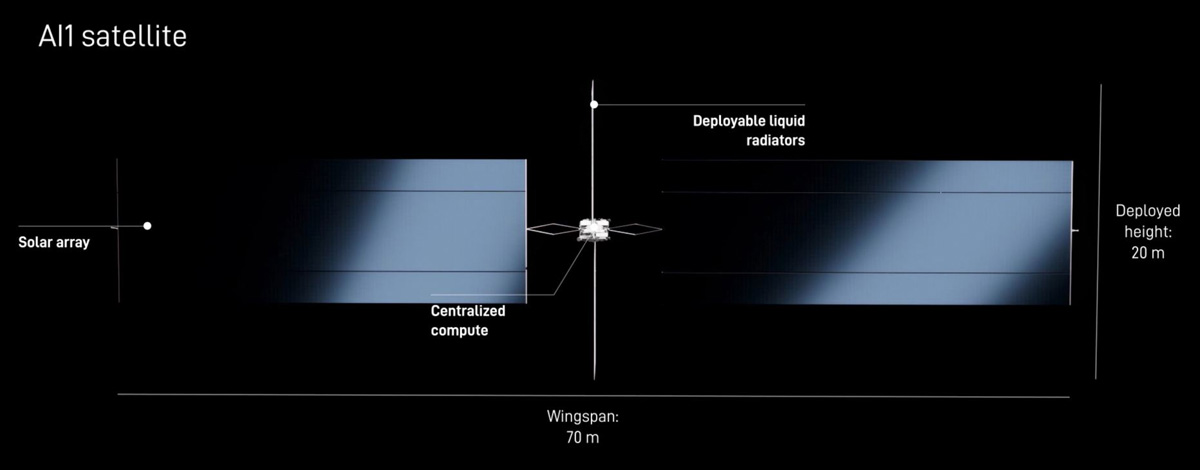
Updated AI1 satellite concept. Illustration: SpaceX
The risks
Active liquid-cooling adds mass, mechanical complexity, and new failure points. Ammonia is toxic, raising questions about handling on the ground and leaks in orbit. The bigger concern, though, is scale. NASA and ESA have both flagged Kessler syndrome — a cascade of collisions triggered by too much debris — as a serious risk above 100,000 LEO satellites. SpaceX claims it can deorbit each unit within five years, but its FCC filing also proposes "graveyard orbits" for most of the fleet rather than full atmospheric reentry. No international enforcement mechanism exists to hold the company to either commitment. The FCC has authorized more than 13,000 satellites in the past two years alone, but has yet to issue a final rule on mega-constellation liability.


