Anthropic's Claude Science turns AI into a full research workbench

Anthropic has launched Claude Science, a dedicated research platform that goes well beyond chatting — it connects AI agents directly to scientific databases, compute clusters, and domain-specific tools. Available now in beta on macOS and Linux, it's aimed at researchers in biology, medicine, and adjacent fields who spend more time wrangling data pipelines than doing actual science. Access requires a paid Claude plan: Pro ($20/month), Max ($100–$200/month), Team, or Enterprise.
Not a new model — a new workflow
Claude Science doesn't introduce a new AI model. It runs on Claude Opus 4.8, the same model already available to subscribers. What's new is the architecture around it. A coordinator agent routes tasks to more than 60 specialized sub-agents covering genomics, proteomics, structural biology, and cheminformatics. A separate reviewer agent independently checks citations and calculations — a direct attempt to reduce the hallucinations that make standard language models unreliable for peer-reviewed work.
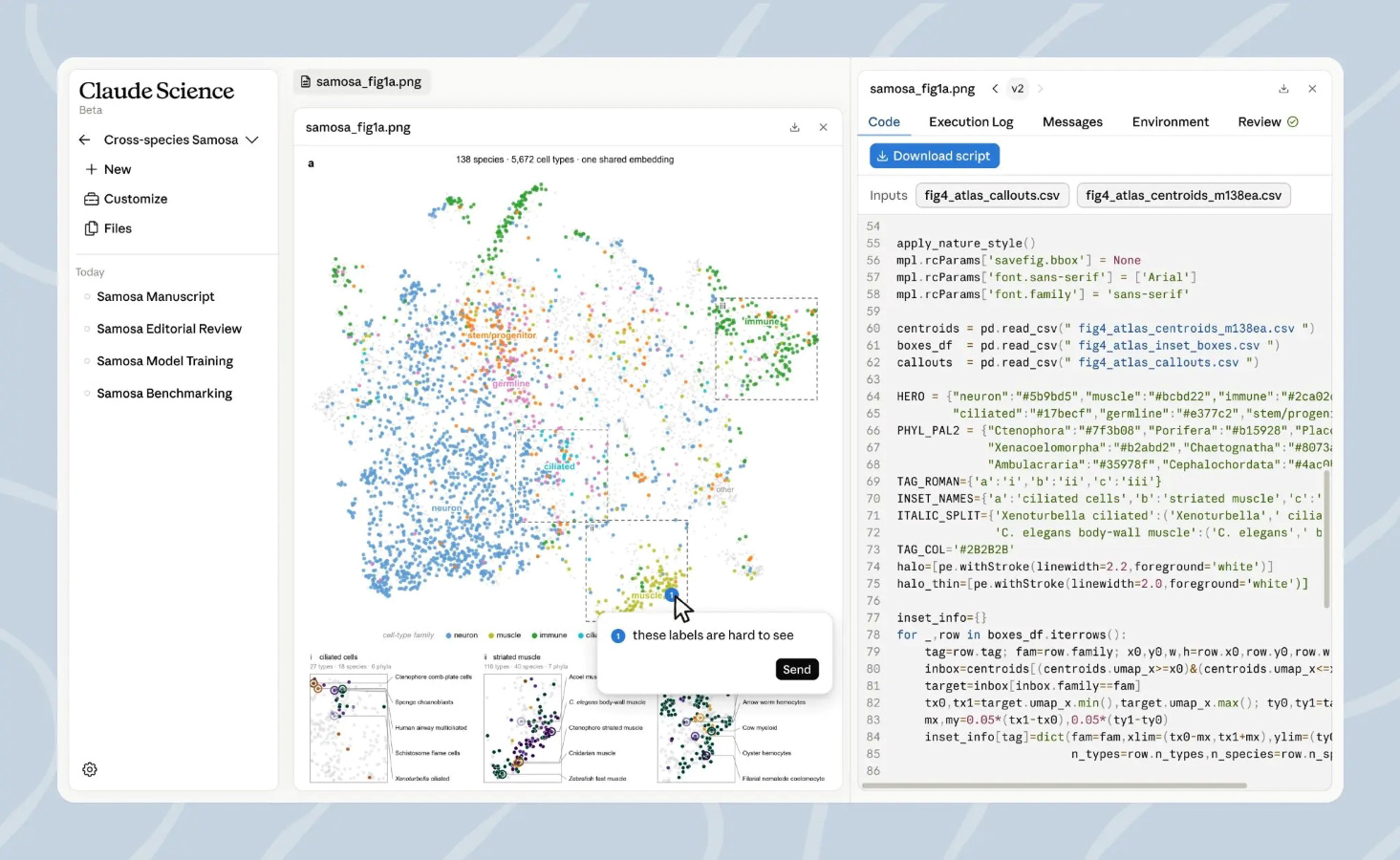
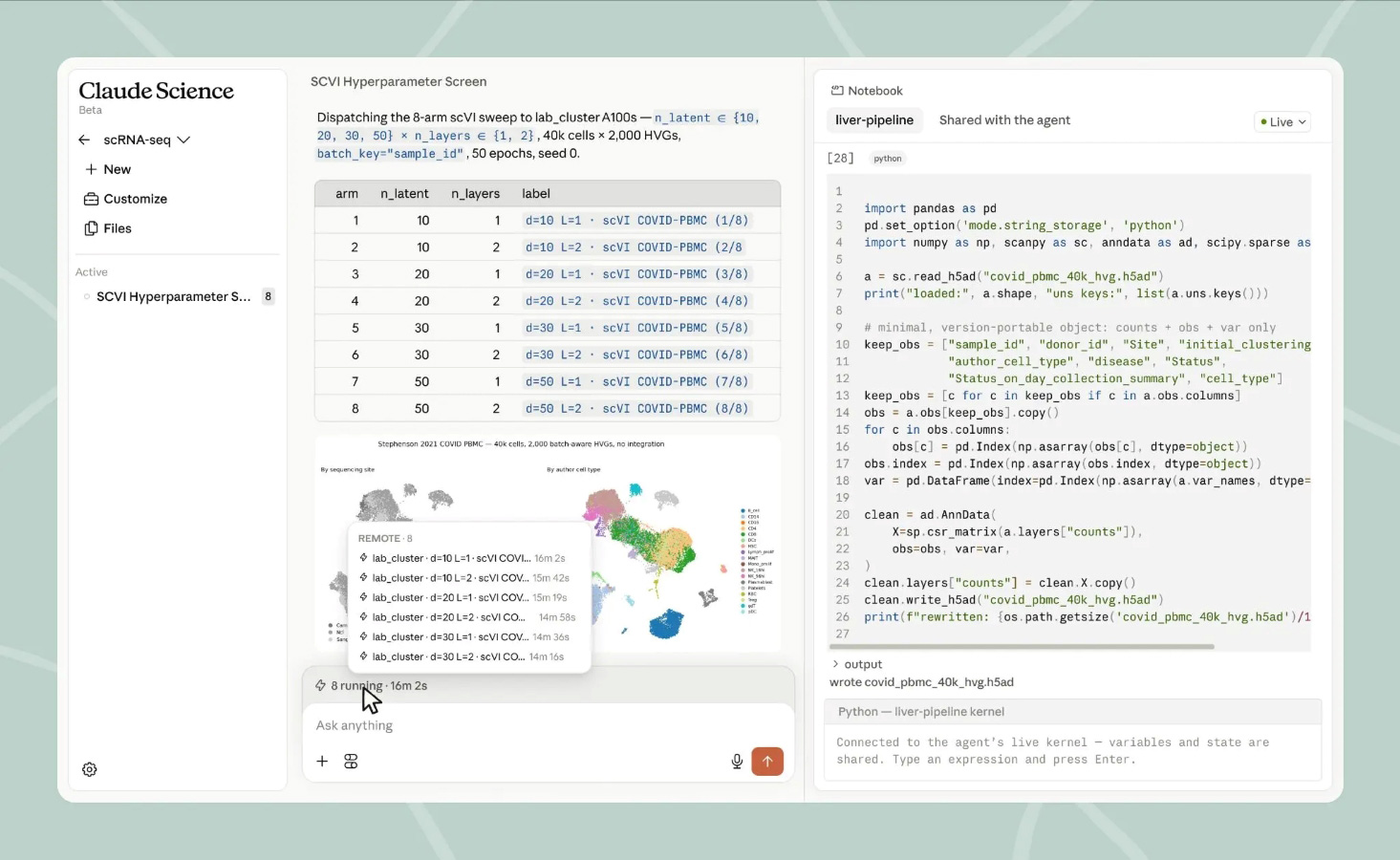
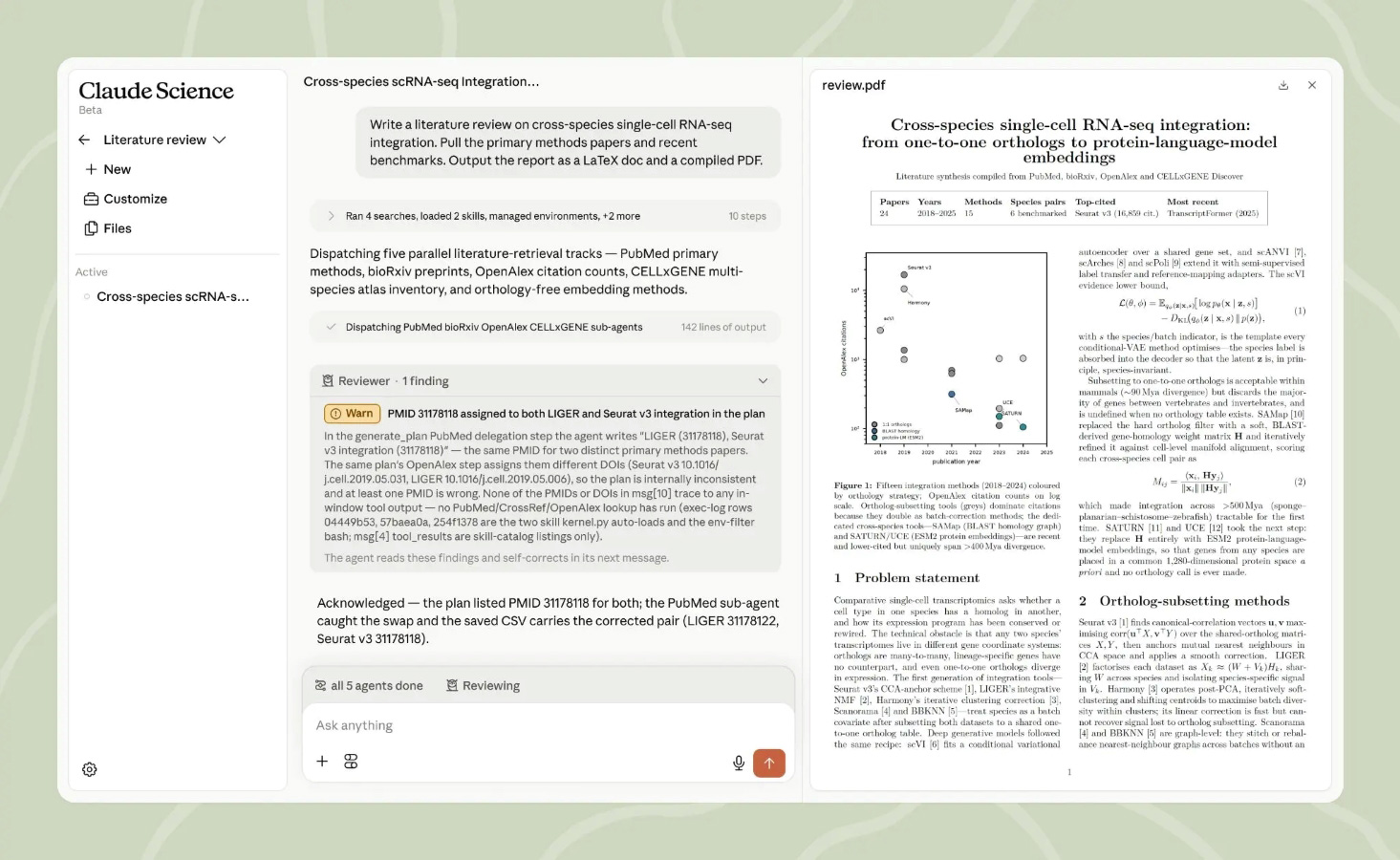
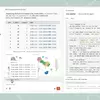
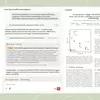
The platform integrates with UniProt, PDB, and Ensembl for biological data, and includes NVIDIA BioNeMo models (Evo 2 and Boltz-2) for protein and genetic analysis. For heavy computation, it can scale out to local lab servers, cloud platforms, or HPC clusters, spinning up hundreds of GPUs when needed.
Reproducibility built in
One persistent problem in science is that published results often can't be replicated. Claude Science addresses this directly: every graph, protein visualization, or statistical output automatically saves the underlying source code, the computational environment description, and the full query history. Another researcher — or the same one, years later — can rerun the exact same analysis without guessing at parameters.
Early results and funding
The real-world numbers are striking. Jerome Lecoq at the Allen Institute used a 20-agent pipeline to produce ten large-scale literature reviews in the time it previously took to complete one — a process that used to take up to two years per review. Stephen Francis, an epidemiologist at UCSF, reported a tenfold speedup on genetic analysis of glioma risk factors, per the Anthropic official announcement.
To push adoption further, Anthropic is funding 50 research projects with up to $30,000 in compute credits each. Partner company Modal adds another $2,000 per project. The grant slots are competitive — and at those credit levels, they're realistically aimed at biomedical labs rather than solo researchers.
The catch
Windows support is not mentioned anywhere in the launch materials — a hard limit for labs that standardize on Windows workstations. Competing tools like ChatGPT Deep Research and Perplexity Pro offer cheaper entry points for basic literature review, even if they lack Claude Science's depth of integration. The bet Anthropic is making, as SQ Magazine notes, is that provenance and reproducibility — not raw model capability — are what serious research institutions will pay for.


