No cowling, no problem: CFM's open fan engine targets 20% fuel savings by the 2030s

The joint GE Aerospace and Safran venture CFM International is pushing its most unconventional engine design in decades closer to a real aircraft. The RISE (Revolutionary Innovation for Sustainable Engines) program targets a 20% reduction in fuel burn and CO2 emissions compared to today's best turbofans — a figure confirmed across CFM's own program page and independent analysis. For airlines spending a third or more of operating costs on fuel, that gap is enormous.
The idea
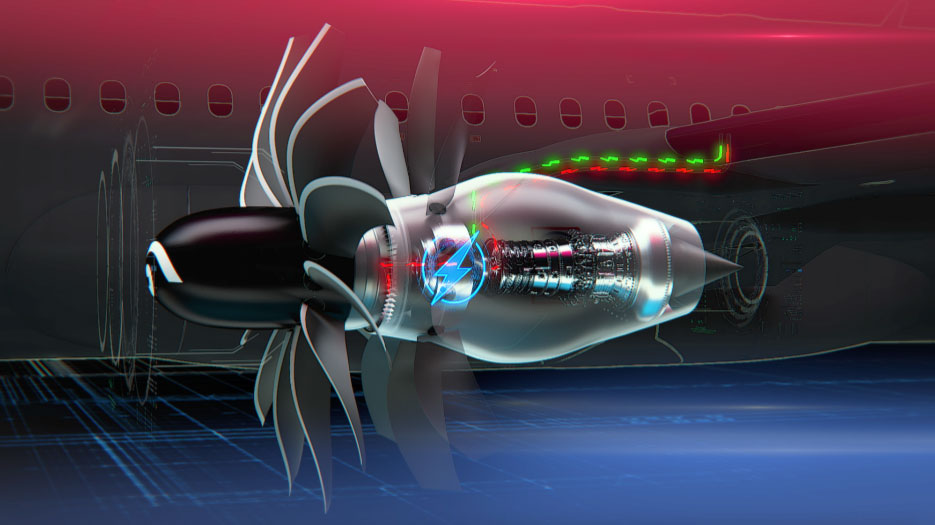
A conventional jet engine hides its fan inside a nacelle — the tube-shaped housing you see under the wing. That housing adds weight and limits how large the fan can grow. The Open Fan drops the housing entirely, freeing engineers to scale up the blades dramatically. The physics are straightforward: push more air through at lower acceleration, and efficiency climbs. In turbofan terms, this is called a high bypass ratio, and Open Fan pushes it further than any ducted design can.
The blades themselves are single-stage, variable-pitch composites — they can rotate to adjust thrust without changing engine speed, similar in principle to a turboprop. Safran is leading the blade development at its Villaroche facility in France, where a new 8-meter test rig is now running full-scale hardware through real-world punishment: bird strikes, icing, sand and dust ingestion.
Progress and pushback
More than 2,000 CFM engineers are active on the program. The low-pressure turbine — the internal module that drives those massive blades — has already logged over 1,000 hours of validation, per GE Aerospace. Noise tests in wind tunnels at ONERA in France and DNW in the Netherlands show sound levels matching CFM's current LEAP engines. That matters because noise was a key reason previous open-rotor attempts, including GE's 1980s GE36 and Pratt & Whitney's propfan, never made it to airlines.
Flight testing on an Airbus A380 demonstrator is planned for the late 2020s out of Toulouse. Airbus is expected to make an architecture decision for its next-generation narrowbody (NGSA) around 2030. But not everyone is aligned — Simple Flying reports that Boeing and Pratt & Whitney remain skeptical, and CFM quietly maintains a backup ducted engine design (reportedly called Advanced Ducted-Large) in case the open fan misses its mid-2030s service entry target.
What it means in practice
If the program stays on schedule, the first commercial aircraft powered by an Open Fan engine could enter service in the mid-2030s. The design is also built to run on 100% sustainable aviation fuel and has been designed with hydrogen compatibility in mind. FAA and EASA certification pathways have not been detailed publicly — that regulatory question, along with blade-off containment without a surrounding casing, is where the hardest engineering work still sits.
For now, CFM is ahead of where any open-rotor program has been before. Whether airlines board a Boeing or an Airbus next decade, the engine under the wing may look nothing like today's.


