China plugged a quantum computer into its power grid — and it actually works

China has quietly commissioned the world's first quantum-enhanced power substation, and it is not a prototype — it is running live. The 220 kV facility in Hefei, Anhui province, completed an 18-month trial before its official November 2024 launch, deploying dozens of quantum solutions across measurement, communications, and computing. While the US and UK continue to debate federal quantum grid roadmaps, China has already moved to production.
The hardware
The most striking element is a set of diamond-based quantum sensors that detect tiny fluctuations in electrical current with precision far beyond conventional equipment. They are specifically tuned to catch partial discharges — small insulation failures that are invisible to standard monitors but eventually cause catastrophic equipment failures. According to project data, the sensors are expected to cut measurement errors by over 500,000 kWh per year, enough to power a small residential neighbourhood for a month.
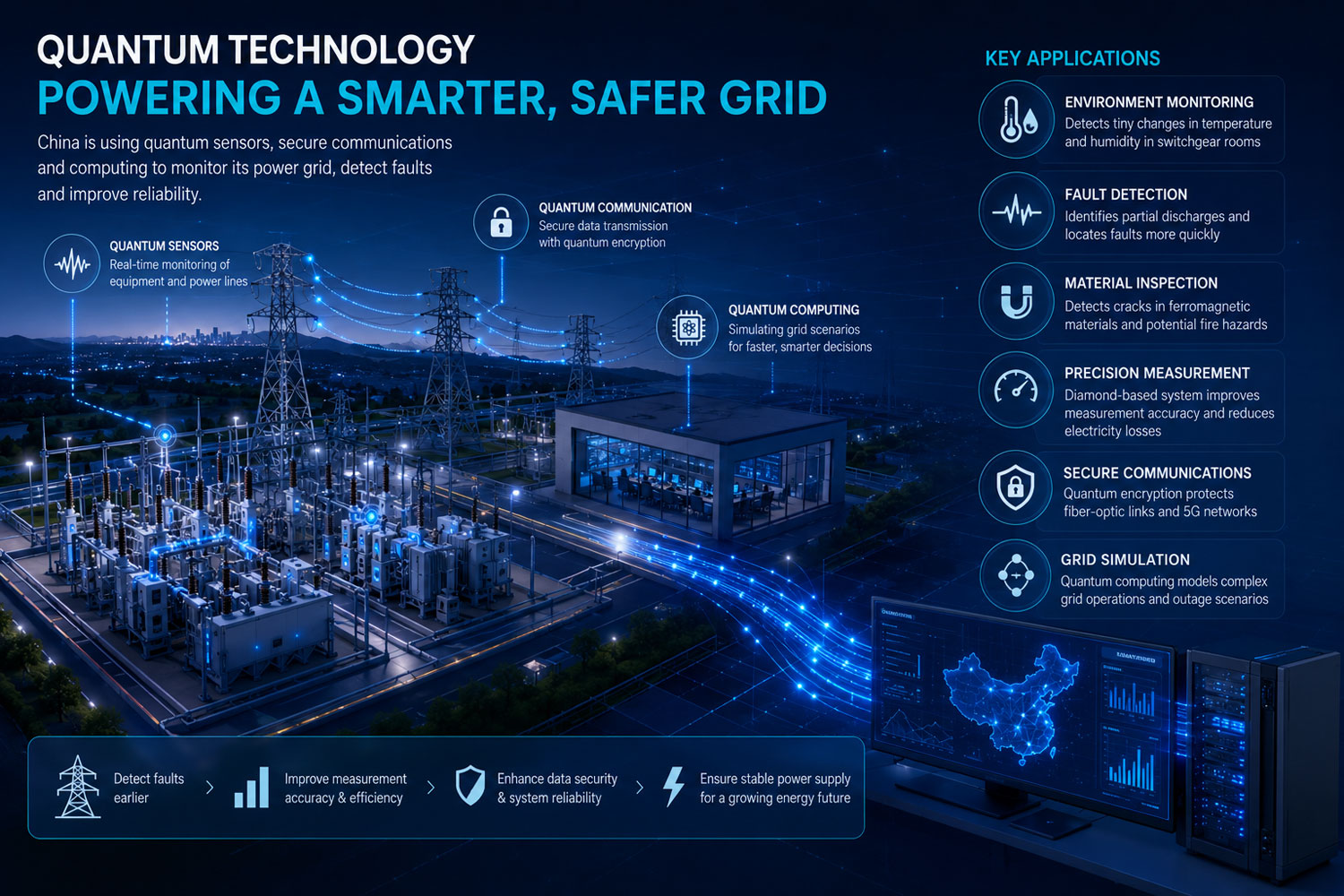
Diamond-based quantum sensors at the Hefei substation can detect insulation failures invisible to conventional monitoring equipment.
The Wukong factor
For scenario modelling, the substation draws on Origin Wukong, a 72-qubit superconducting quantum computer launched in January 2024 by Origin Quantum. The machine runs power-flow algorithms — calculations that predict how the grid responds to sudden demand spikes or line failures — faster than classical supercomputers can manage. That speed matters when a wrong call can cascade into a regional blackout.
Communications across the site are secured with quantum key distribution (QKD), a method that uses the physical properties of quantum particles to make eavesdropping detectable. Fiber-optic and 5G links between the dispatch centre, distribution systems, drone patrols, and inspection robots all pass through this encryption layer.
Where the West stands
The US has government-funded testbeds — Los Alamos National Laboratory and the Chicago Quantum Exchange — exploring QKD for power infrastructure, but no centralized quantum grid network exists yet. The Department of Energy has published blueprints, but funding remains at the research-and-development stage. No comparable UK quantum grid initiative has been announced; British policy has focused on building quantum computing capability rather than hardening critical infrastructure.
China's State Grid Corporation has positioned Hefei as the template for upgrading higher-level substations nationwide. The 18-month trial-to-full-deployment model is notably faster than the multi-year pilot phases typical in Western grid modernization programs — a gap that reflects both different risk tolerance and the scale of state backing available to Chinese grid operators.
Future plans include quantum sensors that can detect gas leaks from degrading materials and spot microfractures in ferromagnetic components before they become dangerous — work that currently relies on thermal imaging cameras and field experience.


