China's Bank of China is lending money based on AI token usage

Bank of China has launched what it calls a Computing Power Token Loan — a credit product that calculates how much a company can borrow based on how many AI tokens it consumes. The pilot is running in Guangzhou's Haizhu district, targeting AI startups and computing services firms. The maximum loan is 30 million yuan (around $4.2 million), repayable over three years.
Tokens as collateral
Traditional bank loans are secured against physical assets: property, equipment, receivables. This scheme replaces that with a digital activity metric. The more tokens a business burns through its AI services, the argument goes, the more real and active that business is.
Three types of companies are eligible: computing infrastructure providers, AI application developers, and AI service firms. When setting credit limits, the bank weighs token production and consumption volumes alongside contract values for computing services and accounts receivable. In the pilot phase, Bank of China has already approved 28 million yuan ($3.9 million) in lending.
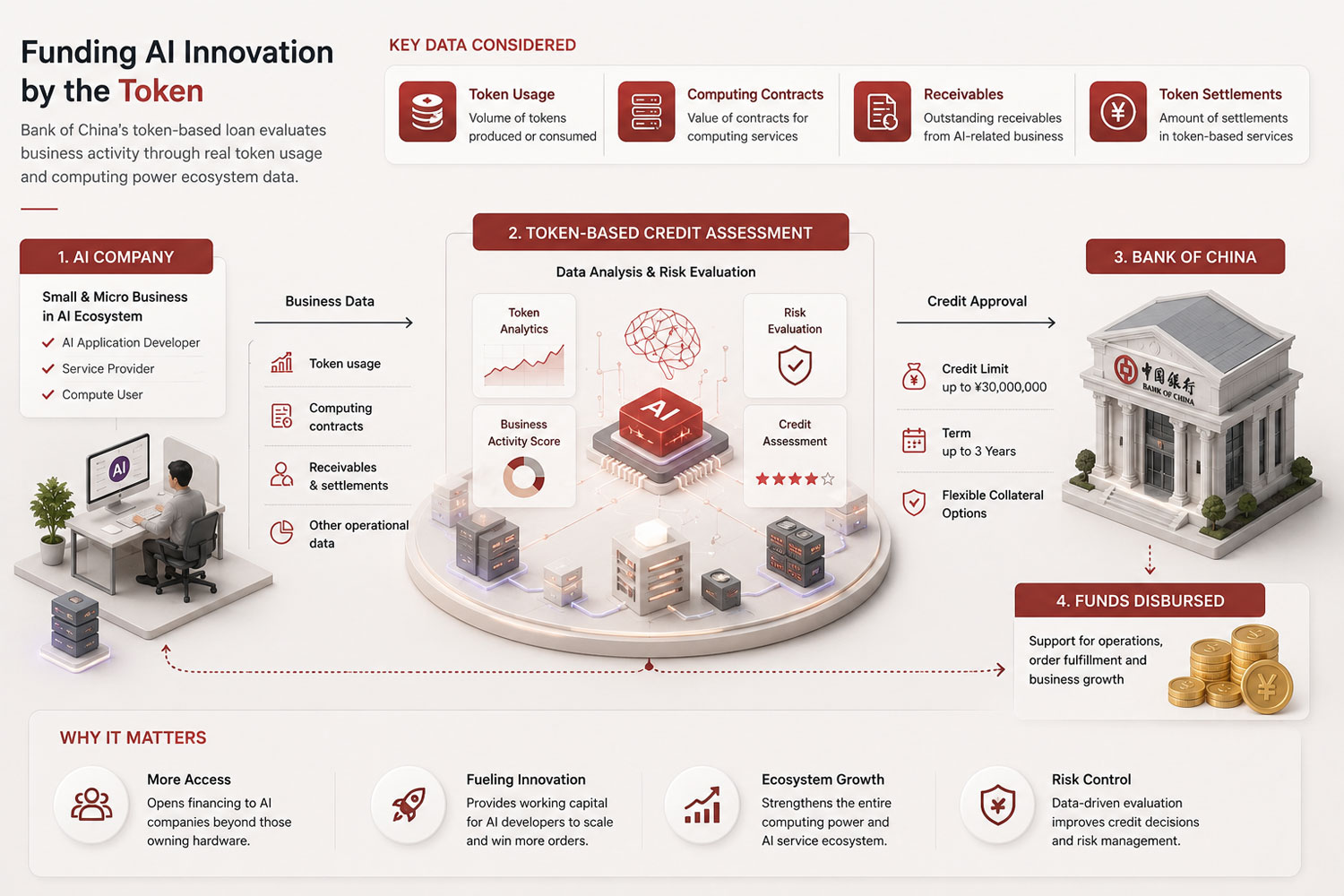
Tokens in action: how China is using AI consumption data to back bank loans. Illustration: AI
The scale of China's AI token market makes the logic easier to understand. Daily token consumption in China exceeded 140 trillion by March 2026 — up from roughly 100 billion in early 2024, a more than 1,000-fold increase. Much of that growth comes from autonomous AI agents running tasks in the background, not just people chatting with chatbots.
No Western equivalent
No US or UK bank currently offers anything comparable. JPMorgan, Goldman Sachs, and their fintech peers have not announced token-based credit products. The Federal Reserve and the Bank of England have not addressed token consumption as a collateral model. China Merchants Bank and Ping An Bank have moved in the same direction as Bank of China, suggesting this is becoming a broader trend in Chinese banking rather than a one-off experiment.
The scheme fits into China's wider push to direct bank lending toward its tech sector. Guangzhou has been investing heavily in AI infrastructure, and the central bank has run re-lending programmes to push commercial banks toward high-tech industries.
The fraud problem
The obvious weakness is that token metrics can be gamed. A startup could inflate its consumption figures with fake requests or model test runs to unlock a larger credit line — a risk that echoes the misreported revenue figures seen in subprime-era lending. Industry specialists are already flagging the issue, calling for standardised token data storage and independent verification platforms. Without those guardrails, the scheme's creditworthiness logic collapses.
For now, Western banks are watching from the sidelines. Whether that reflects regulatory caution or a genuine lack of interest is an open question.


