Young Americans have gone from excited about AI to scared of it

The honeymoon with AI is over for young Americans. A Pew Research, June 2026 survey of 3,488 US adults finds that 55% of those under 30 are now more concerned than excited about AI in daily life — up from just 31% in 2021. The worry isn't abstract: data from the Stanford Digital Economy Lab, Aug 2026 shows a real 19% employment gap has already opened up between 22–25-year-olds in AI-exposed roles and their peers in more stable fields.
The collapse in excitement
Five years ago, 25% of young people said AI made them feel enthusiastic. That figure has fallen to 11%. Across all US adults, 52% now say they are more concerned than excited — compared with 37% in 2021. The shift is happening fastest among the group that grew up with the technology, not in spite of it.
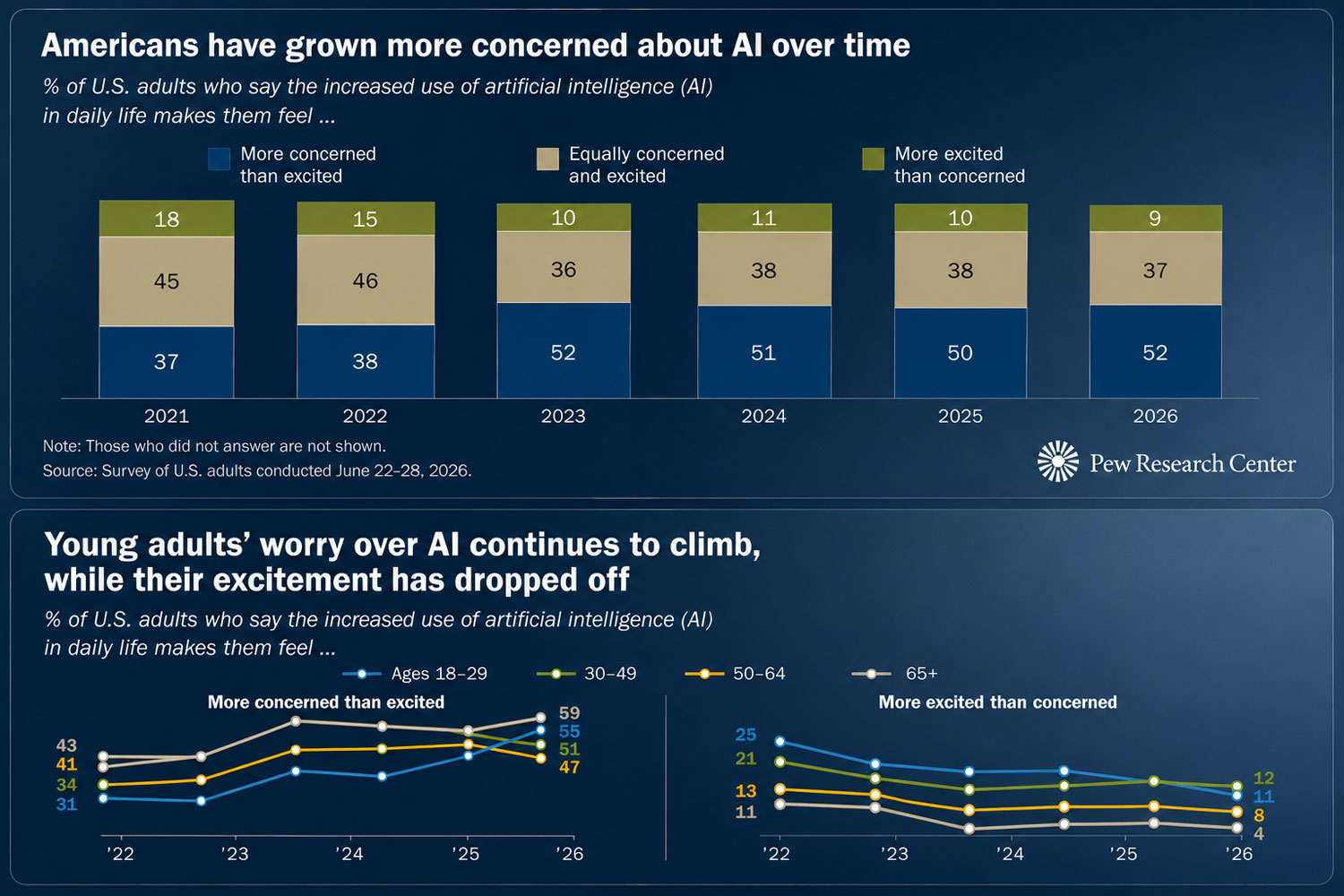
Young adults in the US are the most skeptical age group about AI, even as weekly use remains high.
Jobs, not chatbots
The dominant fear is economic. Seventy-three percent of young adults believe AI will eliminate jobs over the next 20 years, up from 61% in 2024. Only 5% of all respondents think AI will create more jobs than it destroys. Those fears are already showing up in hiring data: the Stanford lab found that entry-level roles in AI-exposed occupations are filling more slowly, widening the gap for workers just starting out.
The user paradox
Despite the anxiety, young people haven't stopped using the tools. Gallup found that 51% of 14–29-year-olds use generative AI at least once a week — a rate that has held steady since 2025. Enthusiasm among that same group, however, dropped 14 points year-on-year, while the share reporting anger rose to 31%. The more familiar young users become with what AI can actually do, the more worried they appear to be about what that means for their careers.
What comes next
Corporations are starting to respond to the mood. OpenAI recently launched a dedicated teen mode for ChatGPT, adding parental controls and usage limits. But sentiment surveys suggest that access restrictions won't address the underlying fear of displacement. The gap between daily use and genuine confidence in AI's net benefit to workers keeps widening — and for now, no policy in the US or UK has a clear answer to that.


