A single AI server rack that costs more than a house: inside Nvidia's NVL72

Nvidia's next-generation AI server rack will carry a component cost of roughly $7.8 million per unit, according to a Morgan Stanley analysis — a price tag that puts serious hardware out of reach for anyone who isn't a US hyperscaler or a well-funded sovereign AI program. The platform, called NVL72, is built around Nvidia's new Vera Rubin architecture and is expected to reach customers in the second half of 2026.
The hardware inside
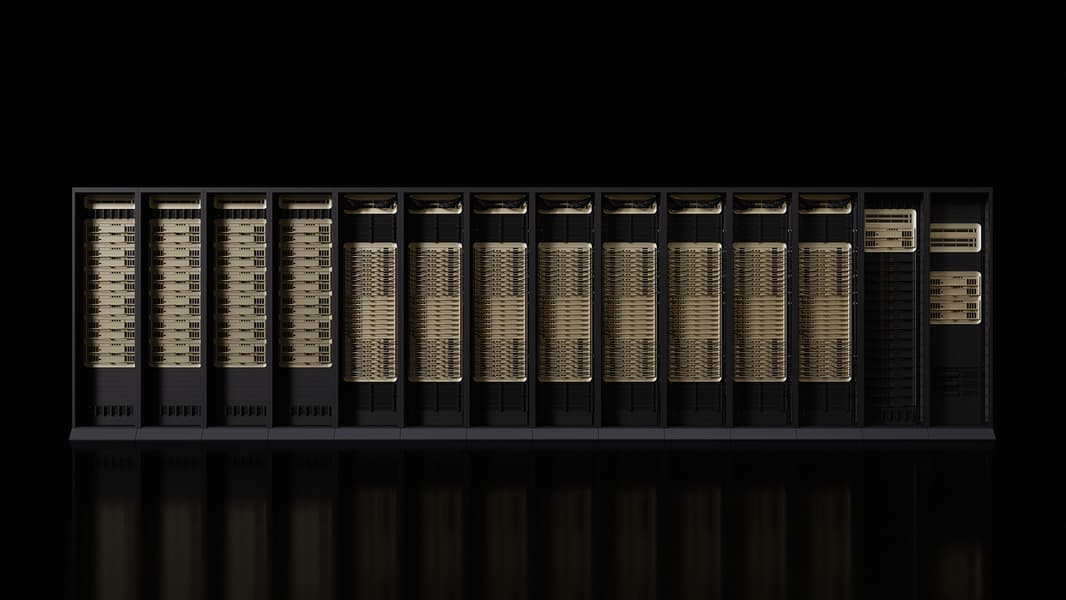
One NVL72 rack packs 72 Rubin GPUs and 36 Vera CPUs. Morgan Stanley puts the cost of a single Rubin GPU at around $55,000 — 57% more expensive than the current Blackwell chips. The GPUs alone account for roughly $4 million of that $7.8 million total.
Memory is where the costs get genuinely startling. Each Rubin GPU carries 288 GB of HBM4 high-bandwidth memory, and each Vera CPU pairs with 1.5 TB of LPDDR5X. Across a full rack that adds up to 20.7 TB of video memory and 54 TB of system RAM. Morgan Stanley estimates memory costs have risen 435% compared to the previous generation — a direct result of HBM4 being far more complex to manufacture than the HBM3e used in Blackwell systems.
Why everything costs more
Printed circuit board (PCB) costs have climbed 233% as well. Moving data between chips at the speeds these systems demand requires manufacturing tolerances that existing supply chains are still catching up to. Nvidia is effectively setting new production standards with every generation, and suppliers are charging accordingly.
HBM4 supply constraints are already a factor. Analysts at KeyBanc flagged that neither Micron nor SK Hynix can currently meet qualification targets and volume commitments, potentially cutting 2026 rack production from a planned 12,000–14,000 units down to around 6,000.
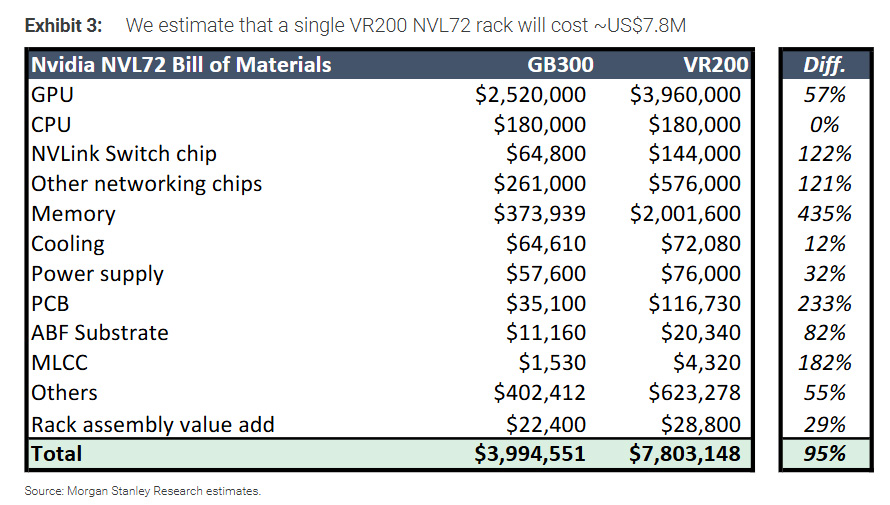
Component cost breakdown for an NVIDIA Vera Rubin NVL72 rack. Illustration: Morgan Stanley
Who actually buys this
AWS, Google Cloud, Microsoft Azure, and CoreWeave have all signaled Rubin deployments for the second half of 2026. These are the buyers the $7.8 million price is written for. OpenAI's pause of its Stargate UK data center in April 2026 — citing energy costs and regulatory delays — illustrates how concentrated this market really is. UK electricity runs roughly 4.4 times the US rate, and grid approval processes can add years to project timelines.
For everyone else, the Rubin platform is a reminder of where the AI hardware investment is flowing. Consumer and workstation GPUs remain a side business for Nvidia compared to this scale of infrastructure spending. Morgan Stanley analysts note that costs like these are becoming the industry norm — meaning "affordable AI" will stay a software and cloud-service story for the foreseeable future, not a hardware one.


