Australia's CSIRO built a quantum device to stop GPS spoofing

GPS isn't just for directions — the timing signals broadcast by satellite navigation systems underpin banking transactions, power grids, emergency services, and transport networks worldwide. Those signals are surprisingly easy to jam or fake, and that vulnerability is now a recognized national security risk in the US, UK, and beyond. Australia's national science agency, CSIRO, has built a portable device it says can fix that.
In July 2026, CSIRO delivered two Quantum Light Sources — compact, high-flux entangled photon generators — to Australia's Defence Science and Technology Group. The technology was developed with Heriot-Watt University and is designed to create a tamper-proof timing link between ground stations and satellites hundreds of kilometers overhead.
How the physics works
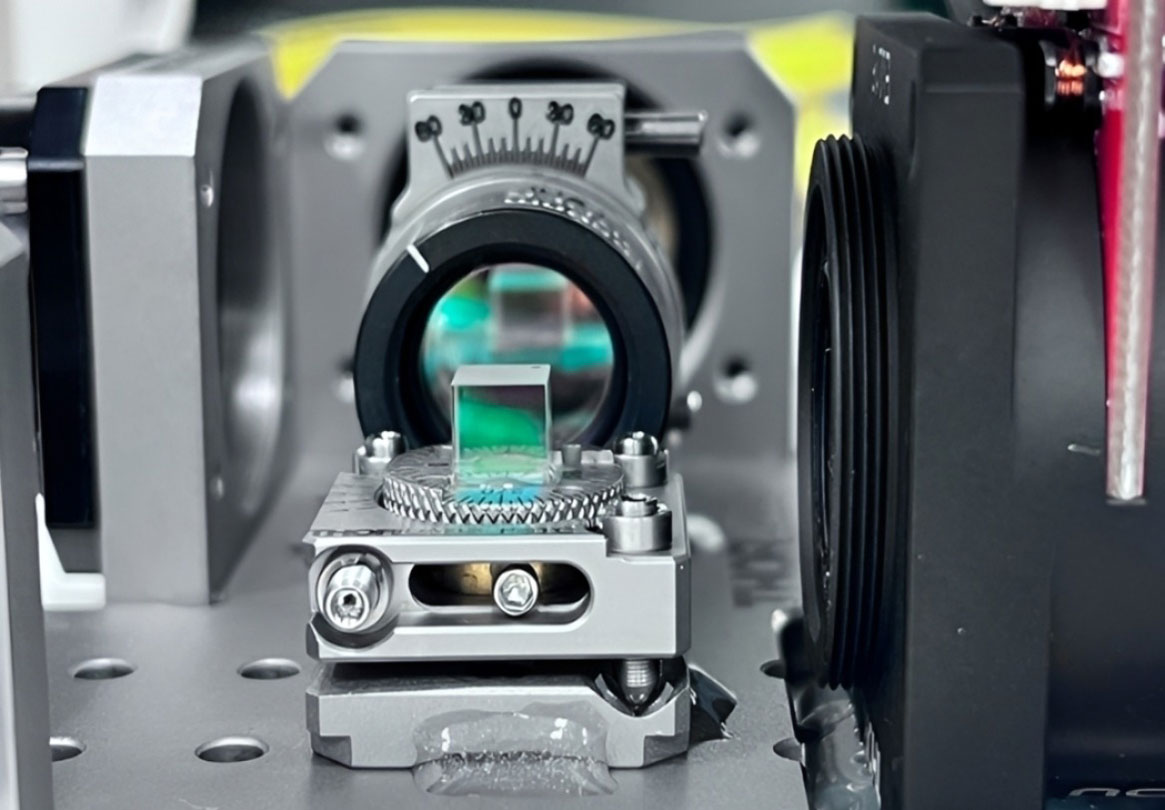
Each device produces pairs of entangled photons. One photon stays at the ground station; its partner travels up to the satellite. Because the two particles are quantum-entangled, any attempt to intercept or alter the signal instantly disturbs the quantum state of both — making interference detectable by physical law, not just software. There is no way to eavesdrop silently. That property is what makes the approach spoof-proof in a way that conventional encrypted radio signals are not.
Why timing matters more than navigation
Satellite navigation systems like GPS are essentially atomic clocks in orbit. Banks rely on their timing pulses to sequence transactions. Power grids use them to synchronize phase across the network. A spoofed or jammed signal accurate to even a few microseconds can cascade into outages or financial errors. Jamming hardware is cheap and widely available; spoofing attacks have been documented in conflict zones across the Mediterranean and Middle East, affecting civilian aircraft and shipping.
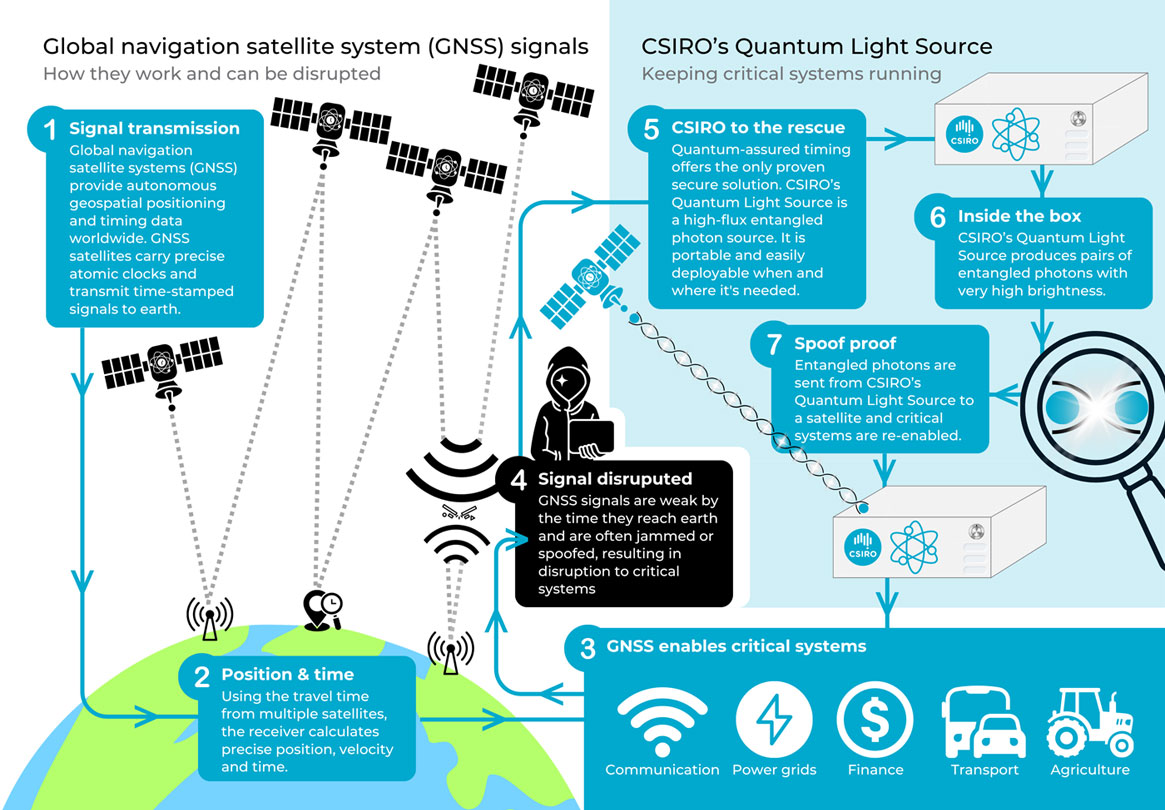
An infographic showing how global navigation satellite systems work, how they can be disrupted, and how CSIRO's Quantum Light Source offers an alternative. Illustration: CSIRO
Where this sits in the global race
The UK has already flown a competing quantum navigation system — Infleqtion's Q-INS, backed by £8 million from UKRI — in test flights completed in May 2024. Q-INS uses ultra-cold atoms rather than entangled photons, a fundamentally different approach. In the US, the Department of Transportation awarded $12.2 million across eLoran revival and LEO-satellite backup programs in 2024–2025, per the Global PNT policy tracker. No head-to-head comparison between any of these systems has been published.
CSIRO's entangled photon method is the first of its kind to be delivered to a defense customer in portable form, according to the CSIRO official release. The agency frames it as a sovereign capability — meaning Australia wouldn't have to depend on foreign systems for critical timing infrastructure.
The gaps
What's missing is a timeline for operational deployment. The July 2026 handover moves the technology out of the lab, but no field trial schedule or commercial pathway has been announced. Cost, regulatory approval, and integration with existing ground station infrastructure are all open questions. For now, quantum timing remains a promising prototype — one that the UK, US, and EU will be watching closely.


