This sodium battery absorbs heat while charging — and it wants to replace lithium

A new sodium-ion battery system does something unusual: it absorbs heat during charging instead of generating it. US companies Syntropic Power and UNIGRID announced a partnership to deploy up to 1 GWh of these sodium-chromium-oxide (NCO) batteries across North America by the end of 2027 — a direct challenge to lithium-dominant grid storage at a time when supply chain independence is a live political issue.
The chemistry
Most battery chemistries produce heat during charging, which is why large storage systems need fans, liquid cooling loops, and all the hardware that comes with them. NCO behaves differently: it's endothermic during charging, meaning the cells absorb heat rather than release it. That removes the need for active cooling entirely — a meaningful cost reduction at grid scale where thermal management systems are a significant line item.
Independent testing at Rochester Institute of Technology's Battery Development Center, an ISO 17025-accredited lab, put the numbers on paper. The 210 Ah cells hit 97.9% round-trip efficiency and retained more than 99% of their original capacity after 1,000 full charge-discharge cycles. Those cycle-life figures match the better end of lithium competitors rather than beating them outright, but the thermal behavior is genuinely distinct.
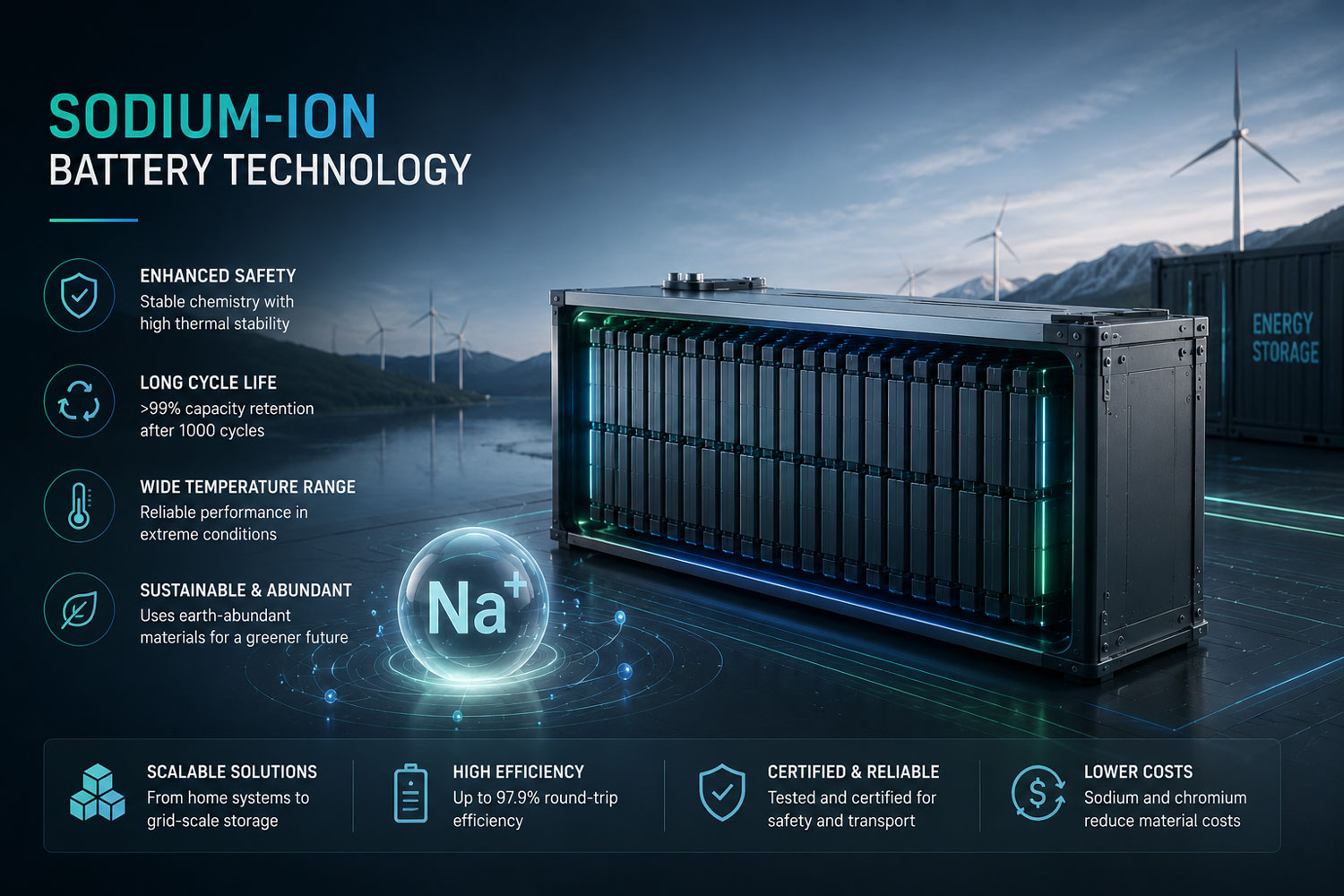
UNIGRID's NCO battery cells passed independent cycle-life and efficiency testing at Rochester Institute of Technology.
The products and the supply chain angle
Two products are planned. Tenet is a wall-mounted unit aimed at homes and commercial buildings, with discharge times from 20 minutes to 20 hours depending on configuration. GridSpan is a modular platform for utility-scale projects with the same flexible discharge window. Both have passed key safety certifications — UL 9540A, UN 38.3, and IEC 62619 — which matters for homeowner insurance acceptance and grid-operator approval in the US market.
The chemistry also sidesteps lithium and cobalt entirely, using sodium and chromium instead. Syntropic says it is targeting non-FEOC (Foreign Entity of Concern) aligned production by the end of 2027, aligning with IRA grid-storage incentives. That's an aspirational commitment for now — no US manufacturing location has been confirmed — but the regulatory tailwind is real, per the Official UNIGRID–Syntropic press release.
What's still missing
No pricing has been announced for Tenet against direct rivals like the Tesla Powerwall or LG Chem RESU. Availability outside North America — including the UK — remains unconfirmed. Pilot deployments for Tenet are reportedly underway from mid-2026, with full commercialization of both products targeted for 2027, according to Solar Power World. All performance data so far is lab-based; real-world field results at scale don't yet exist.


