Terafab: Musk's $16.8B chip factory is a bet on semiconductor independence

Tesla and SpaceX announced Terafab on August 6, a $16.8 billion semiconductor complex in Grimes County, Texas, designed to produce chips for Elon Musk's companies entirely in-house. The facility would cover roughly 100 million square feet — about 1,300 football fields — making it one of the largest industrial sites ever planned. At its core, this is a direct response to the chip supply crunch that has slowed production across the auto and aerospace industries.
The pitch
Terafab is designed as a closed loop. Under one roof, it would handle crystal growth, logic chip fabrication, memory production, packaging, and final testing. The goal is to cut out the third-party foundry relationship entirely. Tesla needs chips for its Optimus humanoid robots and Cybercab autonomous taxis; SpaceX needs them for space-based data centers. Together, the two companies claim their combined compute demand will exceed 1 terawatt — a figure that surpasses current global semiconductor supply capacity.
Phase one alone costs $16.8 billion and is projected to create more than 3,000 jobs. SpaceX will receive a $30 million grant from the Texas Enterprise Fund, per Yahoo Finance, and the project qualifies for the state's Jobs, Energy, and Technology incentive program. SpaceX says its existing Texas operations already support more than 56,000 jobs and have generated over $28 billion in economic impact for the state.
Terafab will be built in Grimes County, Texas
— Tesla (@Tesla) August 6, 2026
In April, we broke ground on our research fab on the North Campus of Giga Texas – the precursor to Terafab.
Both Tesla SpaceX will need far more chips than current future global production can supply.
This is why we're building… pic.twitter.com/je4jKXuQrY
The pushback
The scale of the tax incentives has drawn scrutiny at the local level. According to TechCrunch, Grimes County residents challenged the project's opacity and the terms of the tax breaks at community meetings. Environmental concerns are also in play: the complex would draw water from Gibbons Creek Reservoir rather than groundwater, and the companies promise on-site wastewater treatment and water recycling — though no independent environmental assessment has been published yet.
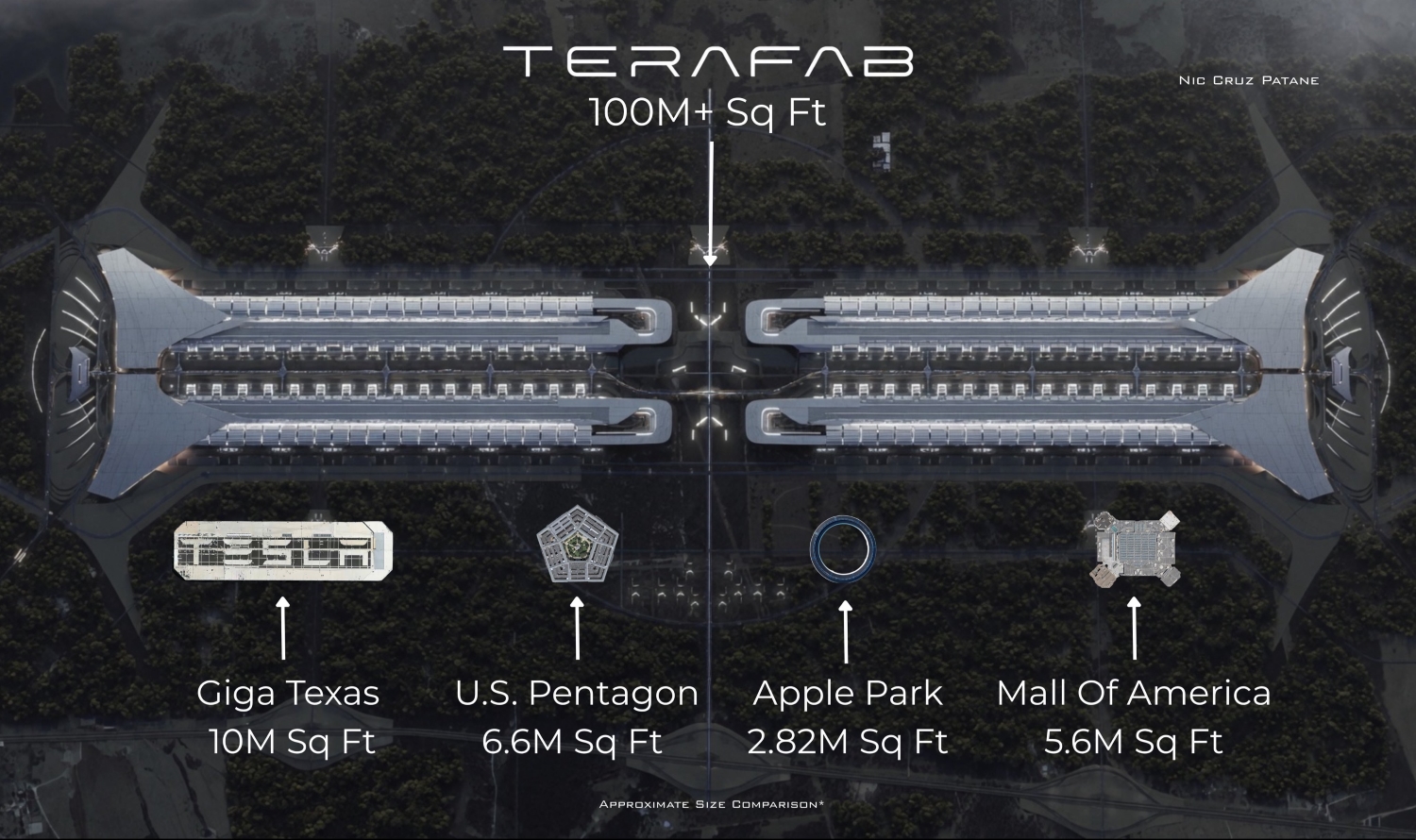
Scale comparison illustration. Image: @niccruzpatane
Terafab also enters a complex regulatory landscape. Intel and Micron are both navigating CHIPS Act negotiations for federal matching funds, and Terafab would compete for the same pool of attention and scrutiny. TSMC, meanwhile, is still ramping capacity at its Arizona facilities through 2025–2026, meaning the global supply picture may look different by the time Terafab produces its first chip.
What comes next
No production timeline or first-chip delivery milestone has been announced. What is clear is that Musk is framing Terafab as a strategic independence move — building the supply chain rather than depending on it. Whether the project delivers on that promise, or runs into the same delays that have plagued other gigascale fab announcements, will take years to know.


