AMD acquires Taalas to challenge Nvidia with AI chips hardwired to a single model

AMD has agreed to acquire Taalas, a Toronto-based startup that etches AI models directly into silicon, the company announced on August 6. Taalas raised $169 million as recently as February 2026 to build chips optimized for specific AI models rather than general compute workloads. The deal is expected to close in Q4 2026, with financial terms undisclosed.
The chip
Taalas's HC1 processor takes a different approach to AI than anything Nvidia or AMD currently ships. Instead of a programmable GPU that can run any model, the HC1 has a single AI model — Llama 3.1 8B — baked into its metal layers at the foundry. The result, per CNBC deal coverage, is a chip that can't be reprogrammed but delivers dramatically lower cost and power draw for that one specific task.
Taalas claims the HC1 hits 16,960 tokens per second — roughly 48 times faster than an Nvidia B200 GPU on the same workload — and costs 0.75 cents per million tokens versus 3.79 cents for the B200. Those numbers are self-reported and have not been independently validated at production scale, so treat them as benchmark targets rather than guarantees.
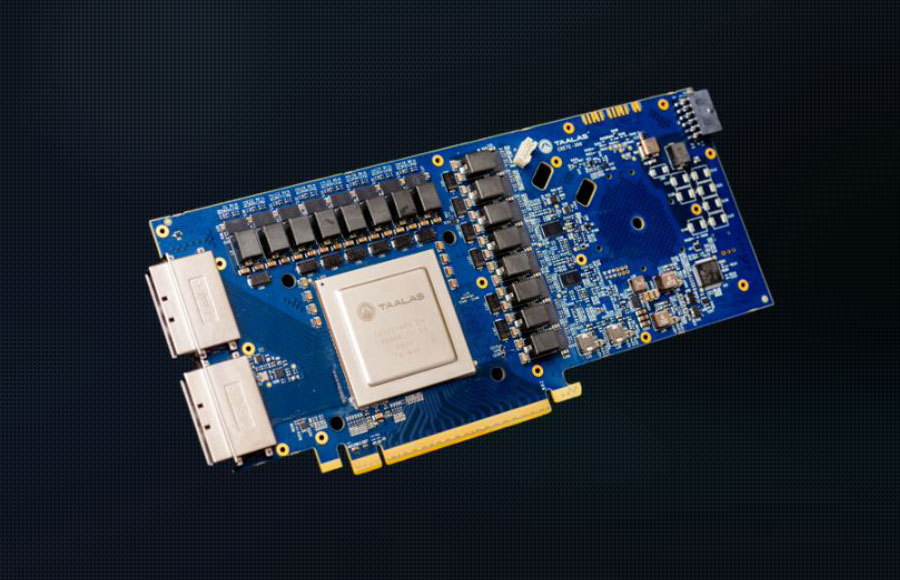
The Taalas HC1 AI processor. Illustration: Taalas
The trade-off
The obvious catch: if you need to run a different model, you need different silicon. Taalas supports LoRA fine-tuning on the HC1, but swapping to a completely different architecture requires a new chip. Only two metal layers need to change for each model variant, which reduces re-spin cost compared to a full redesign, explains The Register. Still, enterprises running a mix of AI workloads would need multiple chip variants — a real operational constraint.
For large cloud operators like Meta and Microsoft, which run the same models at enormous scale for search, recommendations, and translation, that rigidity is an acceptable trade for the cost savings. At data-center scale, cutting inference costs by 80% changes the economics of the entire AI stack.
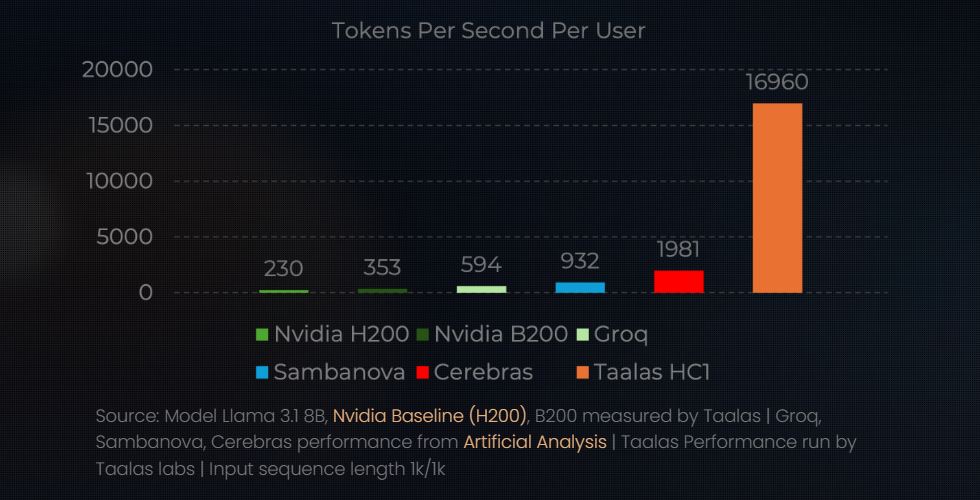
Chart comparing inference speed between the Taalas HC1 and competitors, measured in tokens per second per user. Illustration: Taalas
AMD's position
Lisa Su has been building AMD's AI portfolio through acquisition — Silo AI and ZT Systems preceded this deal. Taalas fits into AMD's Instinct and Helios roadmap as a specialized inference layer alongside its existing GPU lineup, not a replacement for it. Nvidia, meanwhile, closed a reported $20 billion deal for Groq in December 2025, signaling that both companies see the inference layer as the next major battleground. AMD is betting that specialized, model-locked silicon can undercut Nvidia's universal GPU approach on cost — at least for the workloads that never change.


