A robot learns a new skill from a 29-second video — no retraining required

A research team affiliated with X Square Robot has published a method that lets a robot pick up a new physical skill by watching one short video of a human doing it. Called HOST (Human-to-robot One-Shot Skill AcquisiTion), the system needs just 29 seconds to process a demonstration and attempt the task — no retraining, no hundreds of labeled examples. The catch: it still fails roughly four times out of ten.
The method
Most robot learning today works by feeding a neural network thousands of examples until the network's internal weights shift to encode the new behavior. That process is slow and expensive. HOST sidesteps it entirely by treating the video as a context prompt rather than training data. The model's weights stay frozen; instead, the system extracts what stage of a task the human has reached, maps that to the robot's own sensors and body geometry, and builds an action sequence on the fly.
The paper, posted to arXiv 2607.20033v3, benchmarks HOST against two baselines. Zero-shot performance — where the robot gets no demonstration at all — sits at 17% success. HOST pushes that to 62%. Against methods that require 50 separate demonstrations per task, HOST is claimed to be 507 times faster.
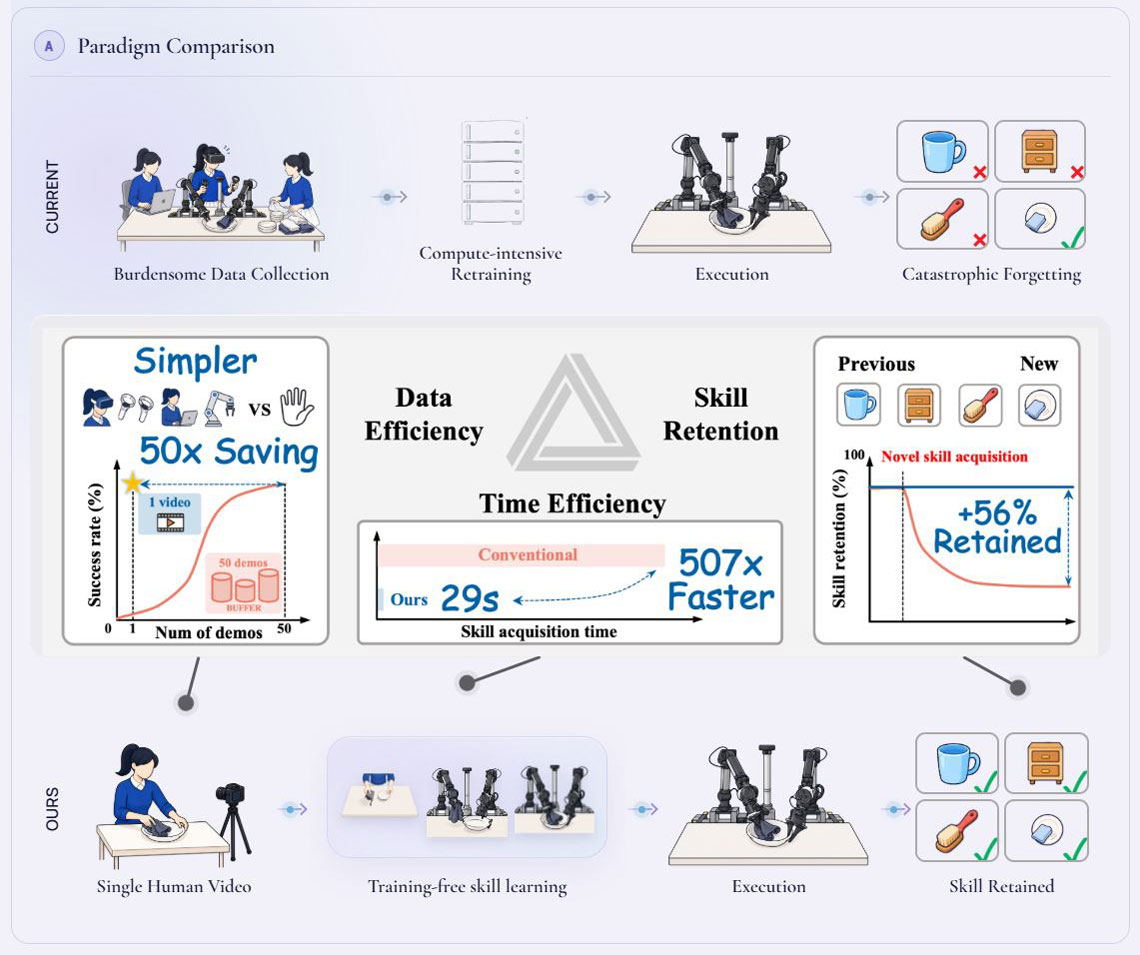
HOST maps a human hand trajectory from video to the robot's own body geometry, then chains actions without updating model weights.
The limits
62% is a respectable research result. It is nowhere near good enough for a factory floor. Automotive assembly lines typically demand 99.5% reliability; pharmaceutical packaging runs at 95% and above. Even optimistic estimates from manufacturing literature put the minimum viable threshold for industrial deployment at 85–90%, per Springer's Advanced Manufacturing Technology.
There is a second problem: the tests ran in controlled lab conditions with familiar objects on the developers' own hardware. Whether HOST generalizes to an unfamiliar room with different lighting, different objects, and different robot hardware is an open question the paper does not answer.
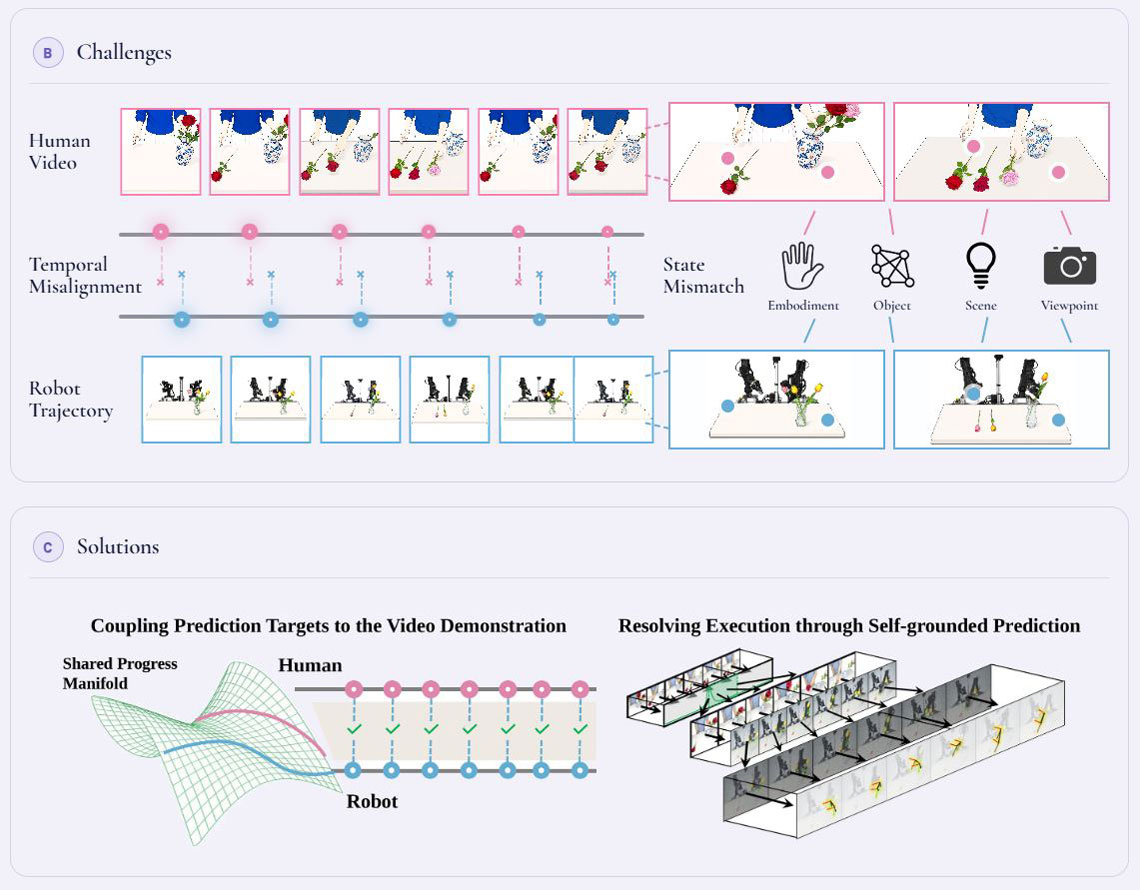
Lab tests show HOST reaching 62% success from a single 29-second clip — a jump from 17% zero-shot, but short of the 85–90% threshold manufacturers need.
What comes next
If independent researchers can replicate the results and push success rates toward that 85–90% band, HOST-style inference-time learning could be a practical tool for rapid robot reprogramming — exactly the capability short-run manufacturers lack today. A line supervisor could demonstrate a new packing task on video and have a manipulator attempt it minutes later, without calling in a programmer.
For now, the concept is the story. The team has indicated an open-source release, which means academic labs can start stress-testing it against messier real-world conditions. Meanwhile, well-funded rivals including LG — which is developing a bipedal humanoid with Nvidia technology for a 2027 debut — are betting on full-pipeline foundation models rather than frozen-weight shortcuts. Which approach scales better is still an open race.


