China sets the global rulebook for solid-state EV batteries

China's new solid-state battery standard took effect July 1, 2026, setting the first national technical benchmark for what can legally be called a solid-state EV battery. The standard — GB/T 43568-2026 — introduces a strict 0.5% weight-loss threshold that most current "semi-solid" batteries fail. While Chinese automakers are already running field trials, US and European rivals are still validating prototypes.
The 0.5% rule
The core test is straightforward: open the battery casing, expose it to 120°C for six hours, and measure how much mass it loses. Lose less than 0.5% and you have a true solid-state battery. Lose more and you don't — regardless of what the marketing says.
That threshold matters because the industry has long been blurry about terminology. The new standard draws a hard line between three categories: conventional liquid electrolyte batteries, hybrid solid-liquid cells (previously marketed as "semi-solid"), and genuine all-solid-state units. Testing of current hybrid products showed weight losses ranging from 1.68% to 10.33% — well above the cut-off. True solid-state prototypes stayed below 0.5%.
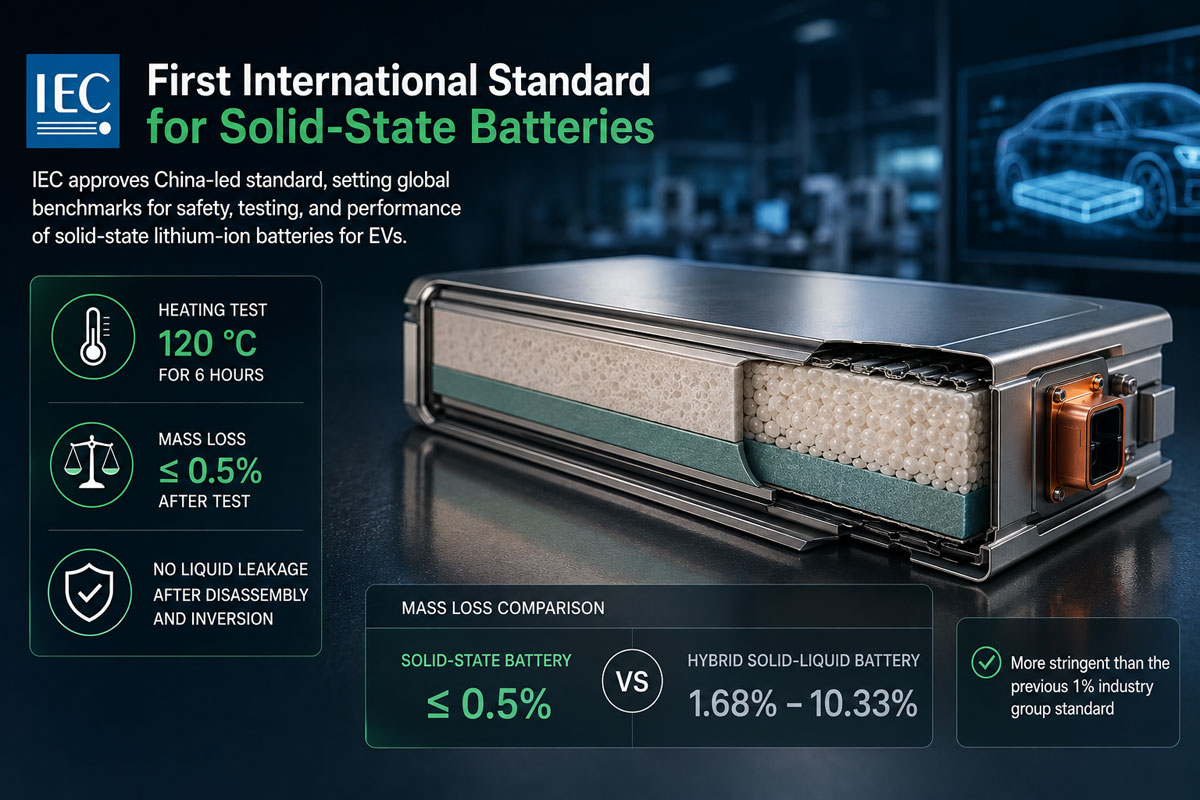
China's GB/T 43568-2026 standard classifies batteries into three categories, with a strict 0.5% weight-loss threshold separating true solid-state cells from hybrid alternatives.
Where Western rivals stand
Chinese manufacturers including Dongfeng, GAC, BYD, Geely, and FAW have already started installation trials. Dongfeng cells are hitting 350 Wh/kg; FAW has reached 500 Wh/kg with a claimed range of over 1,000 km on China's CLTC test cycle. That's not lab data — those are vehicles in the ground.
By contrast, US players like Solid Power and Samsung SDI are targeting mass production around 2030. European automakers — BMW among them — are still in partnership-based prototype validation. No equivalent EU or US performance standard with a comparable threshold exists yet, per Shanghai Metals Market (July 2026). Europe's solid-state battery market is projected to grow 44.6% annually through 2032, with Germany holding the largest share, notes MarketDataForecast (July 2026) — but growth projections don't close the gap with China's field-test head start.
One caveat worth noting
The source article describes GB/T 43568-2026 as the "first international standard approved by the IEC." That's not accurate. The IEC's working groups are still in early-stage research; no formal international adoption of this standard has been confirmed. What China has is its own national spec — significant in itself, given the scale of its EV market, but not yet a globally ratified benchmark. Experts from France, South Korea, and Japan contributed to the drafting process, reports CARNewsChina (Feb 2026), which may lay groundwork for future international alignment — but that step hasn't happened yet.
For now, the standard gives Chinese automakers a clear supplier checklist and shuts the door on vague "almost solid" marketing claims. Whether the rest of the industry writes its own rules or eventually converges on China's framework is the more consequential question.


