Europe's Arctic spaceport is perfectly placed — but EU red tape could lock it out

Europe is pouring record money into space — €22.3 billion in ESA funding for 2026–2028 alone — but its own rulebook may be hobbling the one launchpad best suited for the job. Norway's Andøya Spaceport sits inside the Arctic Circle, which makes it geometrically ideal for polar and sun-synchronous orbits used in reconnaissance, Earth observation, and climate monitoring. The catch: Norway is not an EU member, and that single fact creates a bureaucratic tangle with real strategic consequences.
The IRIS² problem
IRIS² is the EU's answer to Starlink — a 290-satellite constellation due to be operational by 2030 and managed by the SpaceRISE consortium. Current rules require launches under the programme to lift off from EU member-state territory. Non-EU sites are allowed only in what the European Commission describes as "exceptional cases." No EU legal text has publicly confirmed exactly what clears that bar, and neither the Commission nor SpaceRISE has stated whether Andøya qualifies.
That ambiguity matters. Munich-based Isar Aerospace is preparing the second flight of its Spectrum rocket from Andøya — a qualification mission backed by ESA that would make it the first commercial orbital launch from continental European soil. A successful flight would prove the site works. Whether it can then be used for strategic EU payloads is a separate, unresolved question.
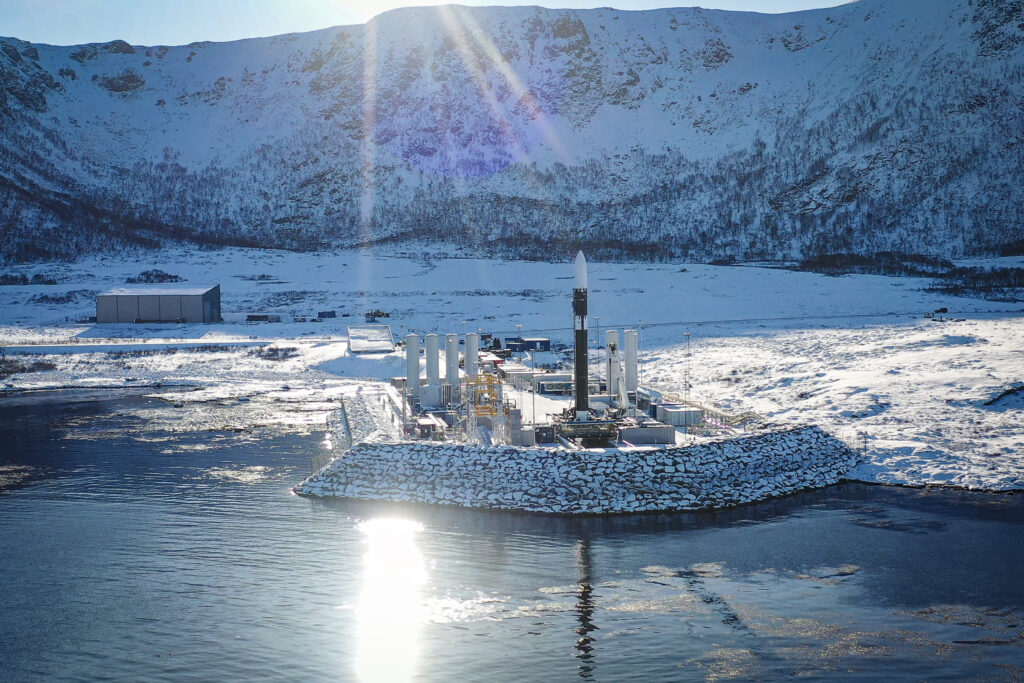
Money is flowing north anyway
The financial signals are hard to ignore. Germany has committed €35 billion to space and defence projects through 2030, with Arctic infrastructure listed as a strategic priority. German Chancellor Friedrich Merz visited Andøya in March 2026, a visible show of political support. ESA and Norway signed a letter of intent in November 2025 to establish a permanent Arctic Space Centre in Tromsø, with a formal opening targeted for 2027, per SpaceNews.
Meanwhile, a broader Arctic space cluster is quietly taking shape. Sweden is expanding the Esrange Space Center. Finnish company ICEYE is growing its radar-satellite network. Norway's KSAT is building the Hyper relay system for polar-band communications. The infrastructure is converging whether or not Brussels updates its rules.
The autonomy gap
The irony is hard to miss. Norway participates in Copernicus and Galileo, chairs ESA technology committees, and hosts critical ground stations — yet its spaceport sits outside the standard framework for Europe's flagship sovereign communications programme. The Arctic is becoming a unified strategic zone, with defence and logistics projects increasingly treated as a single system. Space policy hasn't caught up. Until the EU clarifies IRIS² launch-site eligibility, Andøya will remain an asset Europe funds indirectly but can't fully deploy.


