Samsung's UFS 5.0 doubles storage speeds — but you'll have to wait until 2027

Samsung's new UFS 5.0 flash memory chip hits read speeds of 10.8 GB/s — more than double what UFS 4.1 can manage. The company announced the chip on June 23, and while mass production doesn't start until Q4 2026, first devices are expected in early 2027. If you're buying a phone this year, nothing changes — but the next Galaxy S27 Pro or Ultra could be a different story.
The numbers
Sequential read tops out at 10.8 GB/s and write at 9.5 GB/s, according to the Samsung official press release. For context, UFS 4.1 maxes out around 4.3–4.8 GB/s. Power consumption drops by more than 40% over UFS 4.1, thanks to clock gating and multi-voltage tech. The physical chip is also 16.7% smaller than its predecessor, measuring just 7.5 × 13 × 0.9 mm, with capacity scaling up to 1 TB.
Samsung designed UFS 5.0 specifically for running large language models (LLMs) and other AI workloads directly on a device — no cloud connection required. The same chip is also aimed at XR headsets and wearables with embedded AI.
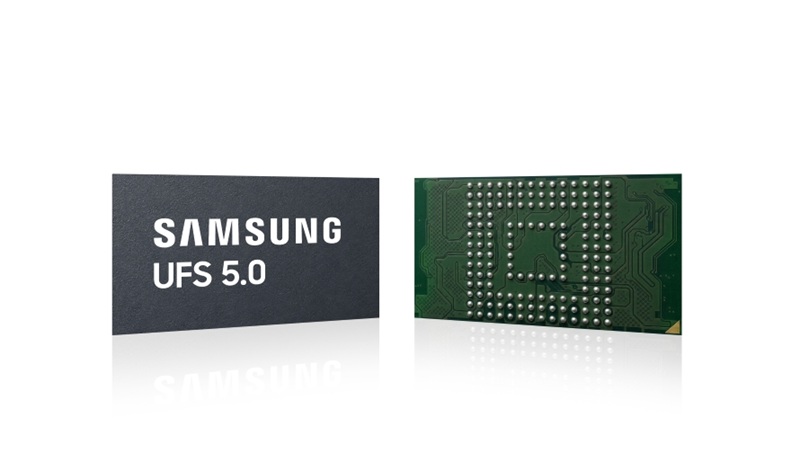
Samsung UFS 5.0 flash memory chip — 16.7% smaller than UFS 4.1 and up to 1 TB capacity.
What this means for your next phone
The catch is cost. Pairing UFS 5.0 with LPDDR6 RAM — the memory standard that matches its speed — could push component costs above $600 for RAM and storage alone, per WCCFtech. That makes it a flagship-only proposition for now. The standard Galaxy S27 and S27 Plus are likely to stick with UFS 4.1.
On the chip side, Qualcomm's Snapdragon 8 Elite Gen 6 and MediaTek's Dimensity 9600 Pro both already support UFS 5.0. That sets up a wave of compatible Android flagships, though the first US devices are realistically late Q1 or Q2 2027.
Apple uses its own proprietary NAND storage, so this standard doesn't apply to iPhones. Intel's x86 storage ecosystem is similarly separate.
The outlook
UFS 5.0 is a genuine step up for mobile storage — faster, smaller, and more power-efficient than what's in phones today. The on-device AI push makes the speed increase meaningful beyond raw benchmarks. The real question is how quickly the premium costs come down enough to reach mid-range phones.


