One chip to rule them all: Microchip's DSA504RT cuts spacecraft clock complexity

Microchip Technology has launched the DSA504RT, a radiation-tolerant programmable clock generator designed to consolidate the timing architecture of satellites and spacecraft. A single chip now does the job of multiple discrete oscillators, reducing board mass and cutting the number of components that can fail in orbit — where no repair crew is coming. The device went into limited sampling on June 25, 2026, per the Microchip press release.
Six outputs, one source
The DSA504RT integrates an analog phase-locked loop (APLL) with two fractional and two integer frequency dividers. That combination allows engineers to derive up to six independent clock signals from a single reference — each output independently configurable for frequency and signal type. Supported formats include CMOS, LVPECL, LVDS, and HCSL, covering everything from basic logic signals to high-speed differential interfaces used in modern compute platforms.
Jitter — the tiny phase fluctuations that corrupt high-speed data links — is rated at around 200 femtoseconds (measured over 12 kHz to 20 MHz). That is low enough to meet PCIe Gen 1 through Gen 7 standards, meaning the chip is already qualified for the fastest computing hardware heading to orbit in the coming years.
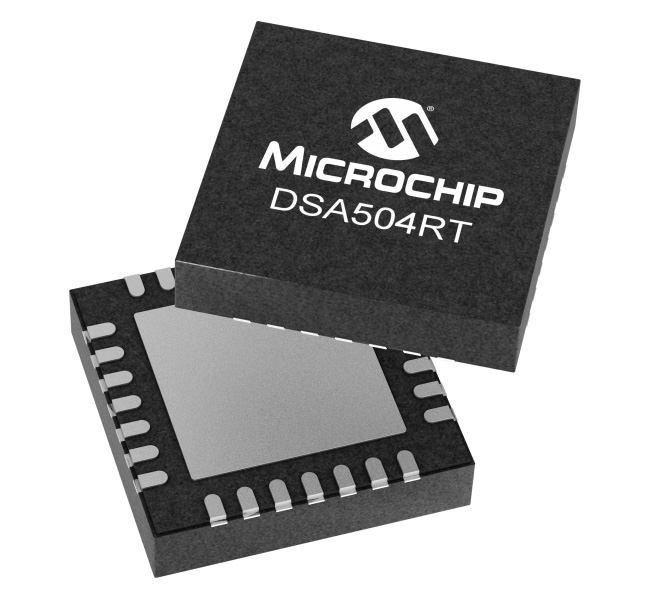
Built for where the radiation actually is
Space-grade electronics must survive conditions that destroy ordinary chips. The DSA504RT clears a single-event latch-up (SEL) threshold above 78 MeV·cm²/mg and handles a total ionizing dose (TID) up to 50 krad(Si) — both standard benchmarks for low-Earth orbit and beyond. The operating temperature range runs from −55 °C to +125 °C, covering the thermal swings of deep-space shadow and direct solar exposure alike. Supply voltage flexibility (1.71 V to 3.63 V) makes it straightforward to pair with existing power rails.
Two package options are available: a hermetic ceramic CQFP32 for long-duration deep-space missions, and a plastic QFN28 for less demanding aerospace or ground-based defense applications. The same internal architecture works in both, so a design validated in one package can migrate to the other without reworking the schematic.
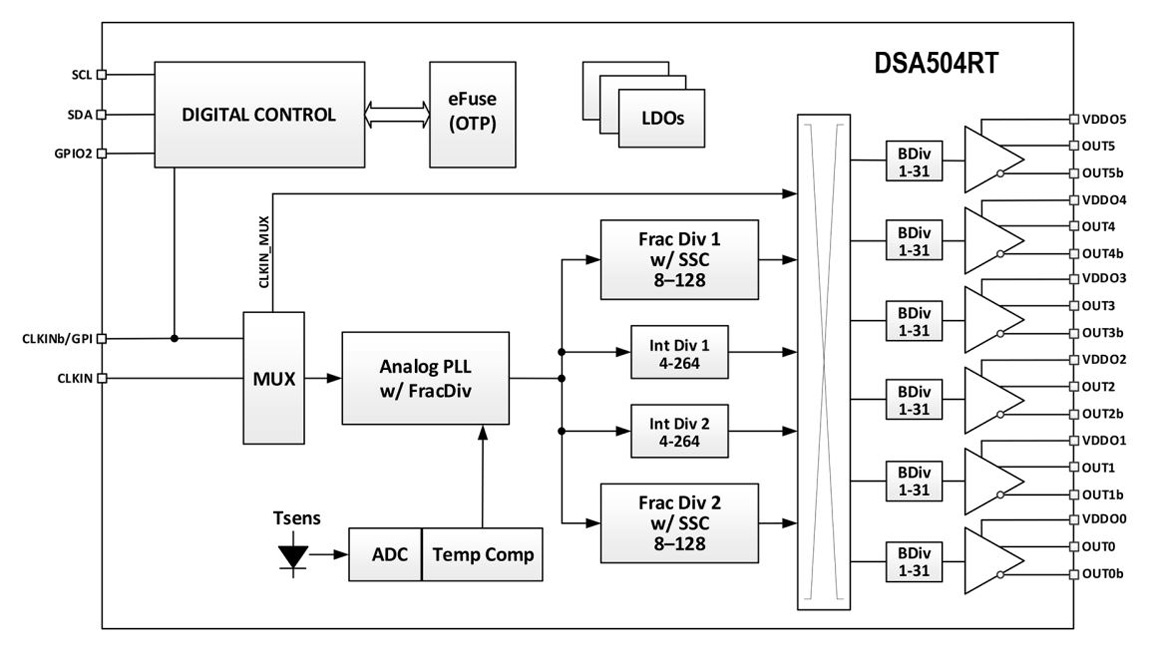
DSA504RT functional block diagram. Illustration: Microchip
Where it fits in the market
U.S. aerospace primes — Boeing, Lockheed Martin, SpaceX — are under constant pressure to trim bill-of-materials count and system weight. The global radiation-hardened electronics market sits at roughly $1.9 billion in 2026 and is growing at around 5–6% a year, driven largely by LEO satellite constellations and defense modernization. The DSA504RT targets that pressure point directly.
The closest rival is Texas Instruments' LMX1906-SP, which offers 15 outputs and sub-100 femtosecond jitter for applications demanding extreme precision. The DSA504RT trades output count for simpler integration and a lower cost-per-channel — a sensible tradeoff for most spacecraft timing buses rather than the most precision-critical payloads. Aero-Defence.Tech notes that consolidation, not raw jitter performance, is the main design goal here.
Pricing has not been disclosed, and no firm production timeline or volume commitments have been announced. Samples are available on request from Microchip directly.


