Best Dash Cams with Parking Mode (Face-Off Time)
Most dash cam shopping happens with driving in mind, yet the footage people actually need most urgently often gets recorded while the car is sitting still and completely unattended. A shopping cart dents a door, a hit-and-run clips a bumper, someone keys a panel out of spite, and none of it happens at highway speed. Parking mode is the feature built specifically for that gap, and it's also the feature most likely to disappoint a first-time buyer once they get the box open and realize the camera doesn't actually do it out of the box.
That gap between the marketing copy and the actual setup is the core story with this category. A dash cam can print "24H Parking Mode" across the front of its packaging while quietly requiring a separate hardwire kit, a specific power source, and sometimes a subscription before that feature does anything at all. I've unboxed enough of these to know the spec sheet rarely spells that out clearly, so the five cameras below get judged as much on what parking mode actually requires to work as on the video quality once it does. Resolution numbers get plenty of attention elsewhere online, but they rarely tell the whole story of what happens once a car is locked and walked away from.
Here are my two top picks for the best dash cam with parking mode:
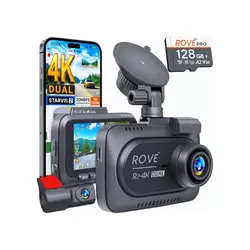
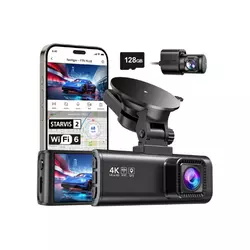
Table of Contents:
- Best Dash Cam with Parking Mode: Buying Guide
- Top 5 Dash Cams with Parking Mode in 2026
- Best Parking Mode Dash Cams: Comparison
- ROVE R2-4K DUAL
- REDTIGER F7NP
- Vantrue N5S
- VIOFO A329S 2CH
- Garmin Dash Cam X310
- Parking Mode Dash Cams: FAQ
Best Dash Cam with Parking Mode: Buying Guide
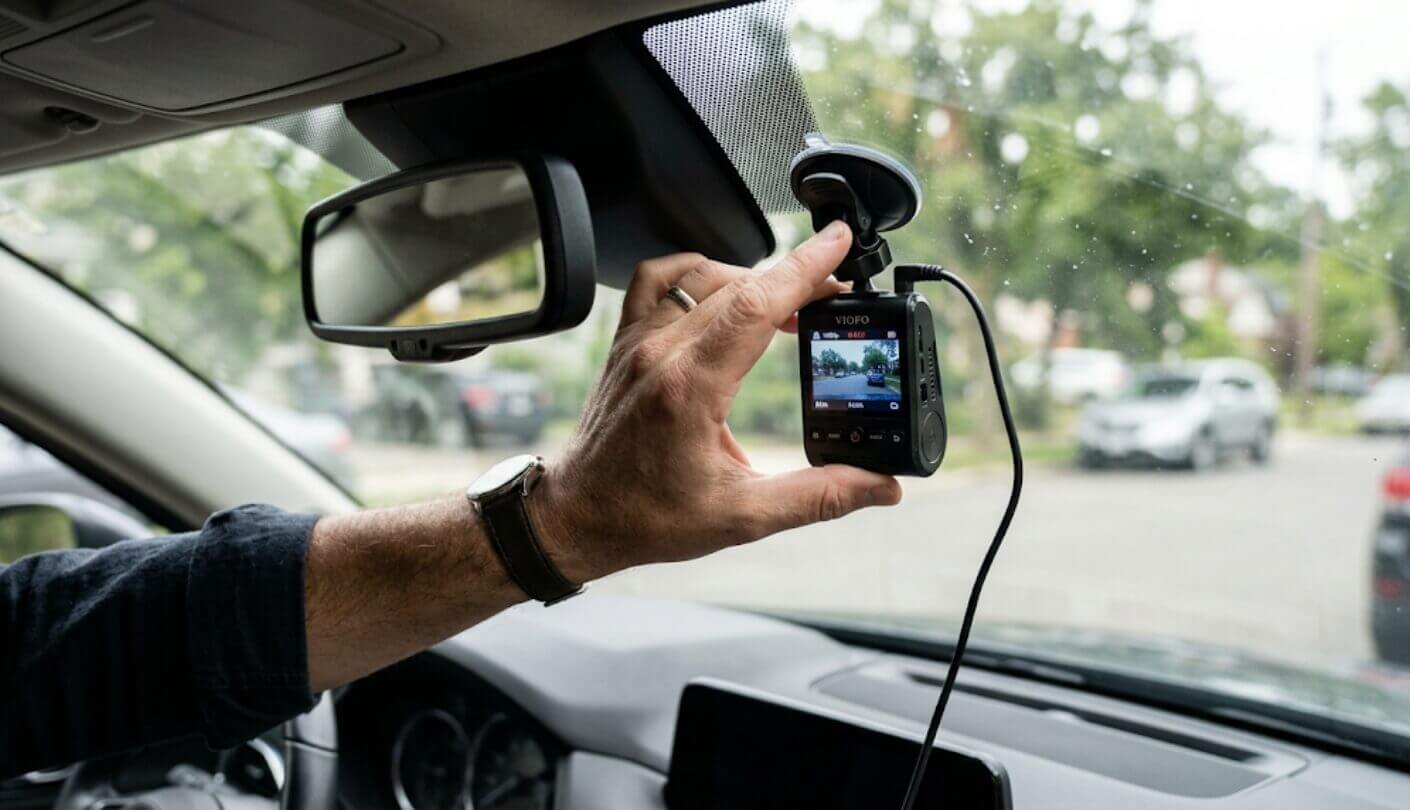
Parking mode sounds like a single feature on a spec sheet, but it's really a stack of separate decisions: what powers the camera when the engine is off, how it decides to start recording, and how much of that decision the buyer has to assemble themselves after checkout.
Hardwire Kits and What "Parking Mode" Actually Requires
The single most common surprise in this category is that "24-hour parking mode" printed on a box almost never means the feature works the moment the camera is plugged in. Four of the five cameras in this roundup need a separate hardwire kit, sold on its own, wired into the car's fuse box to keep power flowing after the ignition turns off. Skip that purchase and the parking mode toggle in the menu simply does nothing.
A hardwire kit sold separately from the camera is the rule in this category, not the exception. Treat that kit as part of the real purchase price rather than an optional accessory, since parking mode is inert hardware without it.
Budgeting for the hardwire kit as part of the actual cost of the camera, rather than as an optional accessory, avoids the letdown of opening the box expecting a working feature and finding a cable missing. I always check whether a listing bundles the kit or sells it as a separate line item before recommending a camera for this specific use case, since the difference changes what someone is actually paying to get parking mode running, sometimes by a meaningful margin once the kit's own price is added on top of the camera itself.
Buffered vs Motion-Only vs Time-Lapse Recording
Not every parking mode captures the same moment. A buffered mode records continuously in the background and saves footage from several seconds before an event alongside the seconds after, which matters enormously if a hit-and-run driver is already backing away by the time a jolt triggers the camera. A motion or impact-only mode waits for a trigger and only then starts recording, meaning the first second or two of an incident can be missed entirely.
Time-lapse recording, meanwhile, trades detail for battery life, capturing a frame or two per second instead of full video, which is fine for confirming that nobody touched the car overnight but far less useful for identifying a face or a plate. Matching the mode to the actual risk, whether that's a shared driveway or a sketchy parking garage, matters more than chasing whichever camera claims the most parking mode options on its box. I tend to trust a camera with one well-implemented buffered mode over one listing four options on its packaging, since the quality of any single mode usually matters more than the total count, and a long feature list can sometimes hide the absence of the one mode that actually matters most.
Supercapacitor vs Battery Power in Parking Mode
A parked car left in direct sun can turn its interior into an oven, and that heat is exactly the environment most lithium-ion batteries handle poorly over years of repeated cycles. Most dash cams built with parking mode in mind use a supercapacitor instead of a battery specifically because it tolerates heat and cold far better and doesn't degrade the same way after thousands of charge cycles.
A supercapacitor won't power a camera on its own the way a battery can, but it survives years of heat cycling in a parked car far better than lithium-ion cells do. That trade-off is why most parking-mode-focused cameras lean on capacitors rather than batteries.
The trade-off is that a supercapacitor alone can't power a camera for long once the car's constant power source is cut off, which is why the hardwire kit's own voltage-cutoff protection matters just as much as the capacitor inside the camera. I still lean toward supercapacitor models for anything living in a car full-time, since a rechargeable battery can keep a camera running briefly on its own without any external power at all, a genuinely different use case than the always-hardwired setup most of these cameras assume.
Storage Endurance for 24/7 Recording
Parking mode writes to a memory card constantly, cycling through footage far more aggressively than normal driving footage does, and a bargain-bin microSD card tends to fail under exactly that kind of sustained write load. High-endurance cards rated specifically for dash cam or security camera use hold up considerably longer than a standard consumer card pulled from a phone or tablet.
Storage capacity matters just as much as endurance, since a camera capturing high-bitrate 4K footage around the clock fills a card far faster than one used only during commutes. I'd rather oversize the card upfront than discover a dead zone in the footage right when an incident actually happens, and the cost difference between a mid-size card and a genuinely high-capacity one is small compared to the cost of missing the one clip that mattered. Cameras that support external SSD storage, like the VIOFO in this comparison, sidestep the endurance question almost entirely, since an SSD handles sustained write cycles far better than any microSD card on the market.
Voltage Cutoff and Battery Drain Protection
Wiring a dash cam directly into a car's electrical system introduces a risk that wasn't there before: a dead battery from a camera that quietly drained power while the car sat for a few days. Hardwire kits with a built-in low-voltage cutoff monitor the battery's charge and shut the camera off automatically before it drains the car below what's needed to start the engine.
A hardwire kit without voltage-cutoff protection can leave a car with a dead battery after just a few days of parking mode running unattended. Checking for that specific feature matters more than comparing camera brands once the wiring is actually in place.
Not every hardwire kit handles this the same way, and the more sophisticated ones display the current voltage in real time rather than cutting power silently with no indication of what happened. I look for that voltage readout specifically before recommending any kit, since anyone leaving a car parked for more than a day or two at a stretch benefits from confirming the cutoff protection actually works rather than assuming it does.
Top 5 Dash Cams with Parking Mode in 2026
Hardwire requirements, buffered recording, and power source all shift which of these five actually protects a parked car the way its packaging implies, so the picks below weigh those factors as heavily as raw video resolution. A camera that looks identical to a competitor on a spec sheet can behave very differently once the engine actually shuts off, and that gap is the whole point of this list.
- Sony STARVIS 2 Sensor
- 4K Front Recording
- Free 128GB Card
- Supercapacitor Power
- Three Parking Modes
- Wide 170° Front Lens
- Free Memory Card
- Supercapacitor Power
- 18-Month Warranty
- Bright F1.5 Aperture
- Four-Channel Coverage
- Buffered Motion Detection
- Dual Interior Cameras
- 1TB Storage Support
- 5GHz WiFi Speed
- True 4K 60FPS
- Buffered Parking Mode
- Low-Power Impact Detection
- Wi-Fi 6 Speed
- 4TB SSD Support
- Built-In Battery
- Touchscreen Interface
- Voice Control
- Integrated Polarizer
- Compact Single Unit
Best Parking Mode Dash Cams: Comparison
The numbers below focus on what actually determines how well each camera performs once the engine shuts off, not just how sharp the daytime footage looks:
| Specification | ROVE R2-4K DUAL | REDTIGER F7NP | Vantrue N5S | VIOFO A329S 2CH | Garmin X310 |
| Channels | 2CH (front + rear) | 2CH (front + rear) | 4CH (front + rear + 2 cabin) | 2CH (front + rear) | 1CH (front only) |
| Front Resolution | 4K native, 30fps | 2.5K native, upscaled to 4K | 2.7K native, 30fps | 4K native, 60fps | 4K native, 30fps |
| Front Sensor | Sony STARVIS 2 | Sony IMX335 | Sony STARVIS 2 IMX675 | Sony STARVIS 2 IMX678 | Garmin Clarity |
| Parking Mode Type | Time-lapse, motion, collision | Time-lapse or G-sensor only | Buffered motion + 3 more modes | Buffered + hybrid + low-power impact | Motion-triggered only |
| Hardwire Kit | Sold separately | Sold separately | Sold separately | Sold separately | Sold separately |
| Power Source | Supercapacitor | Supercapacitor | Supercapacitor | Capacitor | Li-ion battery (20 min) |
| Wi-Fi | 5GHz, 20MB/s | 5.8GHz, 20MB/s | 5GHz | Wi-Fi 6 (5GHz + 2.4GHz) | Not band-specified |
| Max Storage | 1TB microSD | Not specified | 1TB microSD | 4TB SSD or 512GB microSD | 512GB microSD |
None of these five ships ready to run parking mode straight out of the box, which is easy to miss when every listing prints "24H Parking Mode" in bold letters right on the front.
ROVE R2-4K DUAL Review
Editor's Choice
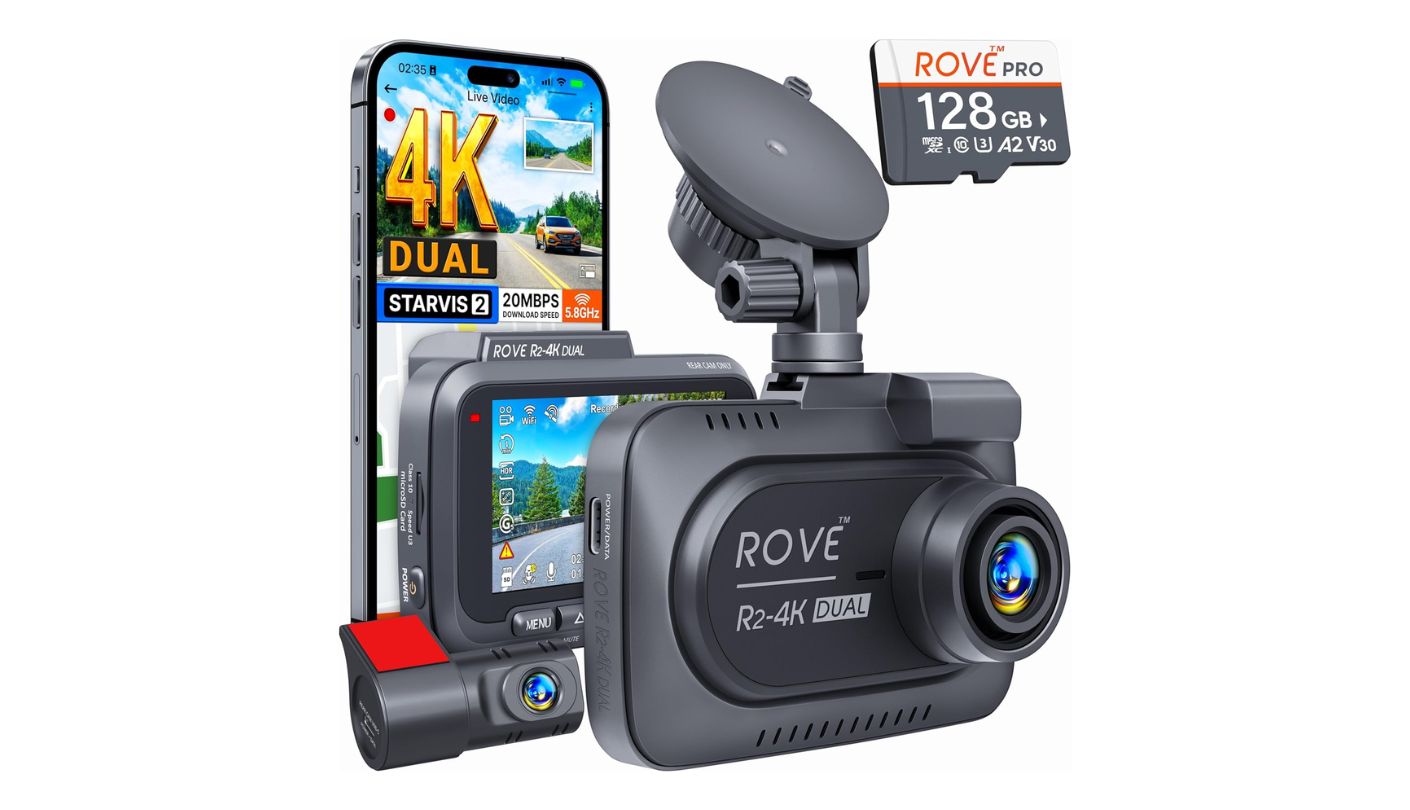
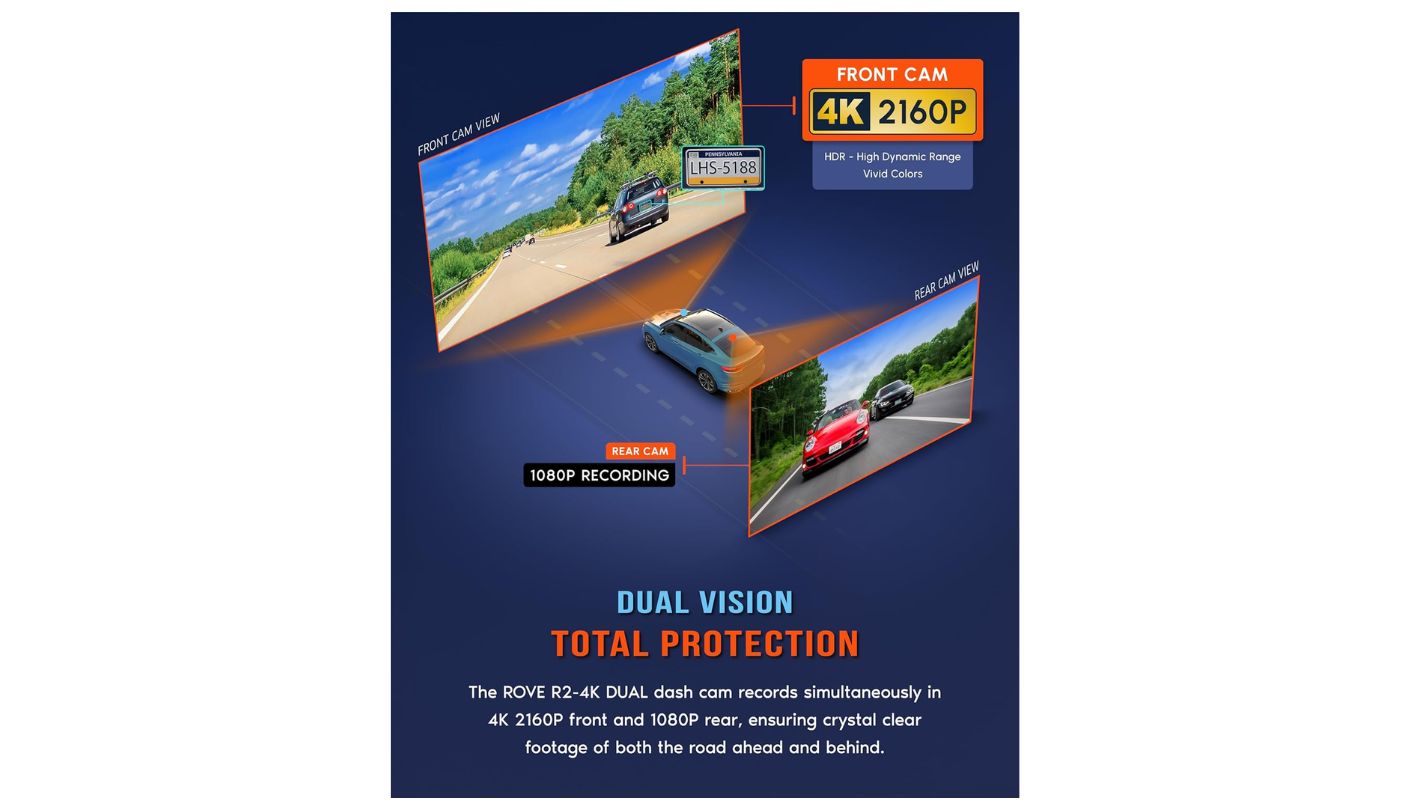
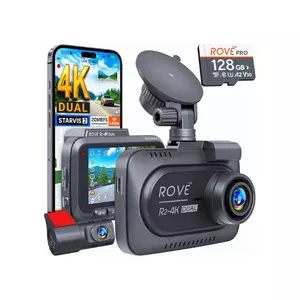
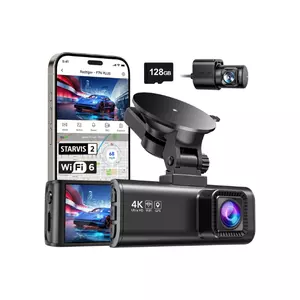
A Sony STARVIS 2 sensor paired with a free 128GB card is not the combination I expected to find on a camera priced the way the ROVE R2-4K DUAL is, since both usually show up several tiers higher in this category. The front camera records true 4K at 3840x2160, and the rear covers a standard 1080p feed, giving a front-heavy setup that favors detail on the road ahead over matching resolution on both ends.
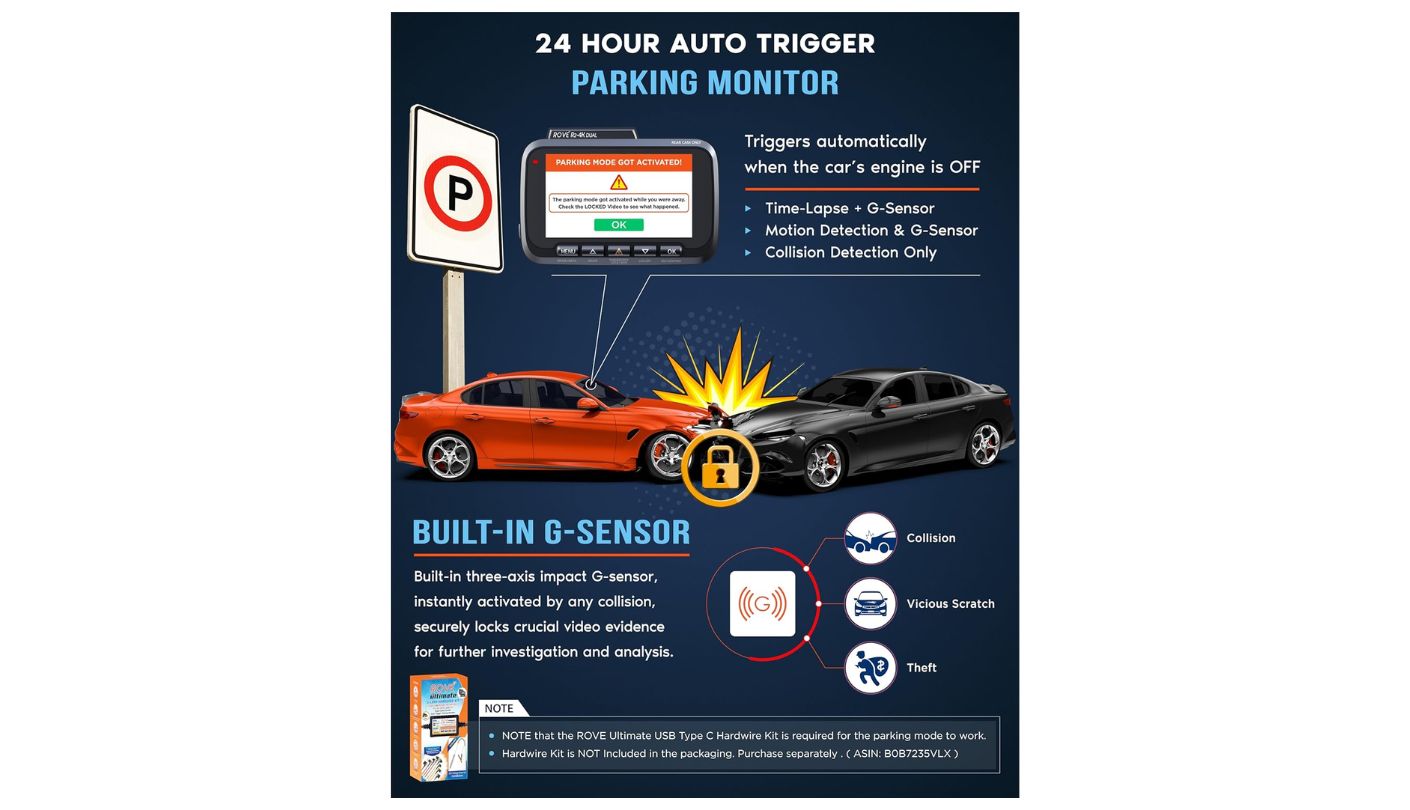
Parking mode here runs through three configurable options: 1fps time-lapse, motion detection, and collision detection, all triggered automatically once the camera senses the ignition has turned off. None of the three is a true buffered mode that saves footage from before an event, which puts it a step behind the more advanced parking implementations later in this roundup, though the voice alert confirming a parking mode event occurred is a small touch that saves a manual scroll through footage every morning.
The ROVE Ultimate Hardwire Kit is required for any of this to function and isn't included in the box, a pattern that holds across every camera on this list. Once wired in, the supercapacitor handles temperature extremes from -4°F to 140°F according to ROVE's own specifications, a wider range than a lithium battery would tolerate sitting in a hot car through a summer afternoon.
WiFi tops out at a claimed 20MB/s download speed over the 5GHz band, quick enough that pulling a full event clip off the camera and into the ROVE app rarely feels like a wait. Storage support up to 1TB gives plenty of headroom for anyone running parking mode continuously rather than just during the workday commute.
The 3-inch IPS screen on the back makes reviewing footage on the spot straightforward without pulling out a phone, and the trim tool and mounting hardware included in the box cover a full DIY install without needing to source anything extra beyond the hardwire kit itself. For a first dash cam purchase, the amount of usable hardware included at this price point is hard to match elsewhere in this comparison.
Pros:
- Sony STARVIS 2 Sensor
- 4K Front Recording
- Free 128GB Card
- Supercapacitor Power
- Three Parking Modes
Cons:
- No Buffered Recording
- Kit Sold Separately
Summary: The included storage and sensor quality do a lot of the heavy lifting here, and for anyone who doesn't specifically need buffered pre-event footage, the three-mode parking setup still covers the basics without asking for a second purchase beyond the hardwire kit.
REDTIGER F7NP Review
Best Overall
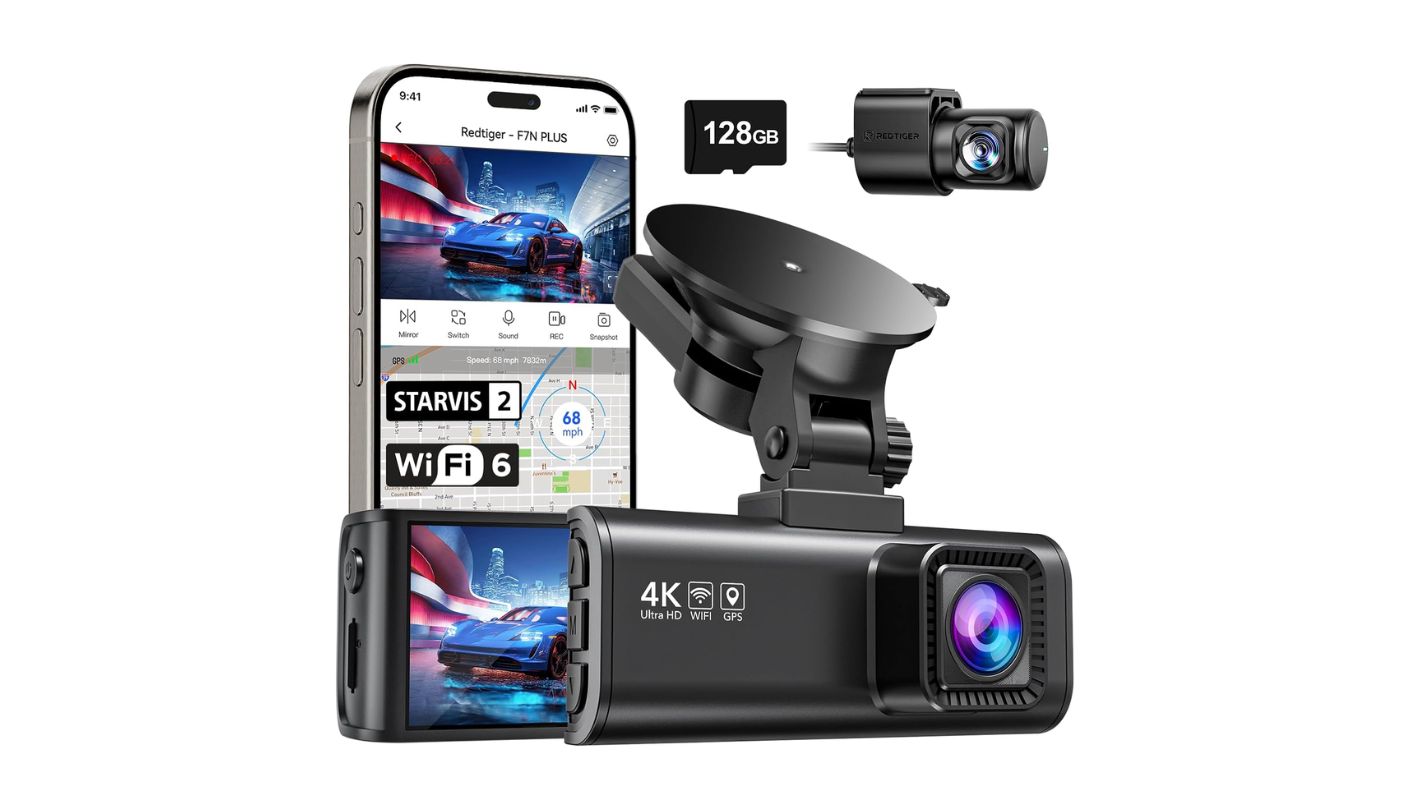
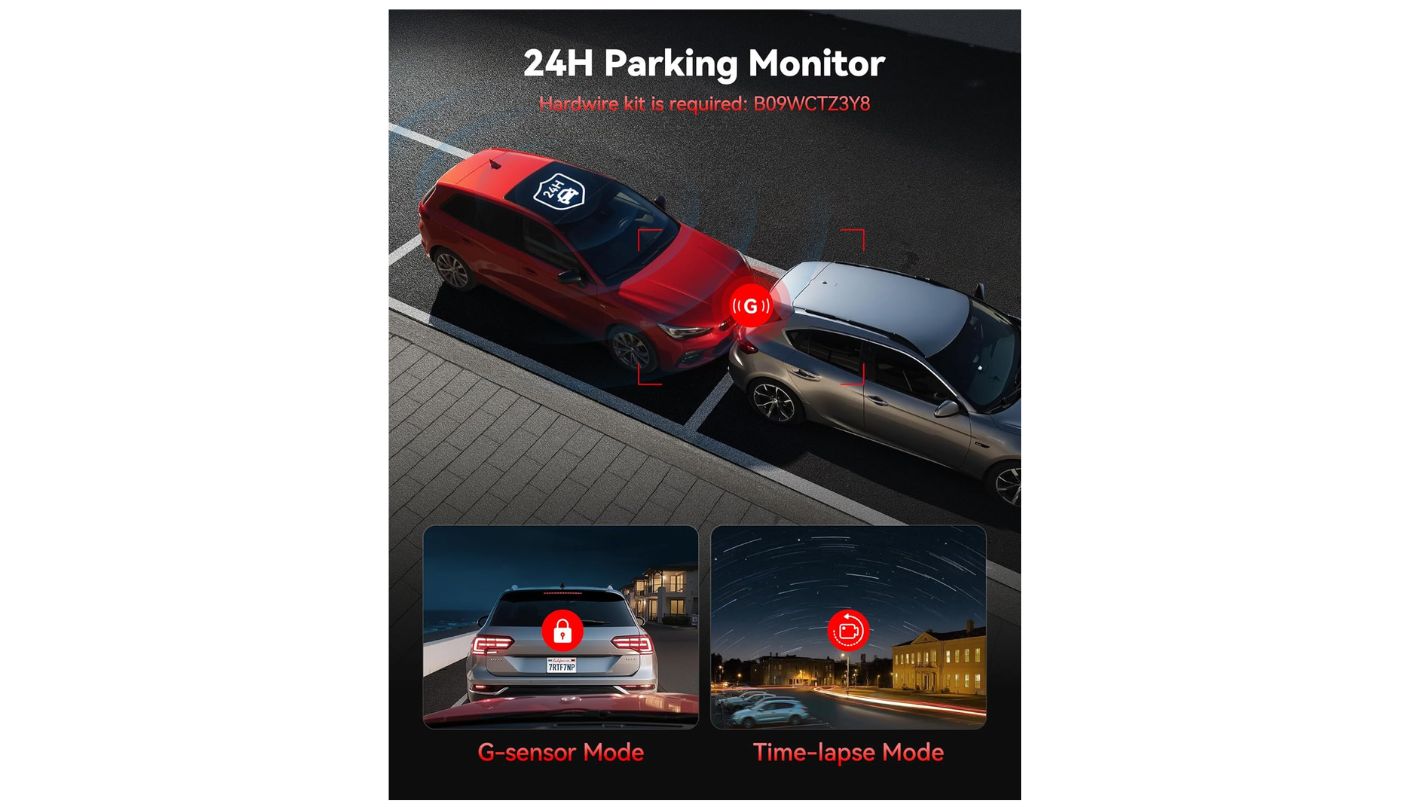
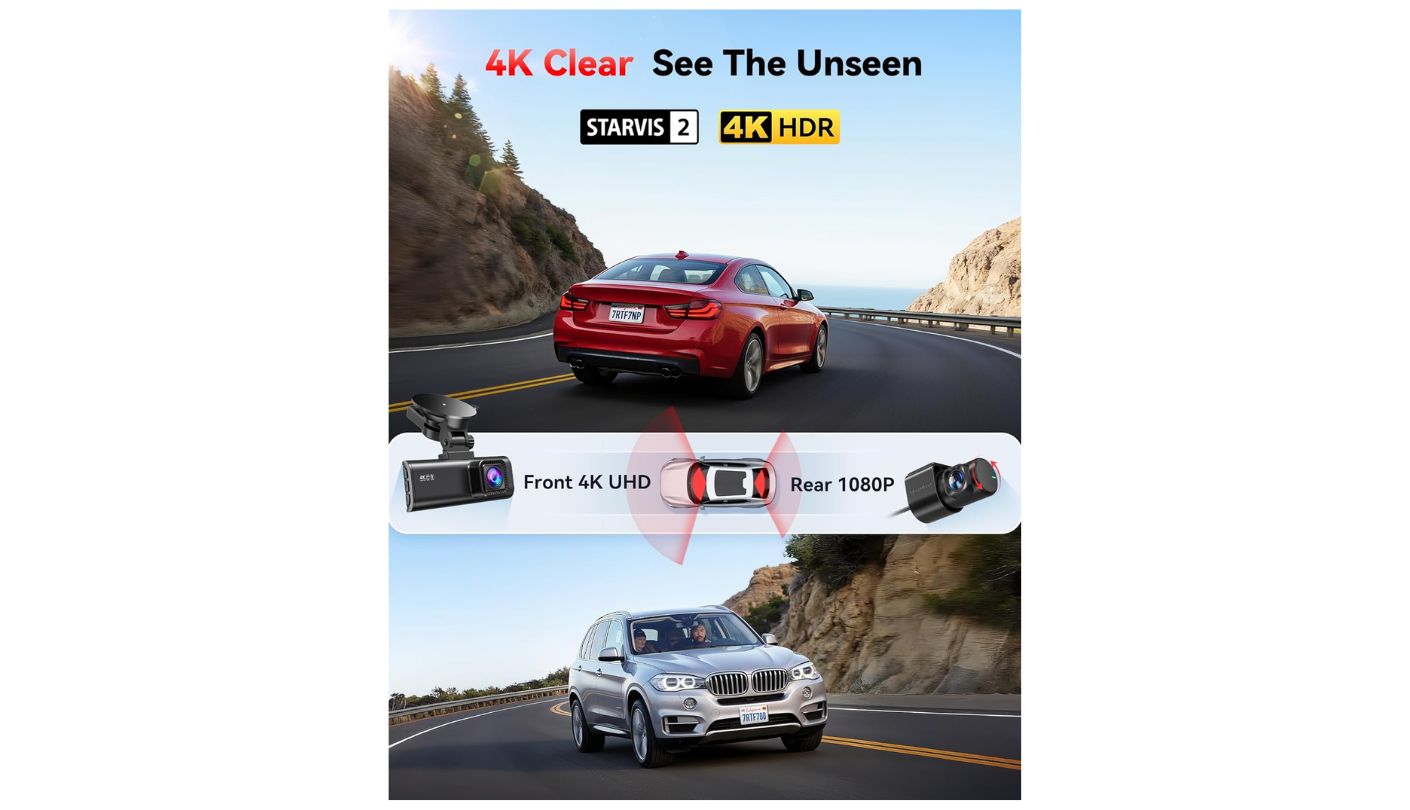
Here's something worth knowing before checking out: the REDTIGER F7NP's "4K" front camera isn't native 4K at all. It uses a Sony IMX335 sensor with a true resolution of 2592x1944, then upscales that footage to 3840x2160 through interpolation before saving it. The result still looks reasonably sharp in daylight, but it's a meaningfully different claim than the true 4K sensors found on a couple of the other cameras in this roundup.
That's a significant asterisk on a camera that remains one of the best-selling dash cams on Amazon, and the rest of the spec sheet explains why it sells as well as it does. The 170° front lens is the widest angle in this comparison, the F1.5 aperture pulls in more light than most competitors at night, and the free memory card included in the box means it's usable straight out of the packaging for normal driving footage.
Parking mode is where the compromises catch up with it. Independent testing has found the F7NP offers only time-lapse recording or G-sensor-triggered clips, without any buffered mode and without motion detection as a separate trigger option, which puts it behind both the ROVE and the more advanced cameras later in this list on parking sophistication specifically. The hardwire kit needed to use any of it is, again, sold separately.
A supercapacitor handles the power side, rated for reliable operation from -4°F to 158°F, and the 18-month warranty runs longer than the standard coverage on some pricier competitors. WiFi runs on the 5.8GHz band at a claimed 20MB/s, matching the ROVE's download speed almost exactly.
The companion app has drawn some criticism for occasional connection hiccups, and the suction cup mount has come up in owner feedback as less secure over time than the adhesive options used elsewhere in this comparison. Neither issue is unusual for a camera at this price, but they should factor into expectations before assuming the whole package matches the strength of the daytime footage.
Pros:
- Wide 170° Front Lens
- Free Memory Card
- Supercapacitor Power
- 18-Month Warranty
- Bright F1.5 Aperture
Cons:
- Not True 4K
- Basic Parking Modes Only
Summary: The sales numbers make sense once the price and the wide-angle daytime footage are weighed against the upscaled sensor underneath, but anyone buying specifically for strong parking mode coverage should treat this as the entry-level option in that department, not the flagship its popularity might suggest.
Vantrue N5S Review
360° Coverage
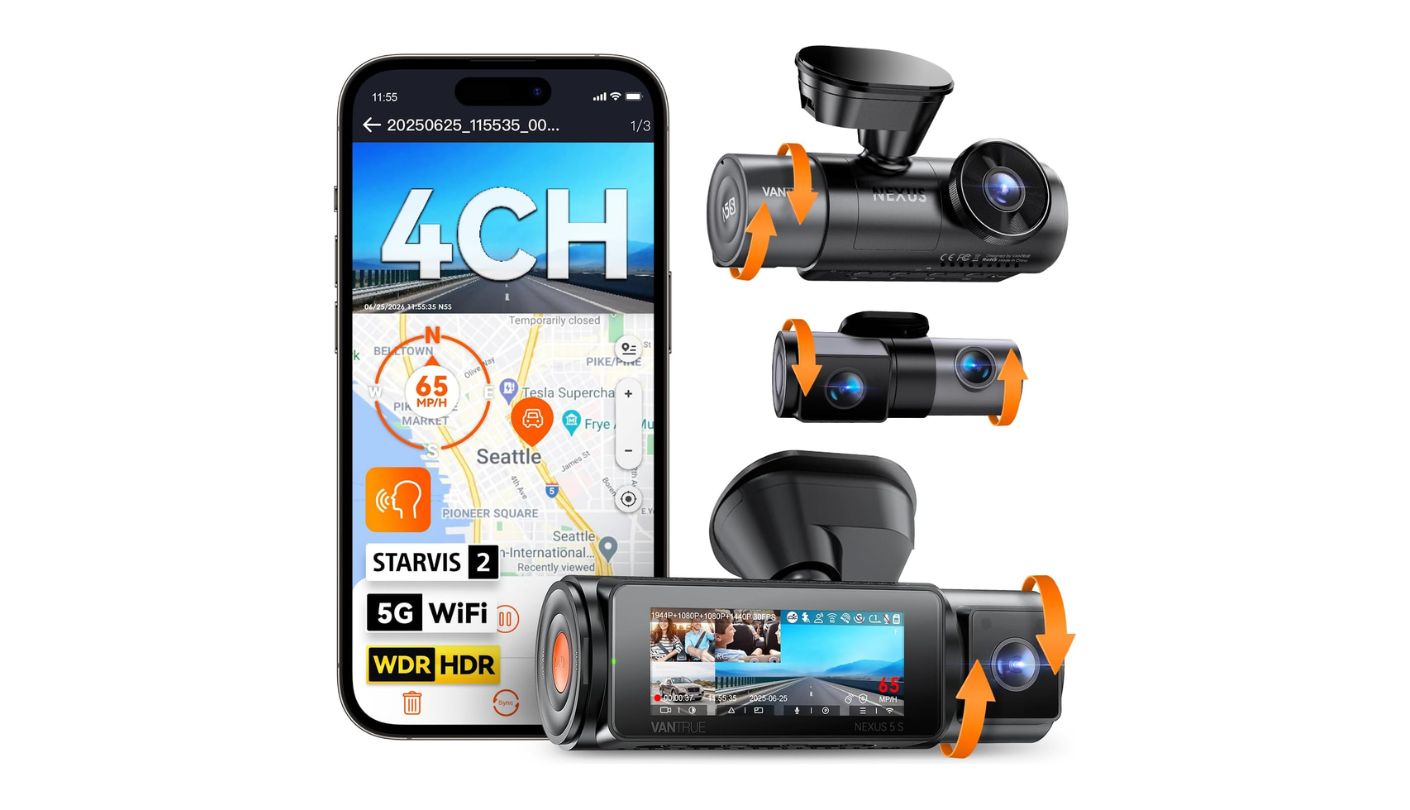
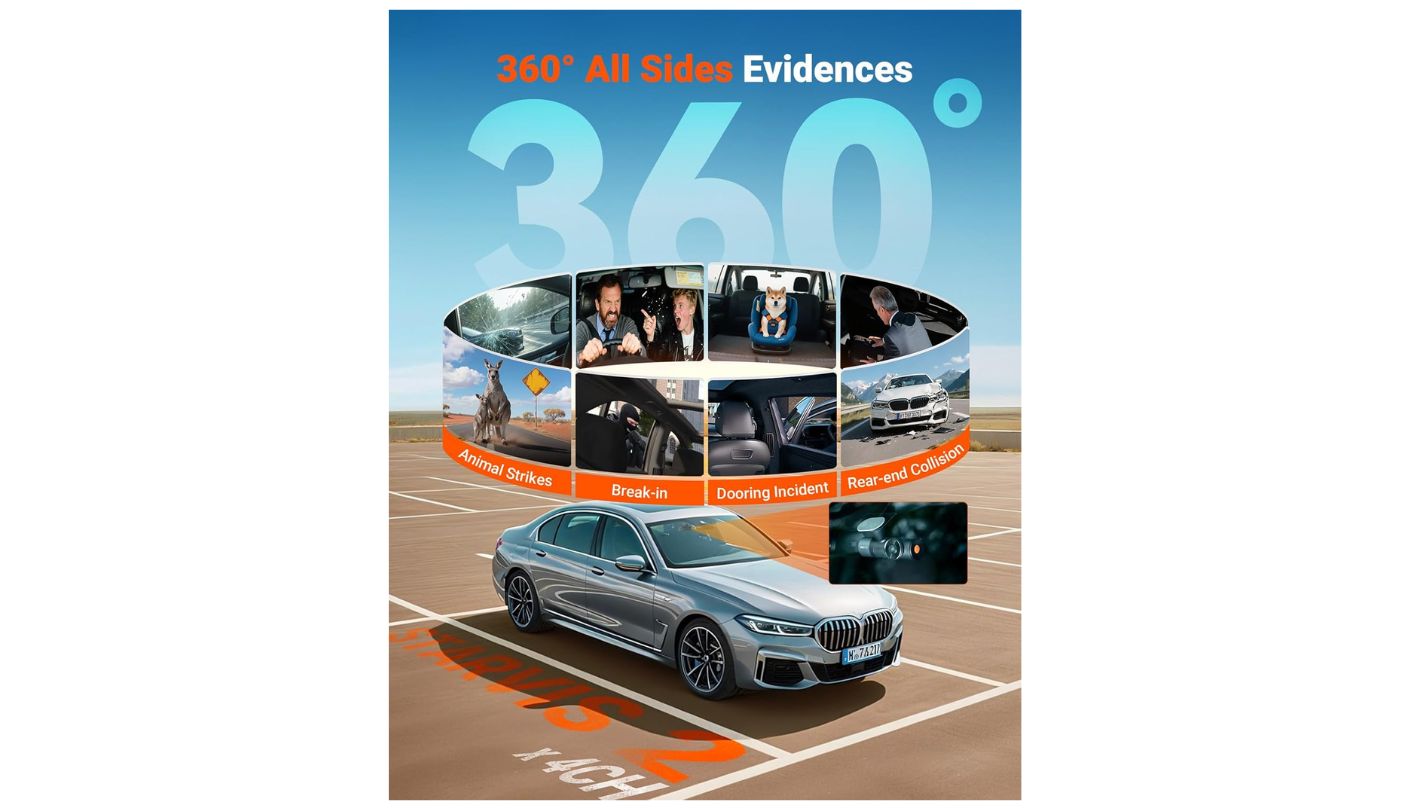
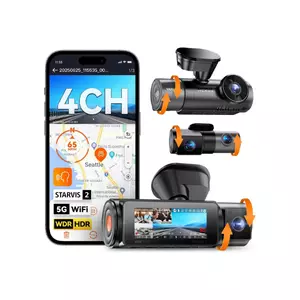
Picture a rideshare driver who needs proof of what happened not just ahead of the car but inside it, from both the front seat and the back. That's the exact scenario the Vantrue N5S is built around, with four separate lenses covering the road ahead, the view behind, and two interior angles from front and rear camera units.
Each of the four channels runs a Sony STARVIS 2 sensor, with the front and rear handling exterior duties at 2.7K and 1440p respectively, while the two interior lenses record at 1080p with infrared LEDs for visibility after dark. Independent testing rates the N5S as the strongest 4-channel dash cam currently available on video quality, though that same testing flags night footage as merely adequate rather than exceptional given how much processing power four simultaneous feeds demand.
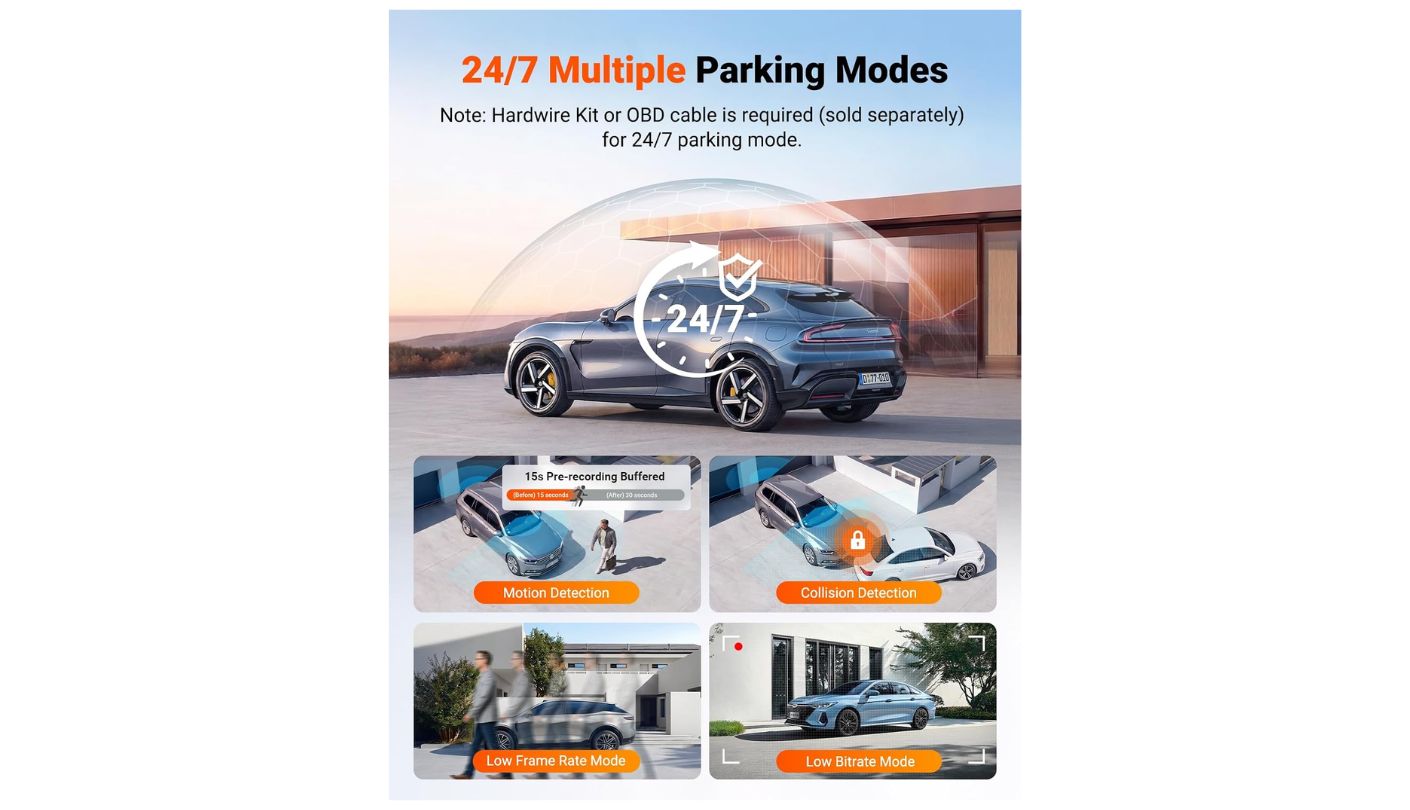
Parking mode is genuinely more advanced here than on the ROVE or REDTIGER, with a true buffered motion detection mode that saves 10 seconds of footage before a triggering event alongside what comes after, plus separate collision detection, low bit rate, and low frame rate options. A hardwire kit remains a separate purchase, as it does across this entire roundup, but the mode selection once it's connected is a meaningful step up in event capture quality.
5GHz WiFi handles the app connection, and storage support scales up to 1TB, useful given how much footage four channels running around the clock can generate. The trade-off for all that coverage is bulk: each camera unit is noticeably larger than the single-lens setups elsewhere in this roundup, which is a fair price for genuine 360-degree coverage but something to measure against a specific windshield before ordering.
Voice control rounds out the feature set, letting a driver lock an important clip or take a snapshot without reaching for the screen mid-drive, and the 18-month warranty matches the longer coverage window offered on the REDTIGER. No card ships in the box, which is worth budgeting for separately given how much storage four simultaneous channels tend to consume over a normal week of driving and parking combined.
Pros:
- Four-Channel Coverage
- Buffered Motion Detection
- Dual Interior Cameras
- 1TB Storage Support
- 5GHz WiFi Speed
Cons:
- Hardwire Kit Extra
- Weaker Night Video
Summary: Four camera angles solve a problem the other cameras on this list simply don't address, and for rideshare or family use where cabin coverage matters as much as the road, that trade-off is worth the extra bulk.
VIOFO A329S 2CH Review
Smartest Parking
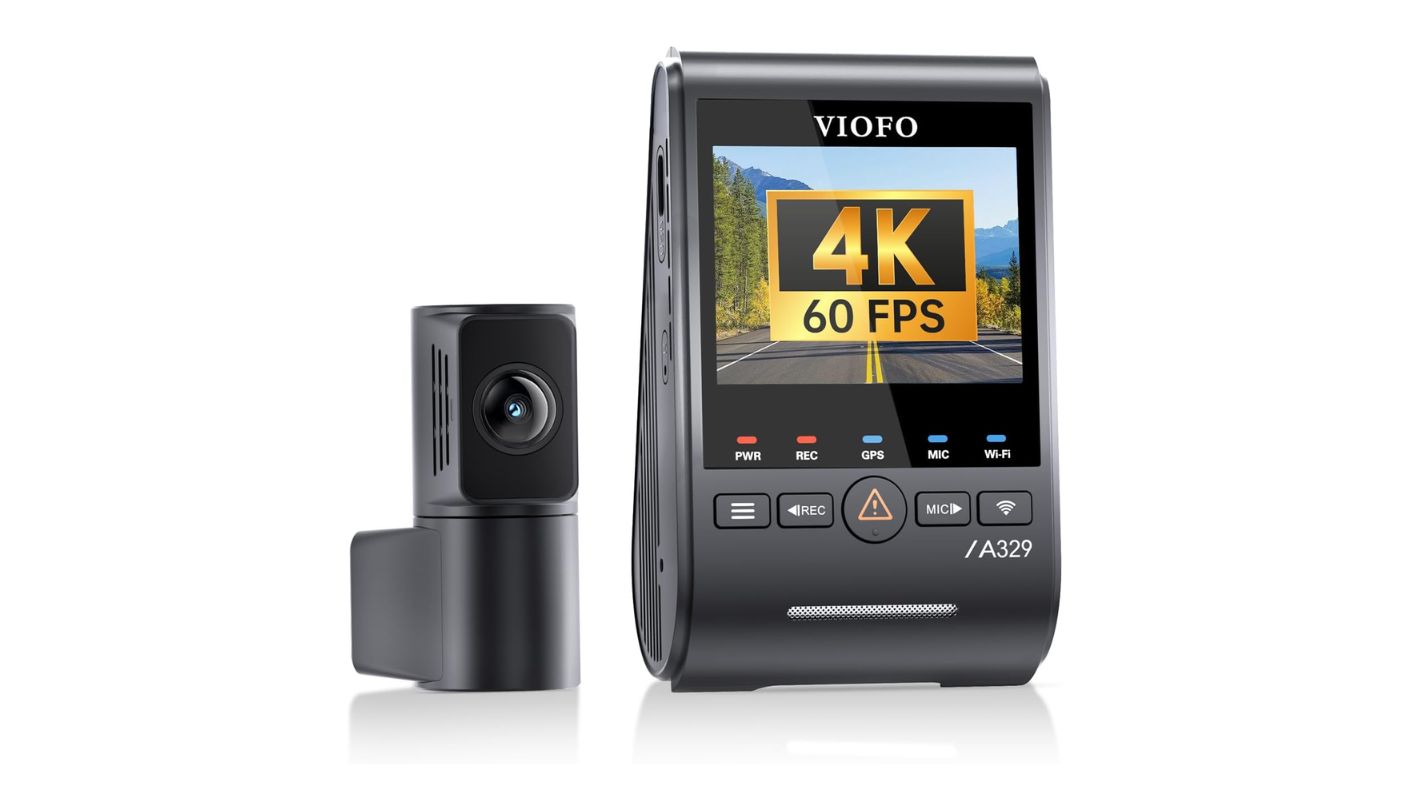
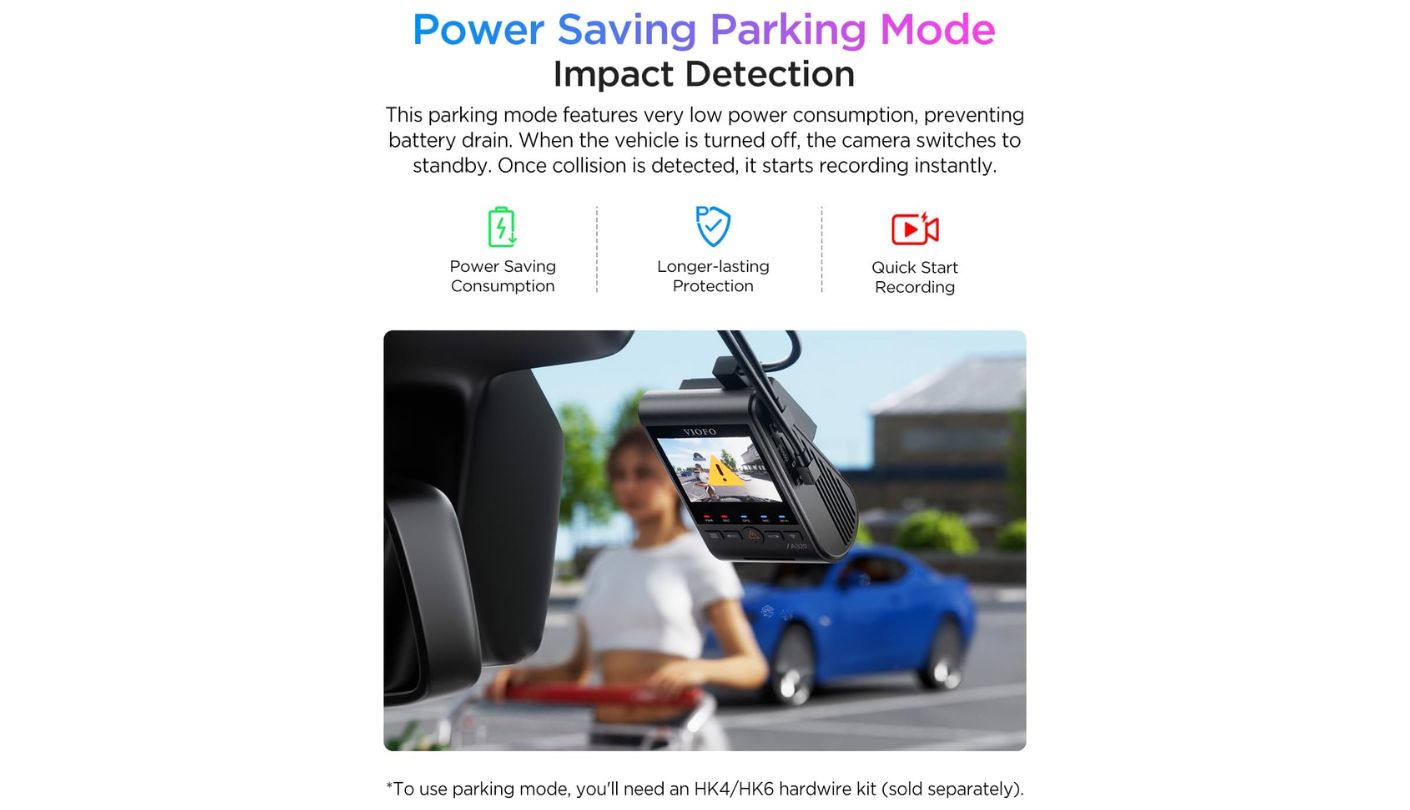
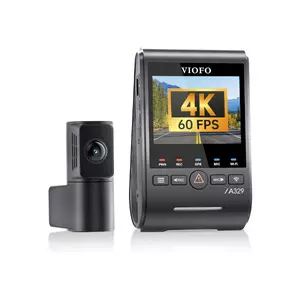
Every other camera in this roundup treats parking mode as a single feature to switch on. The VIOFO A329S 2CH treats it as a set of tools to combine, offering buffered recording, a low-power impact detection mode that wakes in roughly 1.6 seconds when it senses a collision, and a hybrid mode that runs both in sequence to balance coverage against battery drain.
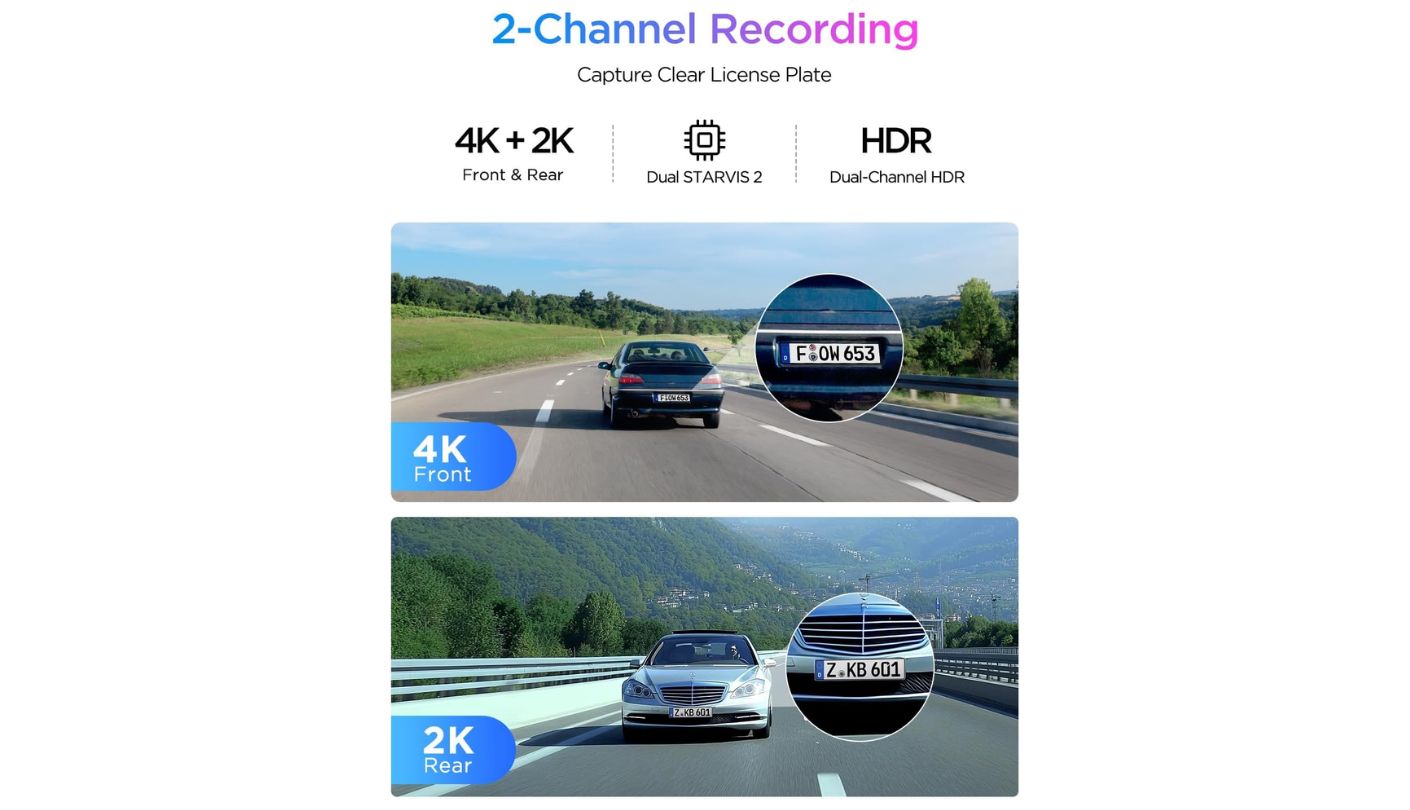
Video quality backs up the parking sophistication, and that combination is why this camera tops a list specifically about parking mode rather than general dash cam performance. The front camera shoots true 4K at 60fps with HDR disabled, or 4K at 30fps with HDR active for better dynamic range, while the rear runs a steady 2K with HDR always on. Dual Sony STARVIS 2 sensors, an IMX678 up front and an IMX675 in the rear, are the same sensor family found in some of the more expensive dash cams on the market.
Wi-Fi 6 is a genuine upgrade over the 5GHz-only connections on the rest of this list, cutting download times for large 4K clips noticeably compared to older WiFi standards. Storage flexibility extends to external SSDs up to 4TB in addition to standard microSD cards up to 512GB, which matters for anyone recording continuously at the camera's highest bitrate settings.
None of this comes cheap, and the hardwire kit needed for parking mode isn't included any more than it is with the other four cameras here. VIOFO sells two versions, a basic HK4 and a more capable HK6 with a voltage display and support for the hybrid parking mode specifically, so buyers aiming for the full feature set need to select the right kit rather than grabbing the cheaper option by default.
A CPL filter comes included on the front lens out of the box, cutting windshield glare without needing a separate purchase the way some competitors require. GPS support covers four satellite systems rather than just the standard GPS constellation, which translates to more consistent location logging in dense urban driving where a single-system GPS can lose the signal between tall buildings.
Pros:
- True 4K 60FPS
- Buffered Parking Mode
- Low-Power Impact Detection
- Wi-Fi 6 Speed
- 4TB SSD Support
Cons:
- Kit Not Included
- No Card Included
Summary: This is the camera built specifically for the theme of this list, since its hybrid parking mode is the only one here designed from the ground up to balance thorough coverage against battery risk rather than forcing a choice between the two.
Garmin Dash Cam X310 Review
Built-In Battery
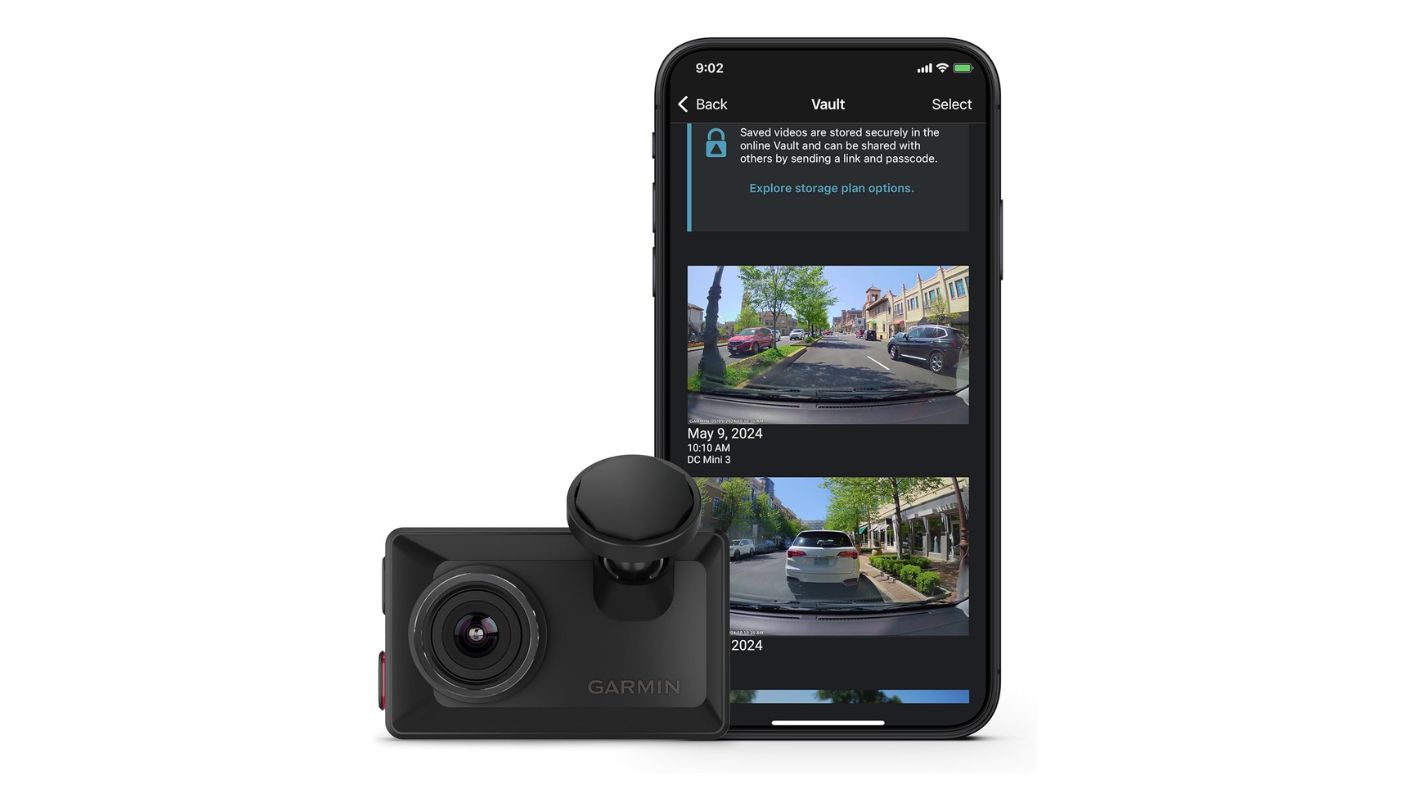
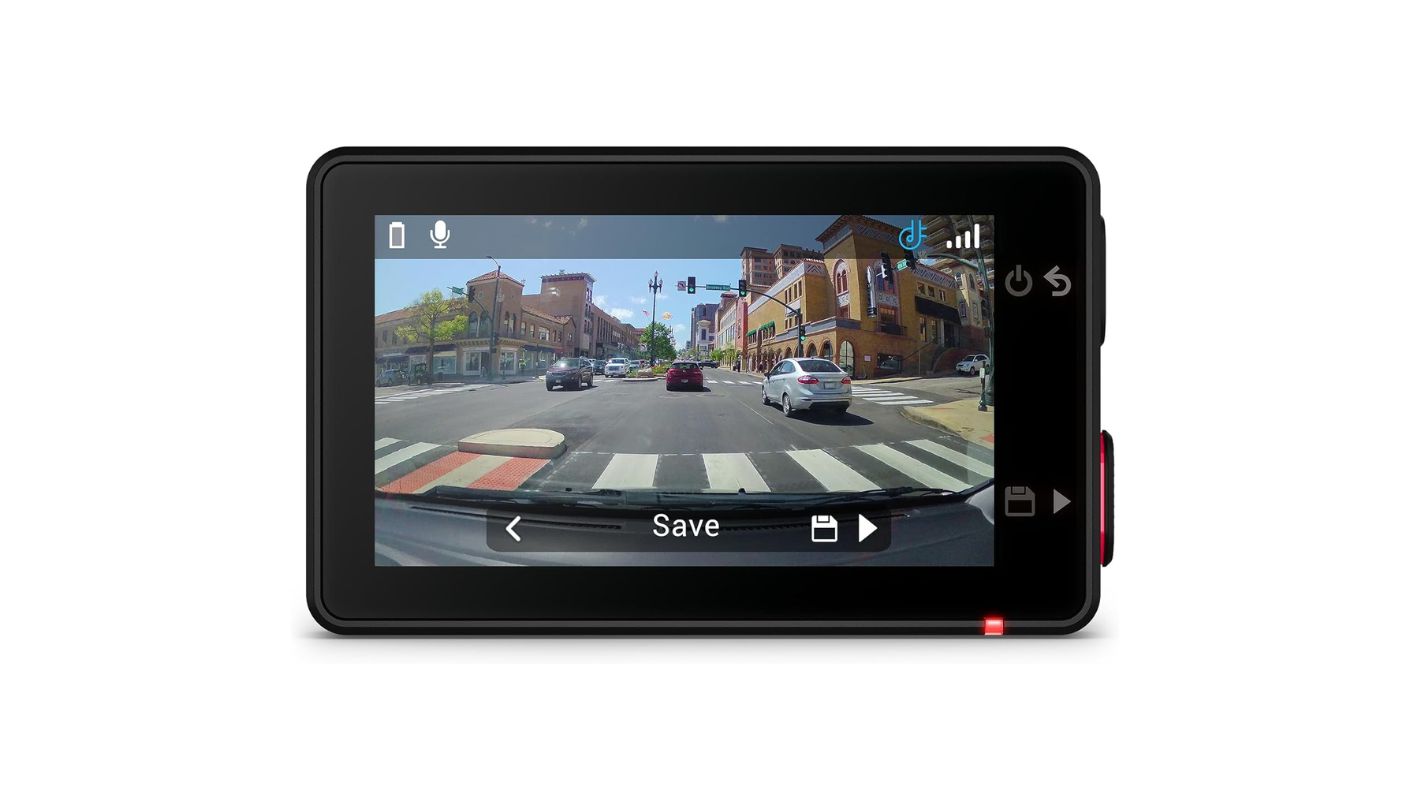
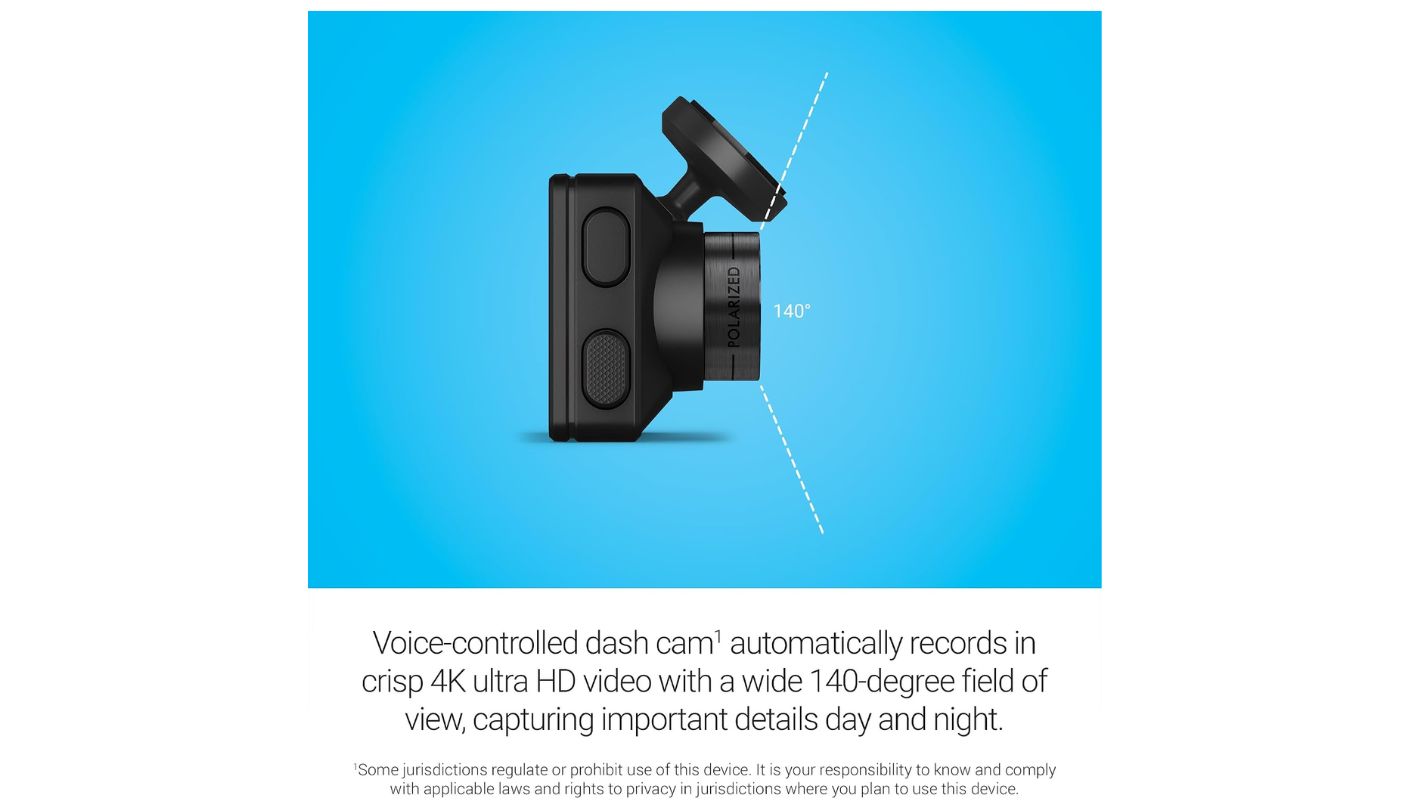
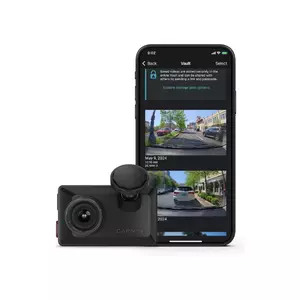
How does a dash cam built by a company known for GPS precision handle parking mode worse than four cheaper competitors? The Garmin Dash Cam X310 is the odd one out in this comparison in more ways than one, starting with the fact that it's a single-channel camera by default, recording only the road ahead rather than front and rear like the rest of this list.
The front camera itself is excellent, shooting true 4K at 30fps with HDR or 1080p at a smooth 120fps, backed by an integrated polarizing filter that cuts windshield glare more effectively than an add-on filter typically manages. A 2.4-inch touchscreen and reliable voice control round out an interface that feels more polished than anything else in this comparison, and the compact single-unit design barely registers on the windshield.
Parking mode requires Garmin's separate Constant Power Cable, sold apart from the camera itself, and covers basic motion-triggered recording once connected. Getting real-time phone alerts or a live remote video feed from the parked car requires stacking a paid Vault subscription on top of that hardware purchase, along with a Wi-Fi hotspot left running in the vehicle, a considerably more expensive and complicated path to full parking coverage than any other camera on this list.
The X310 is also one of the few dash cams here with an actual rechargeable battery rather than a supercapacitor, good for about 20 minutes of standalone recording without any external power at all. That's a genuinely different use case, useful for a quick clip without plugging in anything, though it doesn't substitute for the 24-hour coverage the rest of this roundup is built around.
Independent testing has also flagged the forward collision warning system for occasional false alerts while the car was parked and stationary, a driver-assistance feature separate from parking mode itself but worth disabling if it proves distracting rather than helpful. For anyone weighing the X310 purely on daily-drive video quality, none of that changes the assessment much, but it's one more reason to treat this specific camera as a strong commuter option first and a parking mode camera second.
Pros:
- Built-In Battery
- Touchscreen Interface
- Voice Control
- Integrated Polarizer
- Compact Single Unit
Cons:
- Single Channel Only
- Vault Subscription Needed
Summary: Buy this one for the road-facing video quality and the polish of daily use, not for parking mode specifically, since that particular feature is the weakest link on an otherwise well-built camera.
Parking Mode Dash Cams: FAQ
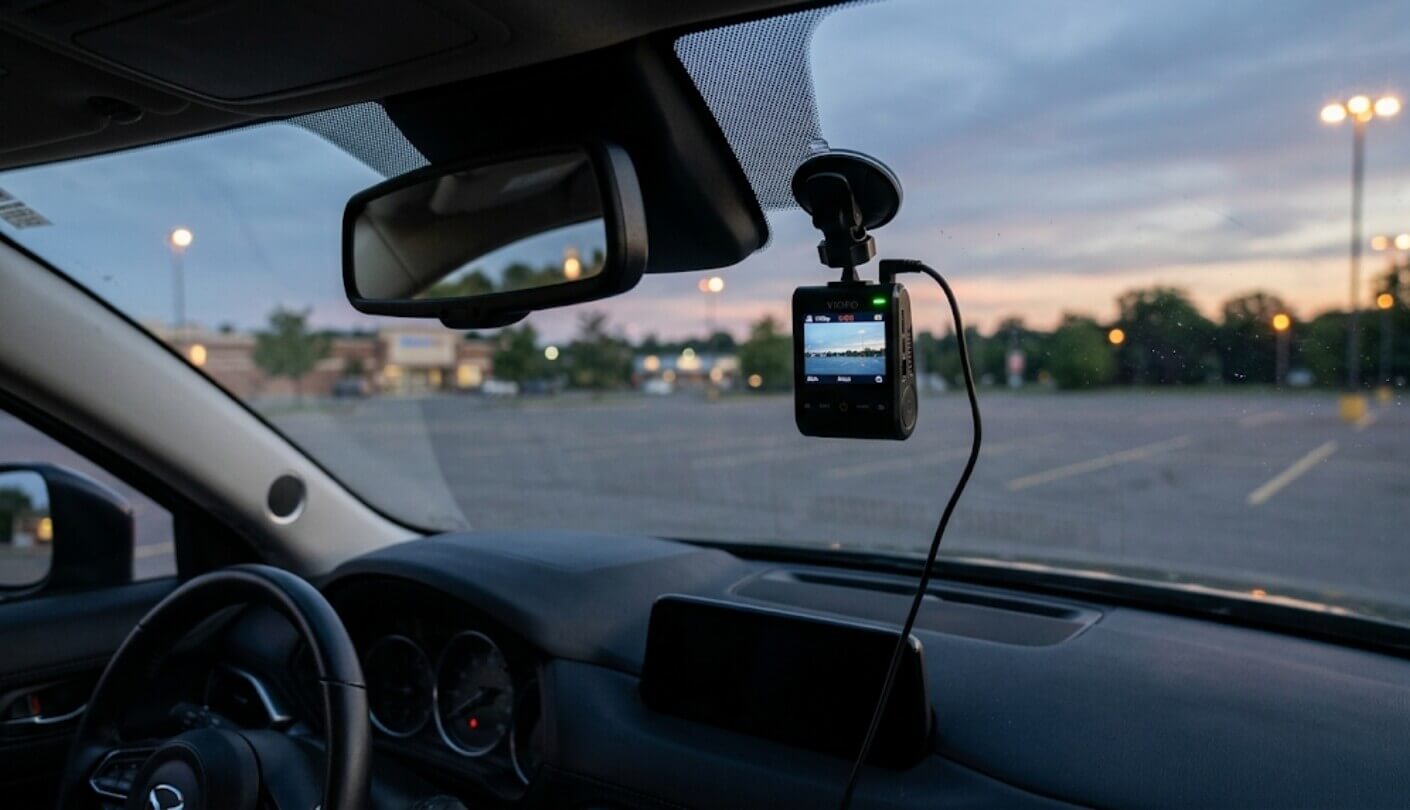
Do all dash cams with parking mode include the hardware needed to use it?
No, and this trips up more buyers than any other detail in this category. Every camera in this roundup requires a separate hardwire kit purchased on its own, wired into the car's fuse box, before parking mode does anything at all. Factor that extra cost into the total price before comparing cameras on price alone, since two cameras that look identically priced on the shelf can end up quite far apart once the required kit is added to each.
What's the difference between buffered and motion-only parking recording?
Buffered recording saves footage from several seconds before a triggering event in addition to what comes after, capturing the full sequence of an incident rather than just its aftermath. Motion or impact-only recording waits for a trigger and starts from that point forward, which can miss the first moment of contact entirely.
Will parking mode drain my car's battery?
It can, if the hardwire kit lacks proper low-voltage cutoff protection. A quality hardwire kit monitors the car's battery charge and shuts the camera off automatically before draining it below what's needed to start the engine, so checking for that specific feature matters more than the camera's power source alone.
Is the REDTIGER F7NP's "4K" footage actually 4K resolution?
No. The F7NP's front sensor natively captures 2592x1944 resolution and upscales that footage to 3840x2160 through interpolation rather than recording true 4K. The footage still looks sharp for the price, but it's worth knowing the underlying sensor doesn't match the resolution printed on the box.
Which of these dash cams needs a subscription to use its parking features fully?
The Garmin Dash Cam X310 is the only one here that requires an ongoing paid subscription, called Vault, to unlock remote alerts and live video access to a parked car. The other four cameras handle their parking mode features entirely through a one-time hardwire kit purchase with no recurring cost, which makes them considerably cheaper to run long-term even if the upfront hardware and kit combination costs about the same.
Do these dash cams work reliably in extreme heat while parked?
Four of the five use a supercapacitor rather than a battery specifically because it tolerates the heat buildup inside a parked car far better over repeated cycles. The REDTIGER rates its supercapacitor up to 158°F and the ROVE up to 140°F, both well past what a typical lithium battery is rated to handle. The Garmin X310's lithium-ion battery is the exception and is more sensitive to sustained heat exposure.
Which of these is best for rideshare drivers who need interior coverage?
The Vantrue N5S stands apart here with four separate lenses covering the front, rear, and two interior angles, giving rideshare and delivery drivers documentation of the cabin from both directions. None of the other four cameras in this roundup records the interior at all without adding a separate camera module.
How much storage do I actually need for 24-hour parking recording?
That depends heavily on which parking mode is active, since buffered and motion-triggered recording at full resolution consumes storage far faster than time-lapse mode. A high-endurance card in the 256GB to 512GB range covers most setups comfortably, while anyone running the VIOFO A329S 2CH at its highest bitrates may want to consider its external SSD support instead, particularly for long-term parking situations where the car sits for days between drives.
Choosing Between These Five
Video resolution is the number every listing leads with, but parking mode sophistication is the number that actually decides whether footage exists when it matters most. The ROVE R2-4K DUAL and REDTIGER F7NP both cover the basics affordably, though the REDTIGER's upscaled sensor and thinner parking mode selection put it a notch below the ROVE for anyone reading past the marketing copy. The VIOFO A329S 2CH is the one built around this exact problem, layering buffered and low-power modes together in a way nothing else here attempts, and it's the camera I'd point toward first for anyone whose main worry is a parking lot incident rather than daily commute footage.
The Vantrue N5S makes sense for a narrower but legitimate need, covering the cabin as thoroughly as the road for anyone who actually requires that footage. The Garmin X310 remains a genuinely excellent single-channel camera for daily driving, but its parking mode asks for more money and more setup than any competitor here for a feature that ends up being the least developed part of the package, which makes it the easiest of the five to recommend for the drive and the hardest to recommend for the parking lot.

Jim's our tech geek with a mission since February 2023. From movies to video projectors, he knows his stuff and aims to make tech work for you. When he's not geeking out, he's there to guide you through making savvy decisions.


