Sophia Space and Caltech patent orbital data centers that cool themselves with vacuum

AI is pushing data centers to their physical limits on Earth — cramped power grids, ballooning electricity bills, and heat that has to go somewhere. On July 14, Sophia Space and Caltech secured US Patent No. 12,679,564 for a modular orbital data center architecture that sidesteps those problems by moving compute into low Earth orbit. The US Department of Energy projects data centers will consume 12% of national electricity by 2028, driven almost entirely by AI workloads — which helps explain why the FCC has already received three separate orbital data center constellation applications since January 2026, per the GAO April 2026 space data center report.
The tile
The core unit is called TILE — Thermal Integrated LEO Edge. Each module measures 1 m × 1 m × 1 cm and houses four enterprise servers. One face points toward the sun and carries solar panels; the opposite face points toward deep space and acts as a passive radiator. Heat from the processors bleeds directly into the vacuum through radiation — no pumps, no coolant loops, no plumbing that can fail in microgravity. Individual tiles connect only via fiber-optic data links, with no shared power or cooling bus, so scaling up means simply bolting on more units.
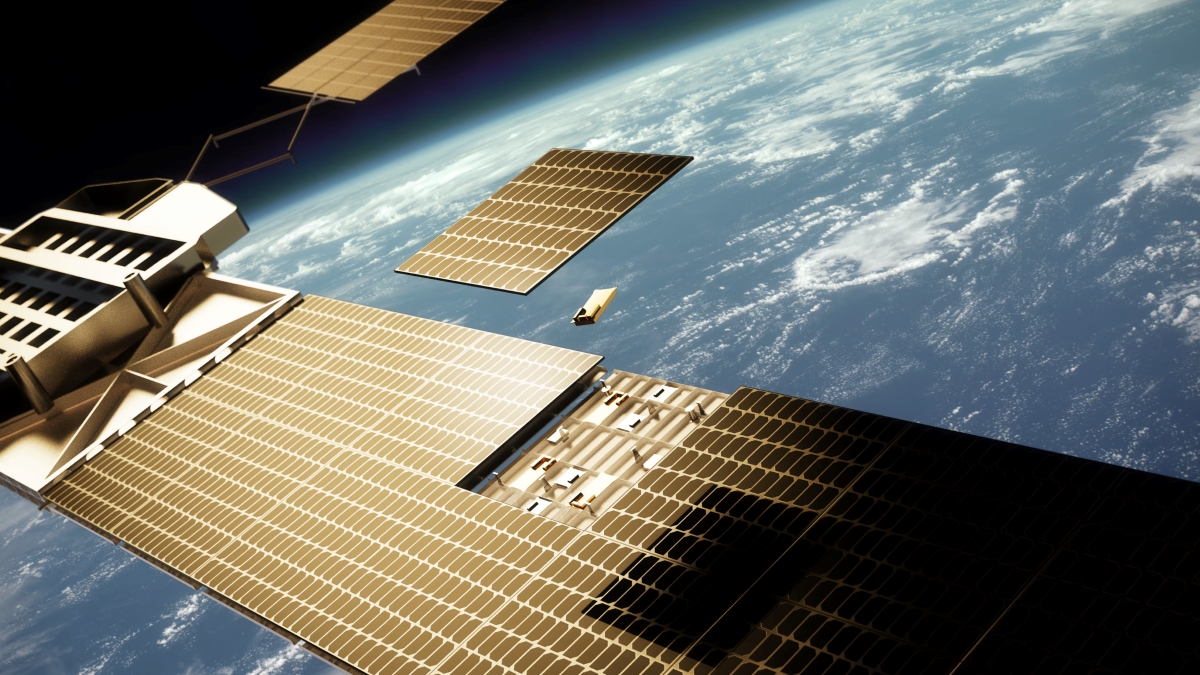
Concept render of the modular TILE system. Illustration: Sophia Space
The claim
Sophia Space founder Leon Alkalai, a former technical fellow at NASA's Jet Propulsion Laboratory, argues that space solves two terrestrial bottlenecks at once: solar energy in orbit is effectively unlimited, and the vacuum handles heat dissipation through basic physics. The technology grew out of Caltech's $100 million space solar power research program. The orbital framing also targets edge inference — processing satellite data in orbit rather than piping it down to ground stations — which cuts latency for applications like Earth observation and defense imagery, according to SpaceNews.
The timeline
The startup, founded in June 2023, has raised roughly $23.5 million across two rounds — $13.5 million led by Alpha Funds, KDDI, and Unlock VPs, followed by a $10 million seed in June 2026. A real-world demonstration using the Apex Nova satellite platform is slated for late 2027 or early 2028. If that goes to plan, commercial module sales begin in 2028, with a four-to-six satellite constellation — functioning as a single orbital supercomputer — targeted for 2030. That demo is the critical gate: passive radiator designs have never been tested at this scale in orbit, and active-cooling competitors will be watching closely.


