Stringman is a ceiling-mounted robot that picks up your clutter — and it's on sale now

A new home robot called Stringman skips the humanoid form entirely and hangs from your ceiling instead — and it's already available to buy. Made by engineer Nathaniel Nifong under his company Neufangled, it uses taut cables strung between four corner anchors to glide around a room, dip down, and pick up whatever you've left on the floor. At $965 fully assembled, it's a fraction of the cost of commercial robotic arms, though getting it working takes real effort.
The cable approach
Stringman is a cable-driven parallel robot (CDPR) — a category that trades the complexity of a humanoid body for a simple wire-and-pulley system. Four "Pilot" anchor units mount near the ceiling corners; the robot hangs from them and moves by adjusting cable tension. An onboard AI model, compatible with Hugging Face's LeRobot framework, identifies objects on the floor and directs the "Arpeggio" gripper to collect them into a designated bin. The whole platform runs on a Raspberry Pi Zero 2W and requires an external Ubuntu Linux PC for motion control.
Out of the box, Stringman can handle one task autonomously: laundry pickup. Every other skill — toys, shoes, general clutter — requires the owner to train it via teleoperation using a controller, then feed those sessions into LeRobot datasets. That's genuinely powerful for technically minded users, but it's not a plug-and-play appliance.
Availability and price
Nifong has confirmed shipping to the US, UK, Mexico, Japan, South Korea, Vietnam, and Taiwan — per the Neufangled store. No GBP pricing is published yet, so UK buyers will need to factor in conversion, shipping, and any import costs. The DIY kit comes in at $655 and includes parts designed for 3D printing. Lead time is roughly two weeks.
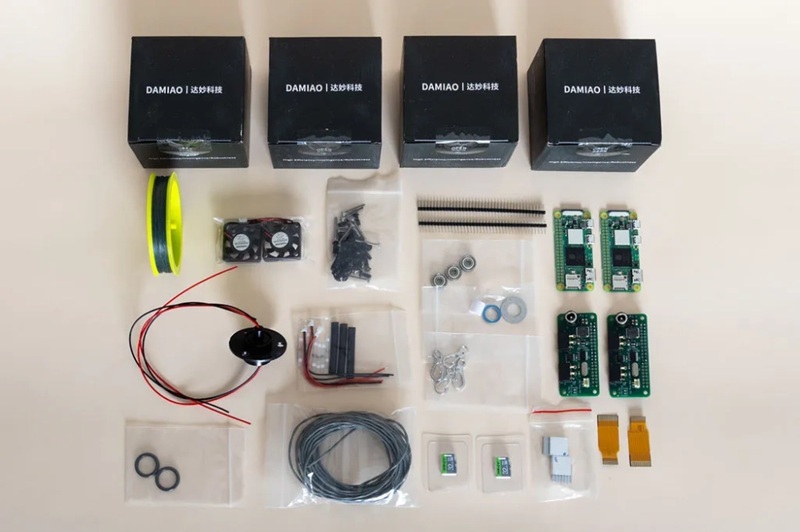
The DIY kit includes all structural components and 3D-printable parts.
Coverage from Hackster.io highlights that the robot can cover rooms up to 8×8 meters and handle a dynamic payload of around 750g — enough for a bundled sock or a child's toy, but not a pile of books. The entire hardware and software stack is open-source under the Apache 2.0 license and OSHWA certified, so the maker community can extend and adapt it freely.
Who is this actually for?
Stringman sits in an interesting gap: too complex for casual buyers, too affordable to ignore for robotics hobbyists. It competes loosely with the idea of Samsung Ballie or Boston Dynamics Spot, but it's really aimed at developers and enthusiasts who want a real, deployable AI robotics platform at home without industrial-scale costs. Nifong's background at Garmin, Google, and Synopsys shows in the engineering — this is a serious project, not a Kickstarter sketch.


