Claude AI helped recover $400K in Bitcoin lost since 2015 — here's how

A Bitcoin holder has recovered 5 BTC — worth roughly $400,000–$500,000 at current prices — after the coins sat inaccessible for over a decade, with Anthropic's Claude AI doing the heavy lifting. The user, known on X as @cprkrn, had been locked out since 2014–2015 after changing his wallet password while drunk and forgetting it the next morning. What finally worked wasn't brute-force cracking — it was AI-assisted software debugging that cost about $15 in compute time.
The problem
@cprkrn still had his original seed phrase — a memorable string involving the phrase "lol420fu\\thePOLICE!\*:)" — but that didn't help because the wallet file had been re-encrypted with the forgotten password. He spent roughly $250 per attempt on commercial recovery services over the years, ran brute-force tools that tried trillions of password combinations, and got nowhere. The encryption itself was never the obstacle. A bug in the recovery software was.
What Claude actually did
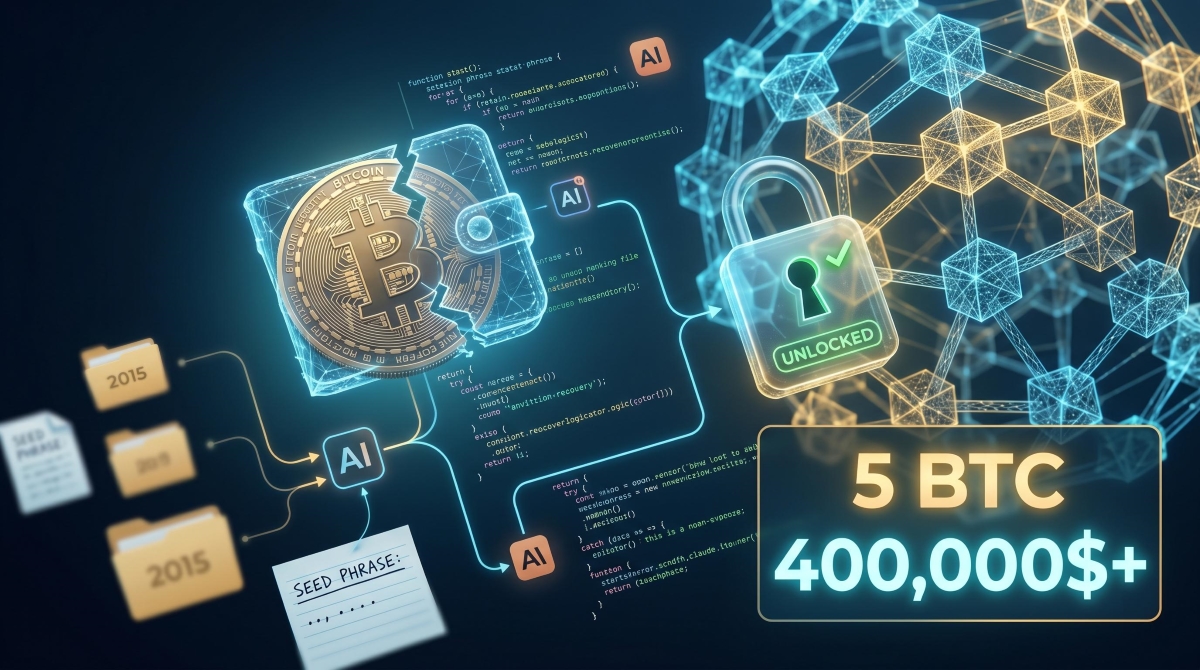
When Bitcoin's price crossed $100,000 and the stakes became hard to ignore, @cprkrn fed Claude his entire digital archive from his old computer — notes, documents, and backup files. Rather than guessing passwords, Claude analyzed the data structure and identified a concatenation bug in btcrecover, a widely used open-source wallet recovery tool. The bug caused the software to process the shared key and password in the wrong order for his specific wallet version, so no combination would ever succeed regardless of how many were tried.
Claude then helped fix the logic, as CoinDesk reported. Once the corrected code ran, the private keys came out and the wallet opened. Recovery experts have been quick to note, per Finance Magnates, that this was file forensics — not a cryptographic attack on Bitcoin itself.
What it means beyond one wallet
The case illustrates a shift from brute-force guessing to contextual analysis. An AI that can cross-reference old files, read code, and spot logic errors opens up a category of recovery that scripts alone can't handle. That's useful — but it also raises a privacy concern: uploading wallet files to a cloud-based AI service means sensitive data passes through a third-party server. Anthropic has not issued guidance on how wallet data uploaded to Claude is handled or retained.
The broader backdrop matters too. An estimated 20% of all Bitcoin — somewhere between 3.7 and 4 million BTC — is considered permanently lost to forgotten passwords and dead hardware. If AI tools lower the barrier to recovery, that dormant supply could gradually re-enter circulation, with real implications for Bitcoin's scarcity-driven value model. For now, @cprkrn reportedly promised to name his future child after Anthropic's founder — which is one way to mark the occasion.


