Astrolab's FLIP Rover Heads to the Moon in 2026 — and It's Hunting Helium-3

A small rover called FLIP is scheduled to land near the lunar south pole in late 2026, carrying four NASA instruments and representing Astrolab's opening move in a three-way race for one of the biggest contracts in space exploration history. NASA's Lunar Terrain Vehicle (LTV) program is worth up to $4.6 billion over 15 years, and the company that proves its hardware works on the Moon first holds a significant advantage.
The mission
FLIP — short for FLEX Lunar Innovation Platform — launches on a SpaceX Falcon Heavy and rides to the surface inside Astrobotic's Griffin-1 lander, the same platform originally designed to carry NASA's now-cancelled VIPER water-ice rover. The lander has a new job now: delivering FLIP and its science payload to the Moon intact.
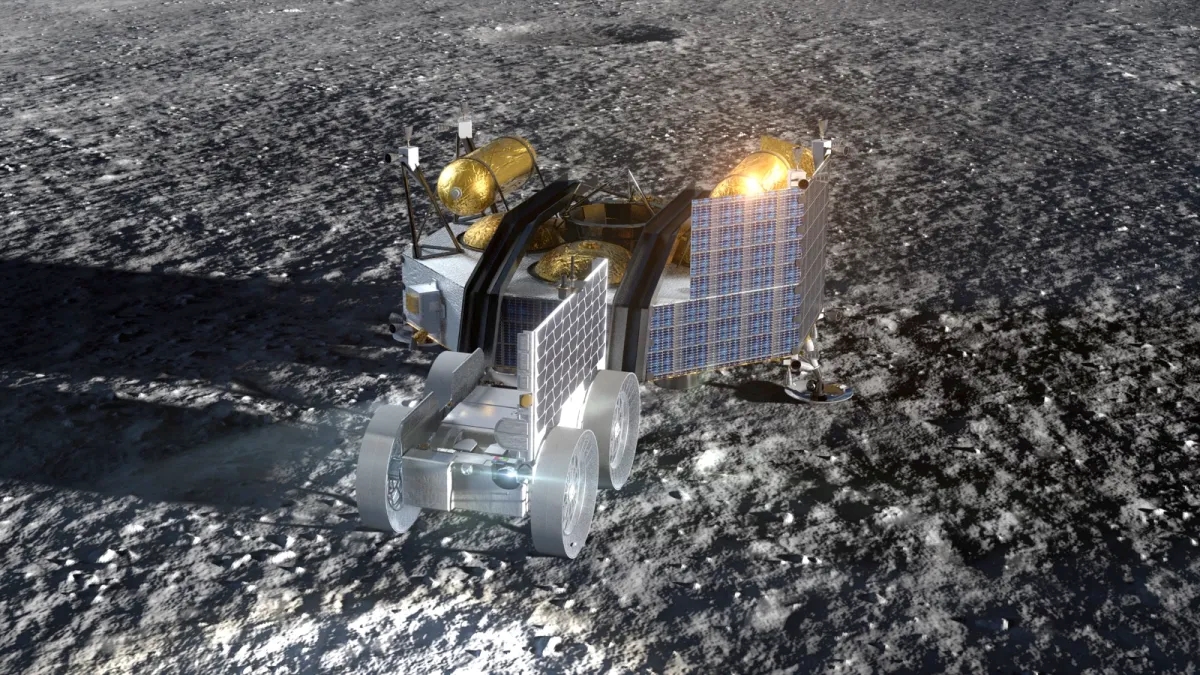
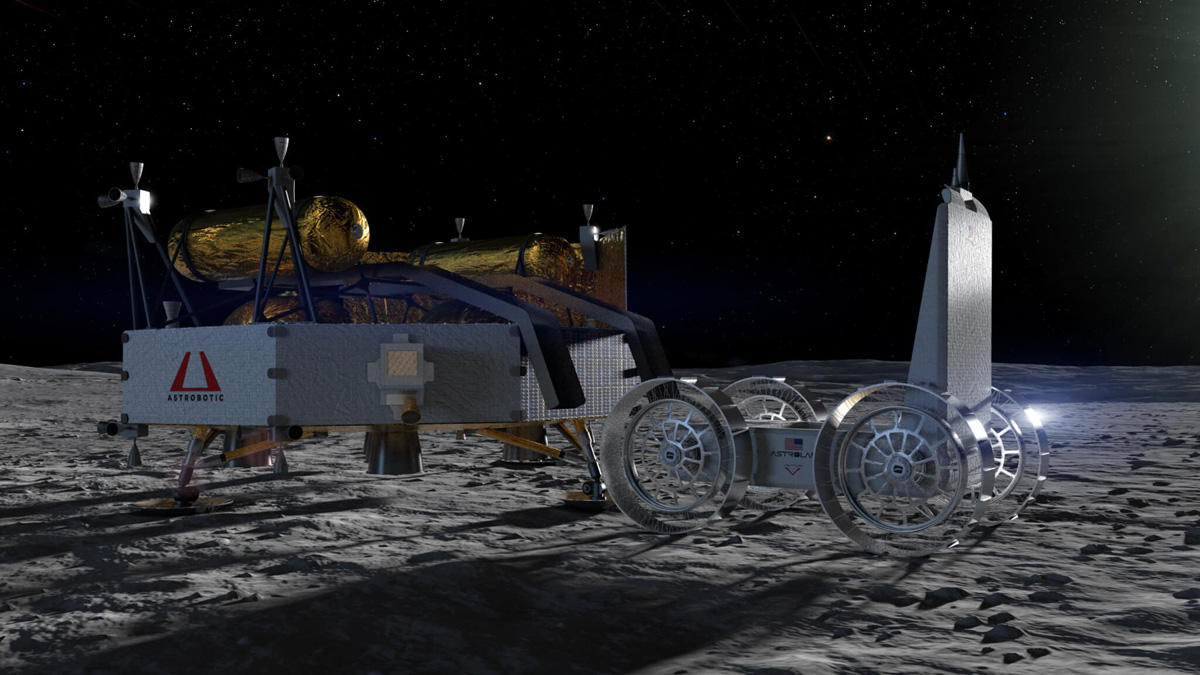
The most attention-grabbing instrument onboard is METAL (Moon Exploration for Titanium with Active Lighting), developed with startup Interlune. Its target: helium-3 trapped in the lunar regolith. The isotope is extraordinarily scarce on Earth — a kilogram costs around $20 million — but the Moon is estimated to hold over a million tons. If commercial fusion reactors ever reach viability, lunar helium-3 becomes a serious energy resource. That day is still decades away, but METAL would at least confirm where concentrations are highest.
The other instruments are less exotic but equally practical. A dust-environment sensor studies how the Moon's sharp, abrasive particles degrade hardware — a problem that wrecked Apollo-era equipment and still has no reliable fix. A lidar unit maps terrain. A Laser Retroreflector Array enables precise Earth-to-Moon distance measurements.
The competition
Astrolab is one of three companies NASA selected in April 2024 to develop LTV concepts. The others are Intuitive Machines (partnered with Boeing and Northrop Grumman) and Lunar Outpost (backed by GM and Lockheed Martin) — a lineup of traditional aerospace heavyweights. Astrolab's answer is to fly first. FLIP is explicitly a technology demonstrator for the larger, crewed rover the company hopes to build under the LTV contract, testing batteries, tires, and avionics in actual lunar conditions before a contract decision is made. Per the SpaceNews LTV race analysis, that real-world flight validation gives Astrolab data its rivals can only simulate.
NASA isn't directly funding FLIP's development. Instead, the agency supplies instruments and buys back the resulting data — a commercial model that lets Astrolab move faster than a traditional government contract would allow.
What comes next
FLIP is nearly complete and is entering a standard pre-launch gauntlet of vibration, shock, and thermal-vacuum testing. According to the Astrolab May 18 press release, most of the technologies validated on FLIP will transfer directly to the full-size crewed rover. A successful landing — and that's never guaranteed in spaceflight — would make Astrolab the only LTV contender with a rover that has actually driven on the Moon.


