Retekess TR642 Review: The Best Portable Boombox?
There is a specific kind of buyer the Retekess TR642 was made for. Not a gadget collector - someone who has a box of cassette tapes from the 90s, a shelf of CDs they never stopped buying, and a strong preference for pressing a physical button over navigating a streaming app. The TR642 covers seven distinct playback sources in one rechargeable, portable unit: cassette, CD, USB drive, TF card, Bluetooth, AUX, and AM/FM radio. The cassette deck records onto tape from multiple inputs. The Bluetooth works in two directions. The battery runs 15 hours between charges via USB-C.
I spent two weeks with the TR642 as my main listening device across a kitchen, a bedroom, and a small workshop, rotating through every playback mode and running the cassette recording function on both archival tapes and fresh stock. What follows is a section-by-section account of how each piece of that feature set actually holds up.
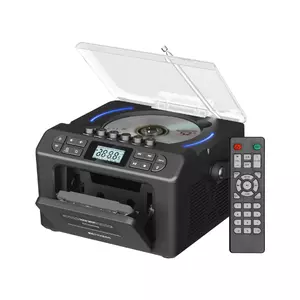
5 Reasons to Buy the Retekess TR642:
- All seven playback sources work - cassette, CD, USB, TF card, Bluetooth, AUX, and AM/FM radio in one unit
- Cassette deck records from CD, FM/AM radio, and Bluetooth with anti-erasure protection on pre-recorded tapes
- Bluetooth 5.3 dual-mode: stream from a phone to the unit, or broadcast from the unit to wireless headphones
- Five genre-tuned EQ presets plus a dedicated BASS boost button for daily listening control
- 15-hour rechargeable battery with USB-C charging from any phone adapter or power bank
2 Reasons to Consider Alternatives:
- LCD has no backlight - checking track info in a dim room means moving closer to the unit
- Remote only reaches CD, USB, and TF card modes - tape and radio need the buttons on the unit itself
Table of Contents:
- Retekess TR642: Complete Specifications
- Shape, Controls, and Build Quality
- What's in the Box and Getting Started
- Speaker Output and Sound Character
- All Seven Playback Modes, Tested
- Battery Runtime and Charging
- Extra Features Worth Knowing
- TR642: What Owners Say
Retekess TR642: Complete Specifications
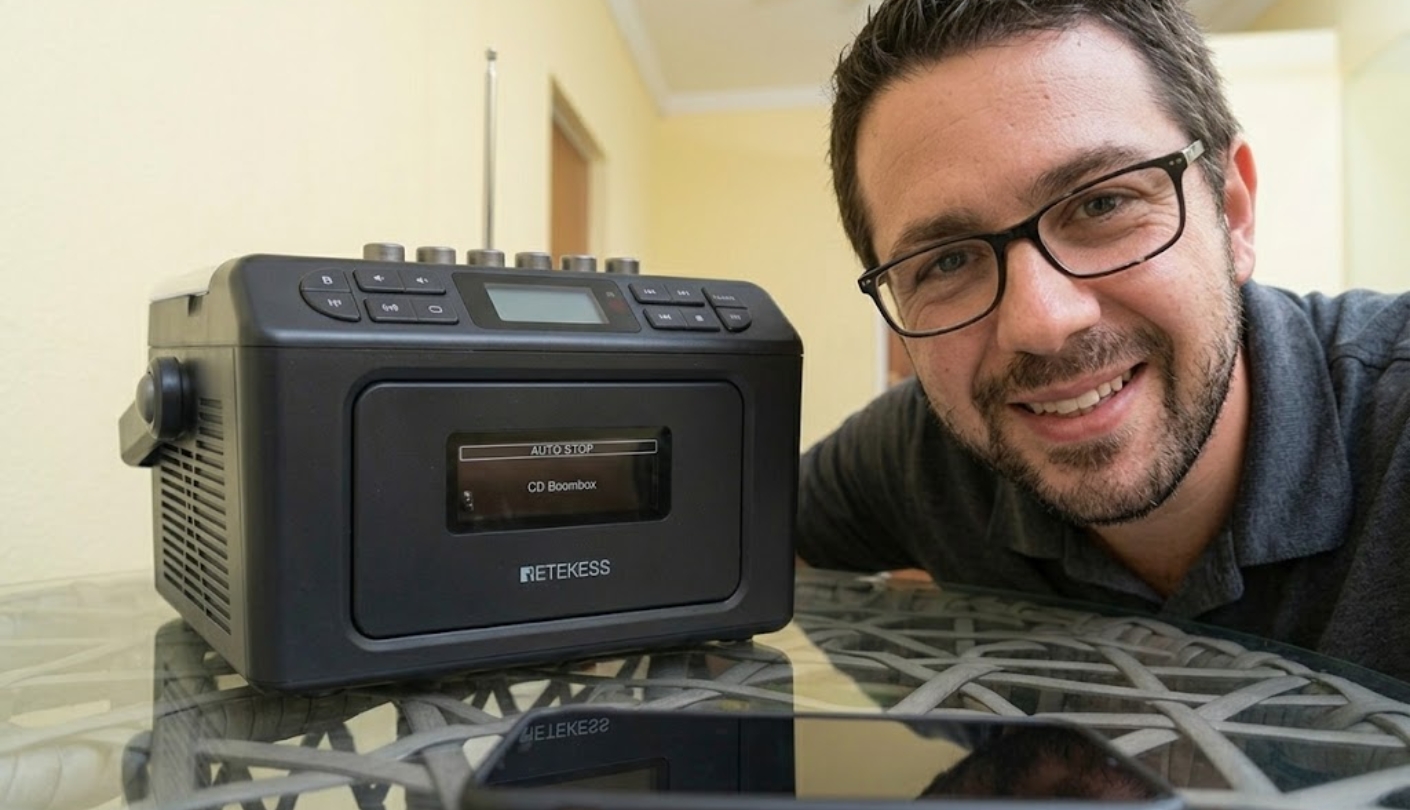
Full technical specs for the TR642:
| Specification | Details |
| Playback Modes | 7: Cassette / CD / USB Drive / TF Card / Bluetooth / AUX / AM-FM Radio |
| Speakers | 3W x 2 stereo with dedicated BASS boost button |
| EQ Presets | 5: FLAT / ROCK / POP / JAZZ / CLASSIC |
| Bluetooth Version | 5.3 - dual mode (receive from device + transmit to external headphones/speakers) |
| Supported Audio Formats | MP3, WMA, WAV |
| FM Frequency Range | 76.0 - 108 MHz, 30 station presets |
| AM Frequency Range | 522 - 1710 kHz, 30 station presets |
| Total Station Memory | 60 presets (30 FM + 30 AM) |
| USB / TF Card Capacity | Up to 64GB |
| CD Compatibility | Standard audio CDs, CD-R, CD-RW, and MP3 discs |
| Programmable Playback | Up to 20 tracks (standard CD) / up to 99 tracks (MP3 disc) |
| Cassette Functions | Playback, fast forward, fast reverse, pause, auto-stop at end, multi-source recording |
| Recording Sources | CD, AM/FM radio, Bluetooth |
| Battery | 7.4V / 5000mAh lithium-ion (two 3.7V cells in series) |
| Charging | USB-C |
| Battery Life | Up to 15 hours continuous playback |
| Weight | 1.66 kg |
| Display | LCD - mode, track number, elapsed time, battery level (no backlight) |
| Additional | LED ambient lighting, sleep timer, 3.5mm headphone jack, remote control, carry handle, rear reset button |
What makes the TR642 worth attention in a crowded boombox category is the combination of cassette recording from multiple sources and Bluetooth 5.3 dual-mode in a rechargeable portable unit. Most all-in-one boomboxes at this tier offer cassette playback only. The TR642 adds recording capability - from Bluetooth, from CD, from the radio - and that changes what the cassette deck is actually good for.
Shape, Controls, and Build Quality
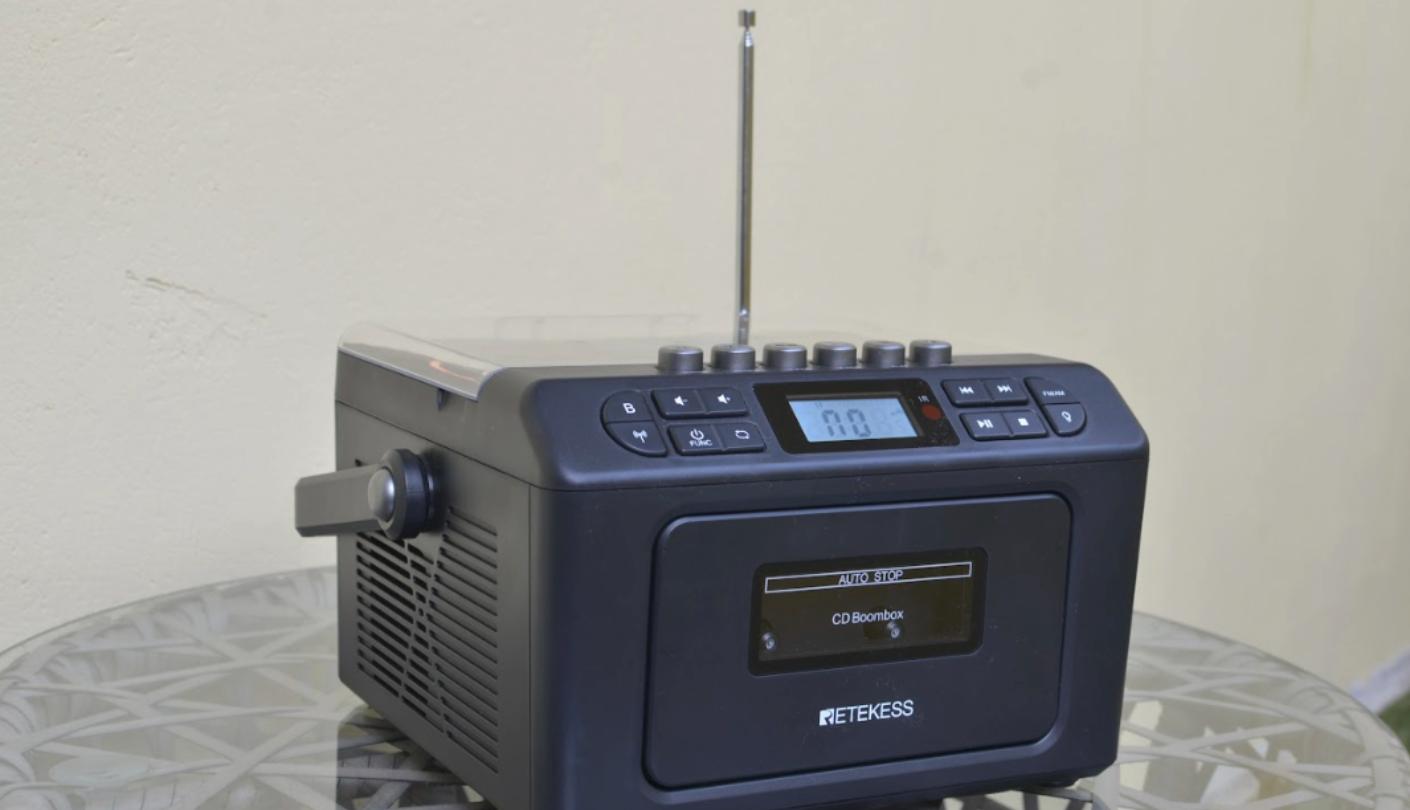
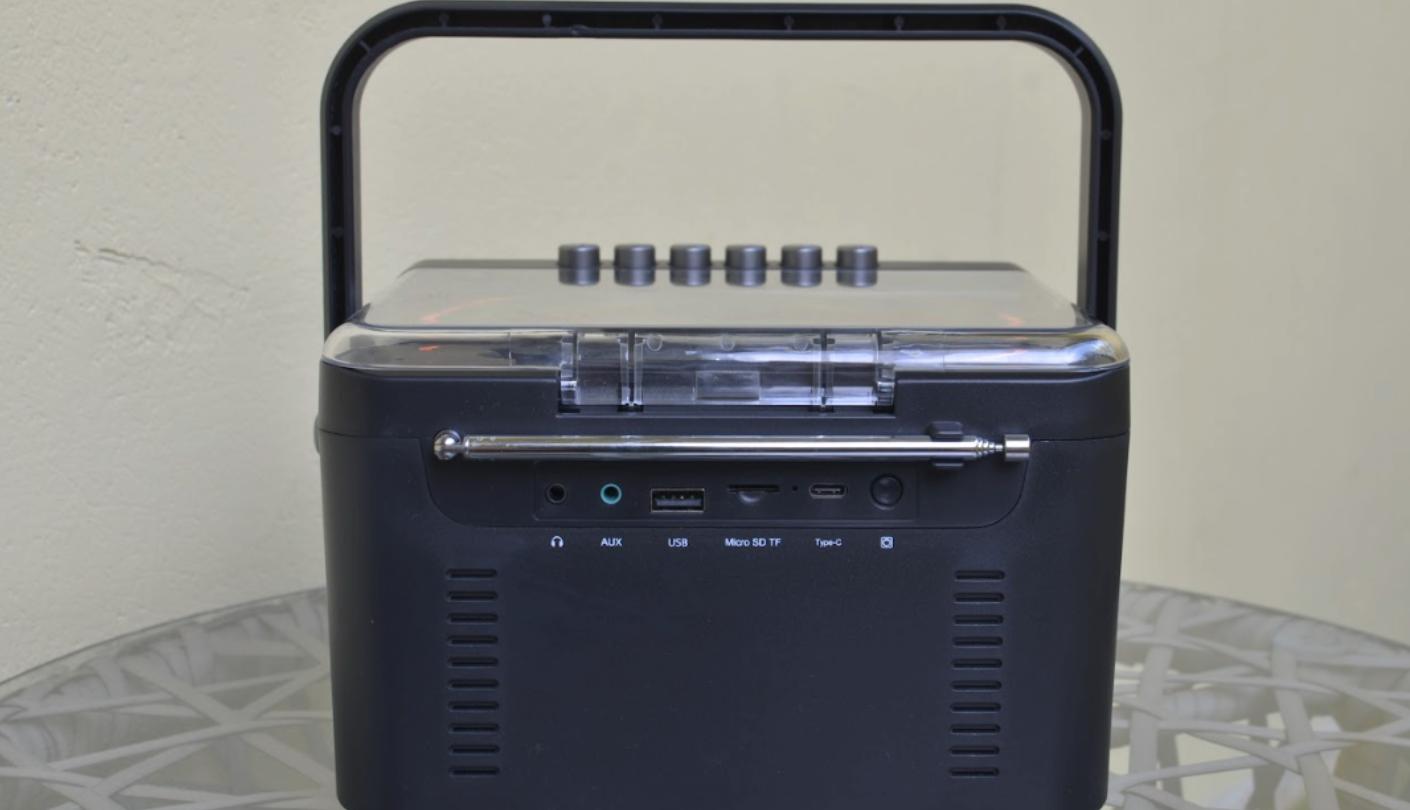
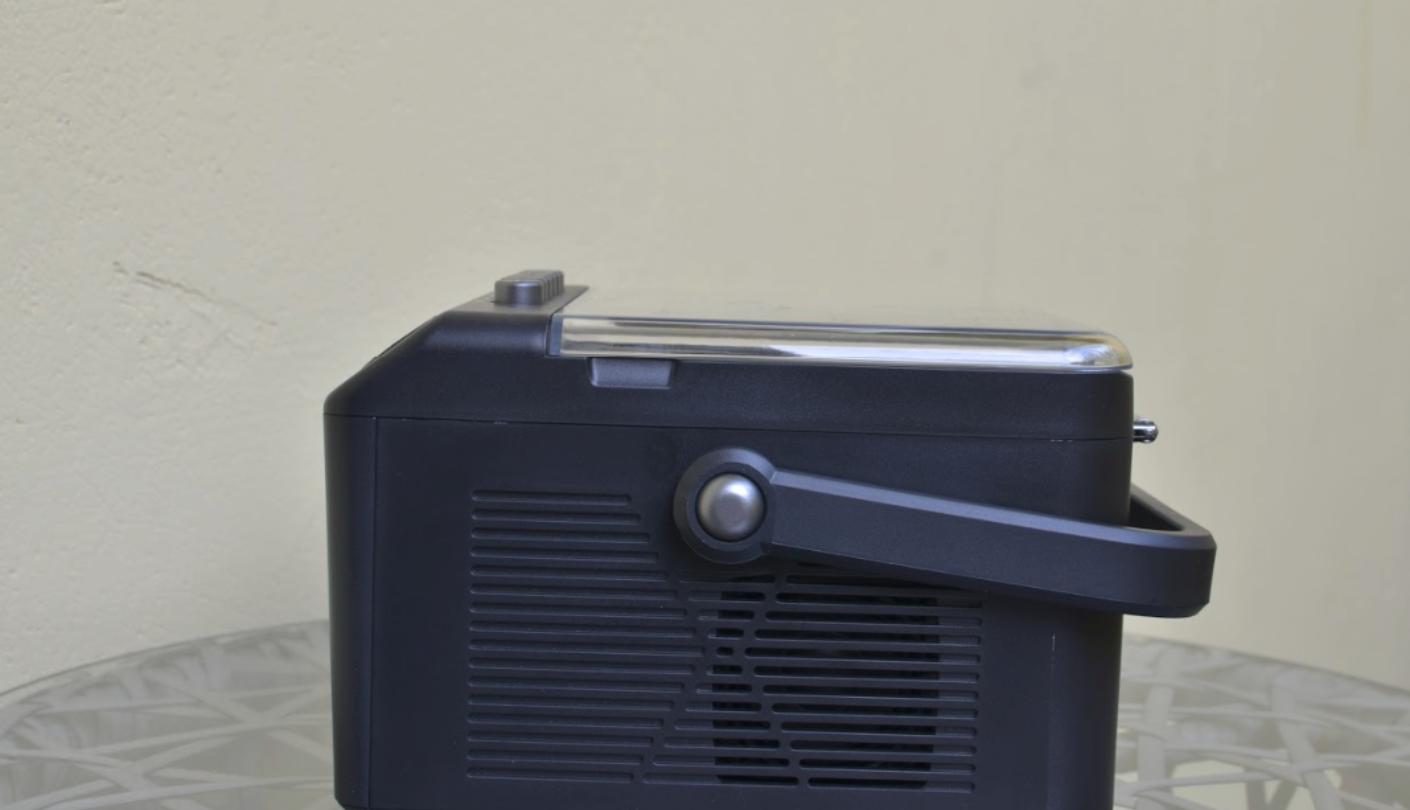
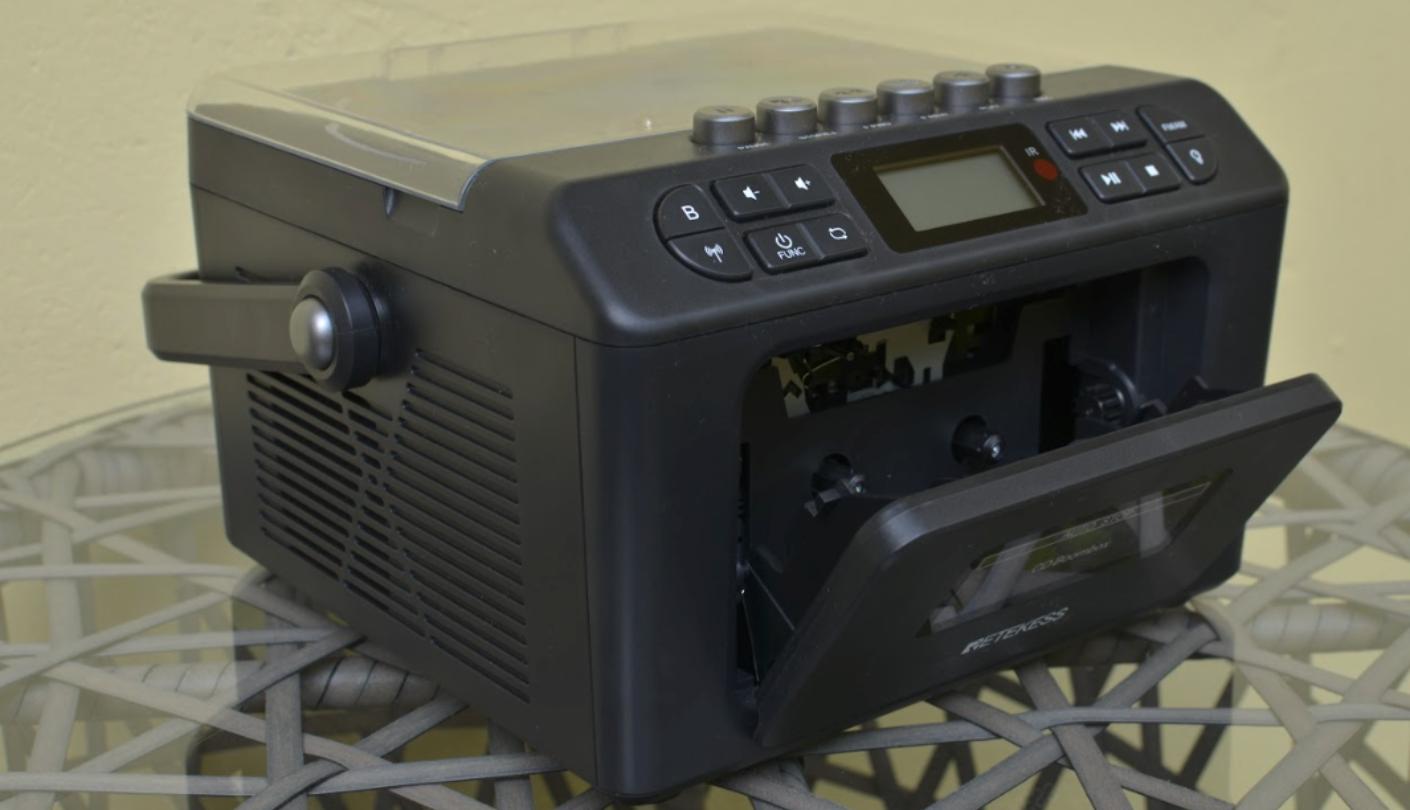
Most boomboxes go wide and low. The TR642 goes square instead - roughly cube-proportioned with a carry handle along the top. On a kitchen counter or a workbench shelf, the footprint is surprisingly compact for a unit carrying both a cassette deck and a CD drive. The 1.66 kg weight is honest: this is a unit you carry in one hand between rooms, not one that lives permanently in the same spot because moving it is a project.
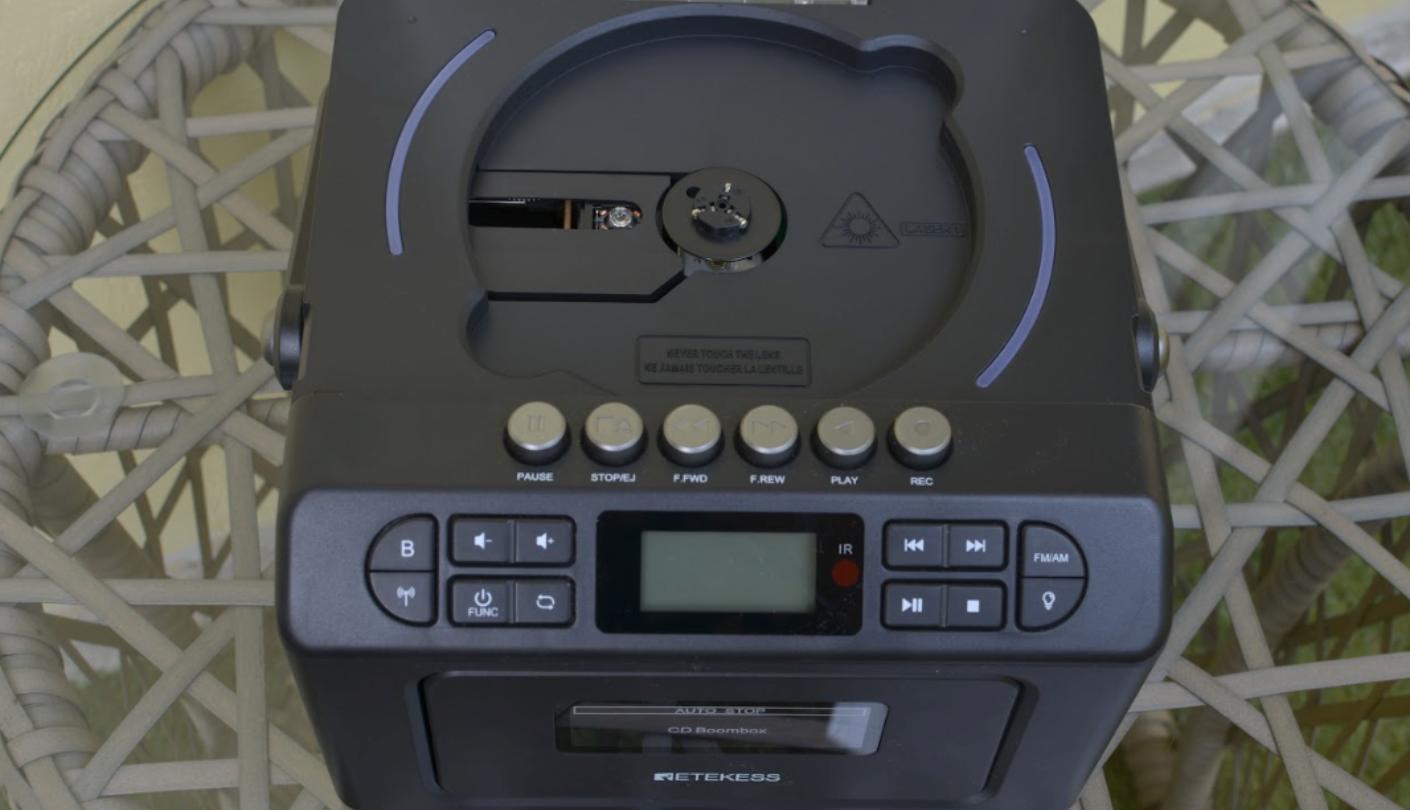
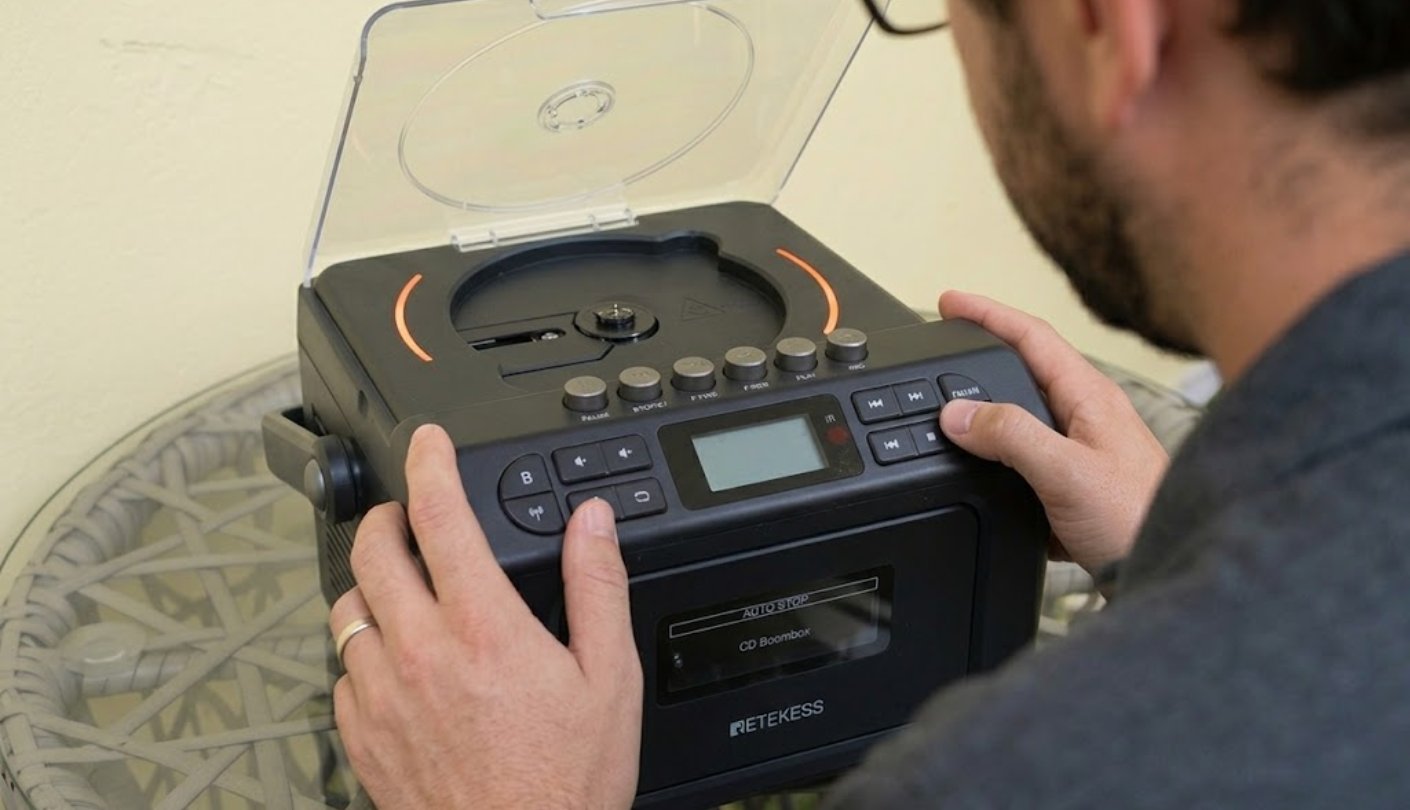
The control layout reflects a specific design decision: no multi-function buttons. Every control does one thing and is labeled for it. The ON/OFF/FUNC button powers the unit on and steps through input modes. Volume is a knob. BASS, EQ, and playback controls are individual buttons. When I handed the TR642 to my mother-in-law, who finds most modern remote-heavy devices frustrating, she was playing a CD in under two minutes without any guidance. The button-per-function approach costs a little extra panel space and gives back a lot in usability.
The cassette compartment and CD slot share the front face, stacked vertically. Looking at it straight on, you're looking at about 40 years of consumer audio formats occupying the same real estate. That's either a selling point or a conversation piece depending on who you ask.
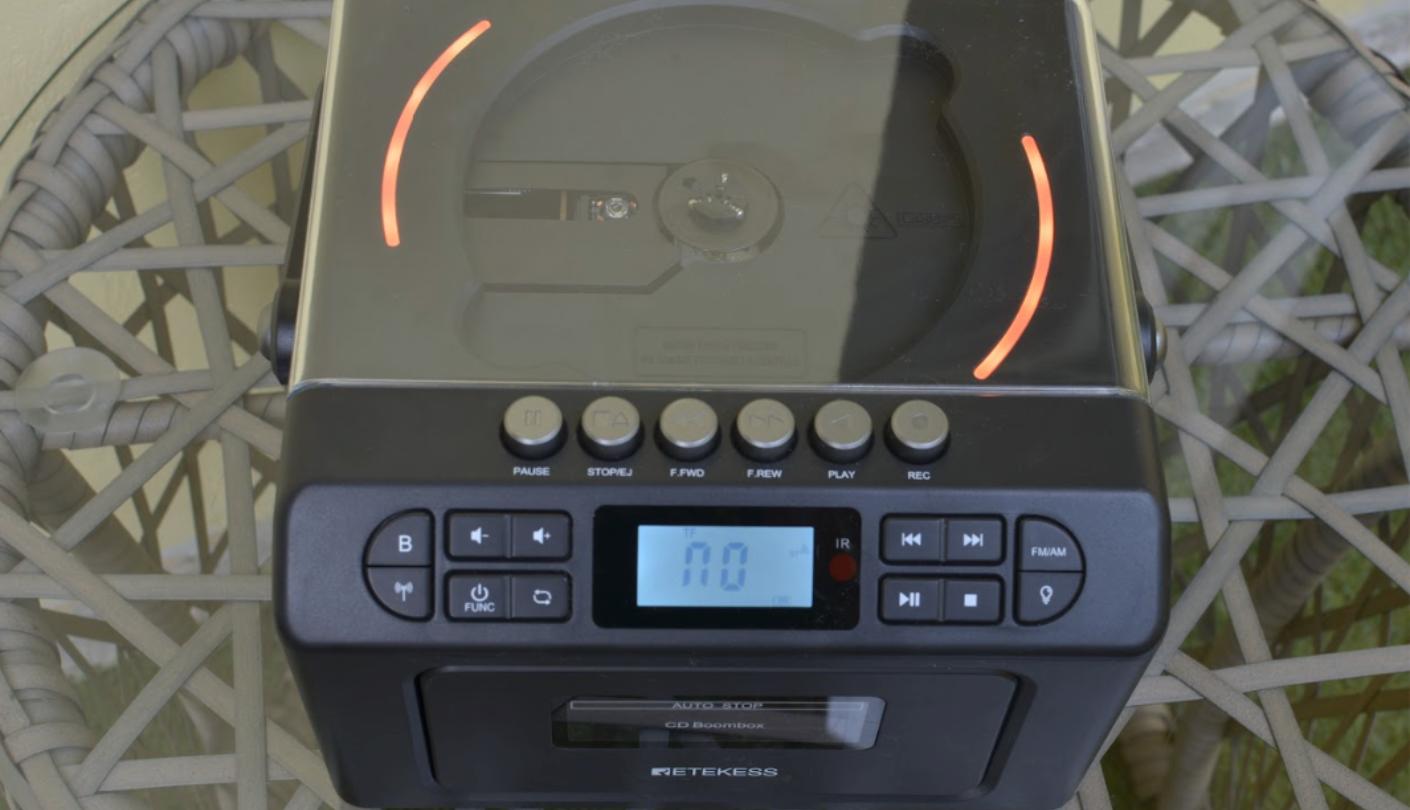
The LCD screen is worth discussing separately from the rest of the build. It shows mode, track, elapsed time, and battery status - all the information you'd want during playback. The screen itself is small. The bigger issue is that there is no backlight. In a lit room this is a non-issue. Set this unit across a dim bedroom and you'll need to lean in to confirm which track you're on. For anyone planning to pair it with the sleep timer function for nighttime radio listening, that constraint is worth knowing up front rather than discovering it after purchase.
The LED strip along the top cycles through colors slowly. It's defeatable with a single button press and I'd suggest doing it immediately - the unit looks cleaner without it and nothing else changes.
What's in the Box and Getting Started
Box contents:
- TR642 boombox with battery pre-installed
- USB-C charging cable
- 3.5mm AUX cable
- Remote control (batteries not included)
- User manual
Power on, press the mode button until you reach your input, start playing. Bluetooth pairing is searching for "RETEKESS-TR642" on a phone and confirming - first pairing takes about ten seconds. On every subsequent power cycle, the unit reconnects to the last paired device automatically. There is no app, no account, and no Wi-Fi setup involved.
AM/FM presets are manual: tune to a station, hold the preset button, saved. With 30 slots per band you can store an entire personal lineup across both FM and AM without running into limits. Running through a full local frequency sweep to populate the presets takes five minutes or so and doesn't need repeating unless your regular stations change.
One thing to sort out before gifting this unit: the remote control arrives without batteries and won't work until AAA cells are added. That's easy to overlook if you're packaging this for someone and want it immediately usable. The remote also operates CD, USB, and TF card modes only - tape playback and radio tuning use the physical buttons on the unit. Worth explaining to the recipient before they discover the remote does nothing when a cassette is running.
Speaker Output and Sound Character
The dual 3W speaker array fills a kitchen or a 15-square-meter room at 60% volume without pushing into distortion on standard material. I wouldn't take this into an open garage expecting to hear it from across the space, and the specs don't suggest otherwise. For the environments the TR642 targets - counter, desk, bedroom, workshop - the output level is appropriate to the room sizes involved.
The BASS button adds a meaningful low-frequency lift rather than a cosmetic one. At listening volumes up to around 65-70%, it thickens the bottom end cleanly - pop, hip-hop, and R&B tracks gain weight without the mids getting muddied. Above that range, the effect starts competing with the speakers' headroom. The practical rule: BASS on at moderate volumes, use the ROCK EQ preset instead when you're listening loud.
All five EQ presets produce clearly audible differences, which is worth confirming because budget-tier EQ presets often don't. JAZZ pushes the lower midrange forward and suits acoustic material well. ROCK adds presence in the upper mids without adding harshness. CLASSIC is the most reference-adjacent setting - reduced bass, extended highs, good for orchestral recordings. POP and FLAT are close but FLAT is genuinely flat on this speaker system. I ran the same three tracks through every preset sequentially: a blues guitar recording, a 90s pop album, and a Beethoven piano sonata. Each preset changed the character noticeably in ways that matched what the label describes.
Tape playback sounds like tape. That means analogue warmth, some tape hiss from older stock, and zero processing applied to the signal. Older recordings carry whatever sonic character they had when first recorded, surface noise included. For the audience buying this unit specifically to play back physical cassettes, that fidelity to the original recording is exactly the point.
All Seven Playback Modes, Tested
I ran each mode as the primary audio source for at least a full day of listening - the table below records what held up, what has limits, and where the TR642 goes further than a basic boombox would.
| Mode | Behavior in Use | Who Benefits and How |
| CD | Auto-loads on disc insertion. Single-track repeat, full-disc repeat, and shuffle available. Programmable queue: up to 20 tracks (standard CD) or 99 on MP3 discs. Reads CD-R and CD-RW in addition to pressed discs | Anyone with an existing CD collection gets a full-featured player here rather than basic playback. The programmable track queue lets you build a listening order from a physical disc without manual skipping - more useful than it sounds for classical albums and mixtapes |
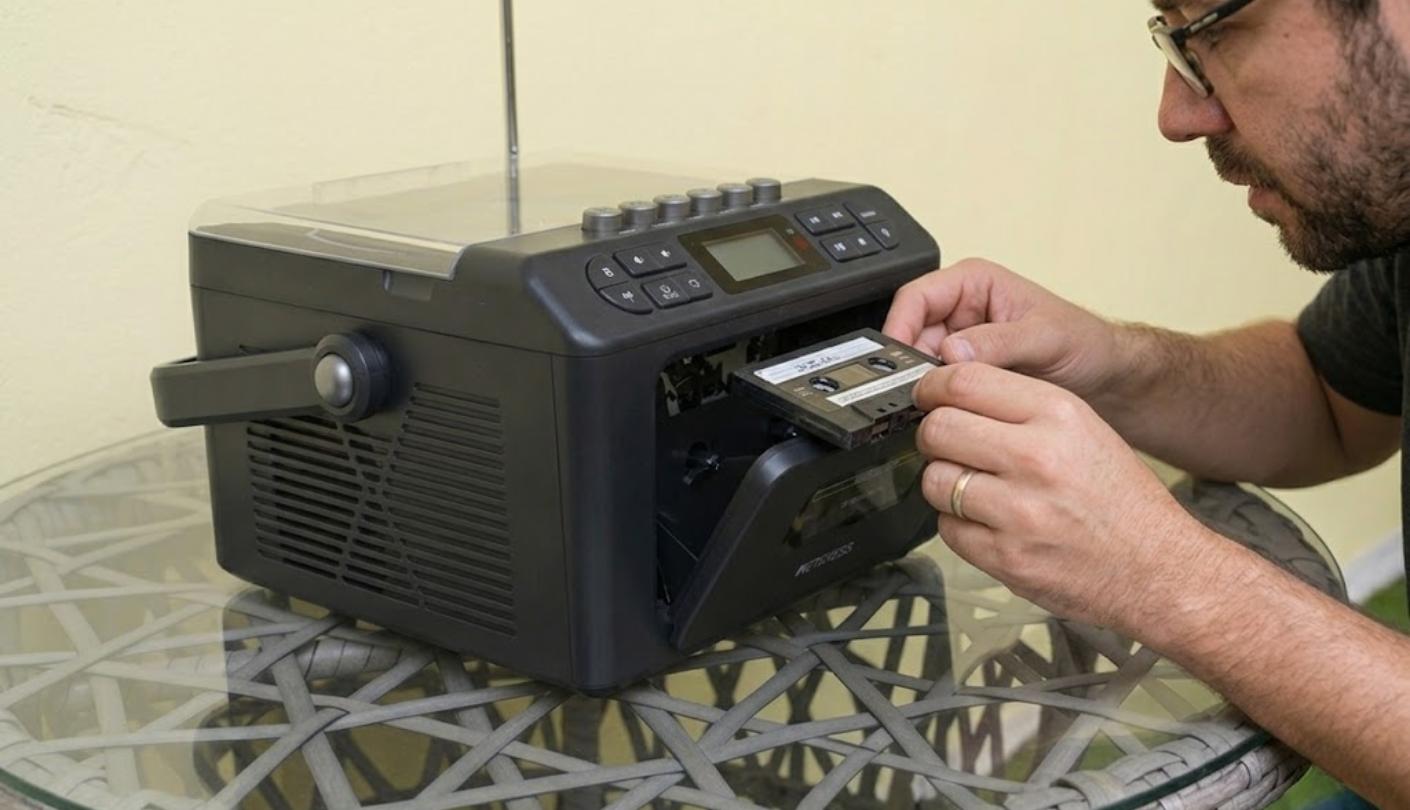
| Cassette | Playback with fast forward, fast rewind, pause, and auto-stop at tape end. Records from CD, AM/FM radio, and Bluetooth sources. Anti-erasure protection on pre-recorded tapes prevents accidental overwriting of commercially pressed cassettes | The recording function is what separates the TR642 from most portable boomboxes in 2025-2026. Capturing a live radio broadcast or a streaming playlist onto tape is a specific workflow, and the TR642 covers it. The anti-erasure feature means you can load an original cassette without checking whether the tab is intact first |
| AM/FM Radio | FM: 76.0-108 MHz. AM: 522-1710 kHz. 60 manually stored presets across both bands. Stereo FM output through the dual speakers | Antenna sensitivity varies by location, as it does on any portable radio. In areas with decent FM infrastructure, reception is clean. AM is functional for news, talk radio, and sports. The 60-preset memory is generous - most personal radio lineups run 10 to 20 stations |
| Bluetooth 5.3 | Receive mode: pairs with phones, tablets, and computers for wireless audio playback. Transmit mode: pushes audio from the TR642 out to wireless headphones or external Bluetooth speakers via the BT LAUNCH button. Reconnects to last paired device automatically on power-on. Supports MP3, WMA, and WAV - no LDAC or aptX HD | The transmit direction is the less obvious feature. Sending cassette or CD audio to a wireless headphone for private listening works exactly as described and is genuinely useful in shared households. Standard Bluetooth quality, not audiophile-grade - which is appropriate for a unit also playing cassette tape |
| USB Drive + TF Card | Reads drives and cards up to 64GB. Auto-play on insert. Programmable track queue for up to 99 files. MP3, WMA, and WAV supported | 64GB holds a substantial MP3 library. People who have ripped their CD collections can carry that content on a single card and access it in a physical-media workflow without needing a screen or an app to navigate |
| AUX In | 3.5mm input jack. Wired connection from any device with a headphone or line output | Covers anything with a headphone jack that doesn't fit the other modes: vintage MP3 players, laptops, turntables with a built-in preamp. No setup, no pairing - plug and play |
Battery Runtime and Charging
The TR642 uses two 3.7V lithium-ion cells wired in series for a combined 7.4V at 5000mAh. The 15-hour rating on the spec sheet reflects realistic performance at moderate volume in radio or Bluetooth mode with the LED strip off. Crank the volume, engage BASS, and run the CD drive - which draws more current than the solid-state sources - and the practical figure drops toward 11 to 12 hours. That's still enough for a full day of background listening without interruption.
A few specific runtime observations from two weeks of daily use:
- Bluetooth streaming, moderate volume, LED on: 12 to 13 hours - the LED strip draws measurably but not dramatically
- CD playback, high volume, BASS active: 10 to 11 hours - the mechanical drive is the biggest variable in the power budget
- AM/FM background listening, low volume: pushes closer to the rated ceiling - the radio tuner draws less than the Bluetooth module at equivalent volume
- Cassette playback: motor draw is real but moderate - similar runtime to CD at the same volume level
USB-C charging on a standard 5V/2A brick takes the battery from flat to full in 4 to 5 hours. Any modern phone charger works. A 10,000mAh power bank covers a full charge with capacity left over, which makes the TR642 viable at outdoor events or anywhere mains power isn't convenient.
One limitation worth flagging for counter or shelf use: the TR642 has no AC mains bypass mode. It runs on battery exclusively and recharges via USB-C. If the plan is to leave it running on a kitchen counter as a permanent radio, the battery cells will complete charge cycles over time. Switching it off between listening sessions and charging every few days is the way to manage that.
Extra Features Worth Knowing
Outside the seven playback modes, the TR642 has five secondary functions - some earn daily use, one exists purely for atmosphere, and one quietly prevents an annoying problem most portable radios never bother to solve.
| Feature | What It Does | Worth Having? |
| Sleep Timer | Auto-off after a set interval, configurable from the unit controls. Fired reliably at every duration I set across two weeks of nightly use | The most useful daily feature for bedroom placement. Pair it with a radio station or a cassette, set a duration, and the unit powers down on its own. No battery drain from an overnight forgotten switch |
| 3.5mm Headphone Jack | Speakers cut automatically when headphones are inserted. Output level is clean across all playback modes | Handles private listening without involving Bluetooth. The speaker cutoff on insert is standard but important - no hunting through a settings menu to mute the room |
| Remote Control | Track skip, play/pause, stop, and volume for CD, USB, and TF card modes. Tape and radio are not included in the remote's command set. Typical across-room range in a standard bedroom or kitchen | Useful for digital source modes at a distance. The mode coverage gap is real - anyone intending to use this primarily as a tape player and control it from a sofa will use the physical panel buttons more than expected. No batteries in the box |
| LED Ambient Strip | Color-cycling LEDs across the top surface. Toggles off with a single button press. No effect on audio behavior either way | A feature for kids' rooms and ambient setups. Most adults in my informal show-and-tell disabled it within the first session. Off by default would have been the better choice |
| Reset Button | Recessed button on the rear panel. Restores normal operation after a frozen display or locked controls without erasing stored radio presets | A minor addition that saves a genuinely annoying situation. A full power cycle on most portable radios wipes the station presets. The TR642's hardware reset skips that step |
TR642: What Owners Say
Verified Owner Feedback
The quotes below come from verified purchases on Amazon and Walmart and capture the two things buyers consistently praise and the two things that consistently catch them off guard.
Praises: "It has a CD player, AM/FM radio, cassette deck, SD card capability, Bluetooth connectivity, AUX in. All the features work as expected. It comes with a remote control. There are some glowing LED lights on the top that slowly change color, but this can be disabled."
"Works great. Easy to set up and use. Decent volume. Bluetooth connectivity is easy. Good value."
"Radio and CD play well. Figuring out the controls took just a few minutes. I am pleased!"
"I bought this to transfer my old cassette tapes onto my phone via Bluetooth and the recording actually works. I was skeptical but it picks up the audio cleanly. Also didn't realize you could record radio directly to a tape until I read the manual - that's a feature I didn't expect at this price."
"Got this for my father who has a collection of tapes going back to the 80s. He had it working within fifteen minutes without asking for help. The buttons are labeled clearly and there's no menu system to get lost in. He listens to it every morning now. Best gift I've bought in years."
***
Drawbacks: "The LCD screen is too small to see anything from a distance. You have to get close to see anything. It also does not have a backlight so good luck trying to see anything at night."
"I bought this boombox for my elderly mother. It looked easy to use and I was glad it came with a remote control. But the remote control has no volume buttons and no on/off button."
Two patterns run through TR642 owner feedback across Amazon and Walmart listings. Buyers who bought it to cover multiple legacy formats - cassettes plus CDs plus a radio - report that the unit does exactly what they needed and the controls are accessible enough that non-technical family members can manage it independently. The second pattern is buyers who bought it as a gift and expected the remote to run everything, including tape and radio modes. That expectation doesn't match the hardware, and the resulting frustration is avoidable with a 30-second conversation before the gift is opened. The LCD backlight complaint is consistent and legitimate - it's the one hardware decision that genuinely limits how and where this unit can be used comfortably.
Final Verdict: Is the Retekess TR642 Worth It?
The TR642 does something that sounds simple but takes real engineering choices to pull off: it puts seven working playback modes into a rechargeable unit that anyone can operate without a tutorial. Cassette recording from Bluetooth and radio sources is not a feature you find in most all-in-one boomboxes regardless of price. The dual-direction Bluetooth extends what the unit can do without adding hardware. The 15-hour battery and USB-C charging mean the portable aspect is actually usable rather than a spec footnote.
The LCD backlight omission is a genuine daily inconvenience for anyone who uses this in a dim space - not a fatal flaw, but a repeated one. The remote's partial mode coverage is a design compromise that makes sense for the hardware architecture but creates a clear gap for users who planned on full remote operation. Both of these are worth knowing before buying rather than after.
The TR642 belongs on a short list for households covering multiple format generations, for gifts to music lovers who still buy physical media, and for anyone who wants a bedroom or kitchen radio with enough playback versatility to handle whatever gets plugged into it or loaded into it on a given day. Competitors like Greadio and Jensen cover similar format lists but drop the Bluetooth transmit mode and the multi-source cassette recording - features the TR642 doesn't give up to hit its price point. For the audience it's built for, that's a meaningful difference.

Jim's our tech geek with a mission since February 2023. From movies to video projectors, he knows his stuff and aims to make tech work for you. When he's not geeking out, he's there to guide you through making savvy decisions.


