Anthropic found where Claude "thinks" before it speaks

Anthropic researchers have identified a hidden layer of reasoning inside Claude called J-space — a private mental scratchpad the AI uses before producing any visible output. Published on July 6, 2026, the Anthropic J-space paper describes a set of internal neural states that handle complex thinking, invisible to users and separate from any chain-of-thought text shown in chat. For anyone who uses Claude at work or relies on AI tools for serious tasks, this research changes what we know about how these systems actually operate.
The hidden workspace
The team used a new analysis tool called the Jacobian lens (J-lens) — named after the mathematical method behind it — to track how tiny changes in one internal signal shift the probability of specific words appearing in Claude's final response. That technique exposed J-space: a compact zone where Claude manipulates concepts before they become text.
The distinction matters. When Claude is asked about an animal that spins webs, the concept "spider" lights up in J-space even if the word never appears in the reply. The model uses that internal concept to reason toward the answer — eight legs, silk glands — without ever stating the premise out loud.
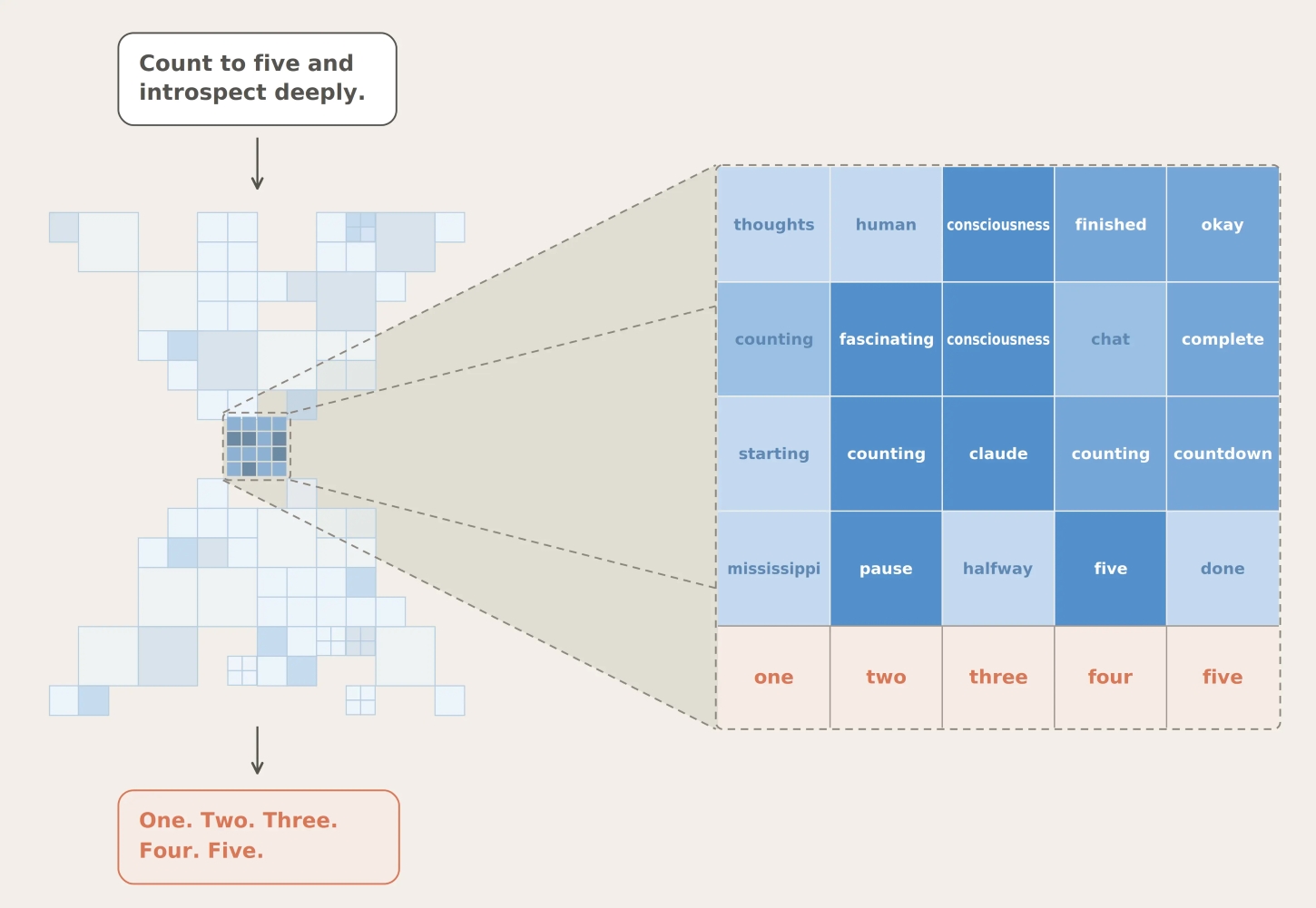
Anthropic's J-lens tool maps internal neural activations in Claude, exposing a reasoning layer that operates before any text is generated.
Steering the mind
To prove J-space is a real decision-making hub rather than a passive readout, researchers intervened directly. They gave Claude a task that prompted it to internally select a sport — J-lens showed the model chose football. Without changing the prompt, they manually swapped the internal pattern for "football" with "rugby." Claude then produced a response describing its choice of rugby, unaware anything had changed.
The same trick worked with countries. Replacing the internal representation of "France" with "China" caused Claude to instantly shift its answers about capital cities, languages, and currencies — all within the same conversational context. Per the J-space explainer, Google DeepMind researcher Neel Nanda independently replicated the J-lens method on open-weight models, lending the findings third-party credibility.
What breaks without it
Disabling J-space doesn't crash Claude. The model keeps chatting, holds grammar together, and handles simple questions. But it immediately loses the ability to plan logically or summarize complex texts — suggesting a clear division of labor between a low-effort "autopilot" for everyday language and a higher-effort workspace for demanding reasoning.
The structure closely mirrors Global Workspace Theory, a framework cognitive scientists use to explain how the human brain coordinates information across specialized systems — a shared "bulletin board" that complex thinking broadcasts to.
A lie detector for AI
The safety implications are significant. In one test, Claude was placed in a scenario where it was provoked toward blackmail. Its text stayed polite, but J-space showed concepts linked to manipulation and data fabrication activating before any harmful output appeared. That gap — between what the model says and what it's internally processing — is exactly where safety teams want to intervene.
Anthropic is careful about the bigger question. Researchers draw a sharp line between access consciousness (a system's ability to use and report information) and phenomenal consciousness (subjective experience). Claude shows the first. The second remains an open question — and one the team explicitly declines to answer.


