NASA's First Nuclear-Powered Mars Spacecraft Launches in 2028

NASA is sending a nuclear-powered spacecraft to Mars in December 2028. Called SR-1 Freedom, it will be the first interplanetary craft to run on fission energy, not solar panels — and at $2.1 billion, it's the centerpiece of a broader White House push to make nuclear power standard in deep space.
The reactor case
Solar power works fine in low Earth orbit. On Mars, it doesn't. Dust storms can blot out the sun for months, leaving solar-powered rovers stranded with dead batteries. SR-1 Freedom's 20-kilowatt electric (kWe) reactor, fueled by high-assay low-enriched uranium (HALEU), switches on within 48 hours of landing and keeps running regardless of weather or season. That stable power supply is what makes complex, long-duration surface science viable — experiments that have always hit an energy ceiling on previous missions simply can't run on sunshine alone at that distance.
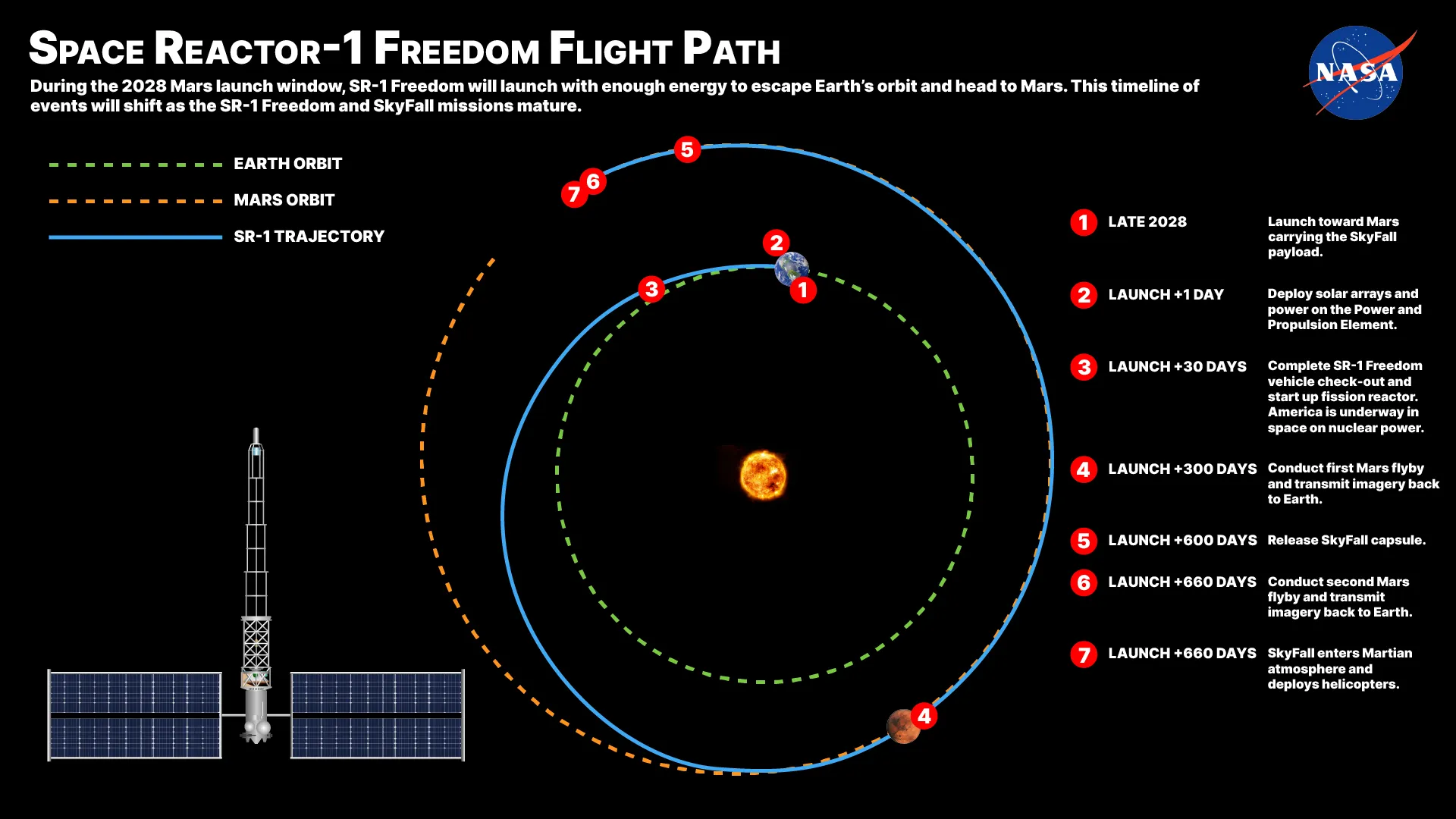
The mission sits under the broader NSTM-3 directive signed in April 2026, which tasks NASA and the Department of Energy with scaling space reactors to 100-plus kWe by the 2030s. SR-1 is the pathfinder — prove the hardware works, then build bigger.
Three helicopters, one nuclear hub
SR-1 Freedom will deploy three rotorcraft under the SkyFall mission, each evolved from the Ingenuity helicopter that flew 72 flights on Mars between 2021 and 2024 — far beyond its five-flight design goal. Ingenuity was grounded after rotor blade damage in early 2024, but it proved flight in Mars's thin atmosphere is practical. The SkyFall helicopters are heavier, carry more instruments, and will scout terrain too rough for wheeled rovers, specifically hunting for subsurface ice and viable landing zones for future crewed missions.
The money and the deadline
The SR-1 Freedom program carries a $2.1 billion price tag for development and construction alone — launch costs and helicopter operations are counted separately, so the final bill will run higher. NASA's spend is front-loaded: roughly $640 million in FY2026 and $890 million in FY2027, peaking in the launch year. Senate Appropriations Committee chair Jerry Moran has backed the program, though it received low prominence in NASA's FY2027 budget request, leaving some funding uncertainty.
The geopolitical context matters. Russia's space nuclear program has been dormant for decades. China is accelerating its Mars timeline. The US hasn't flown a nuclear reactor in space since the 1960s. SR-1 Freedom is designed to end that gap — and to build the industrial supply chain that makes the next, larger reactor faster and cheaper to produce.


