The largest known galaxy is 17 times wider than the Milky Way — and still growing

Astronomers have confirmed the full extent of IC 1101, the largest known galaxy, and it dwarfs everything in its neighborhood — 1.7 million light-years across, 17 times wider than the Milky Way, and still actively pulling in more mass. The figures come from the deepest images ever taken of IC 1101, captured by the Isaac Newton Telescope on the Canary Islands in 2026. For anyone keeping score: you could fit roughly 4,000 Milky Ways inside it.
The numbers
The new measurements, published in an arXiv study by Marrero-de la Rosa et al., pin the galaxy's diameter at around 520 kiloparsecs — significantly larger than earlier estimates of about 370,000 light-years. Its stellar mass comes in at 3.4 trillion times the mass of our Sun, between 9 and 34 times heavier than the entire star population of the Milky Way. Despite that bulk, IC 1101 is surprisingly diffuse: the sheer volume means average stellar density is actually lower than in our own galaxy.
At its core sits a supermassive black hole estimated at 40 to 70 billion solar masses — among the largest of any known galaxy. For context, the black hole at the center of the Milky Way weighs about 4 million solar masses.
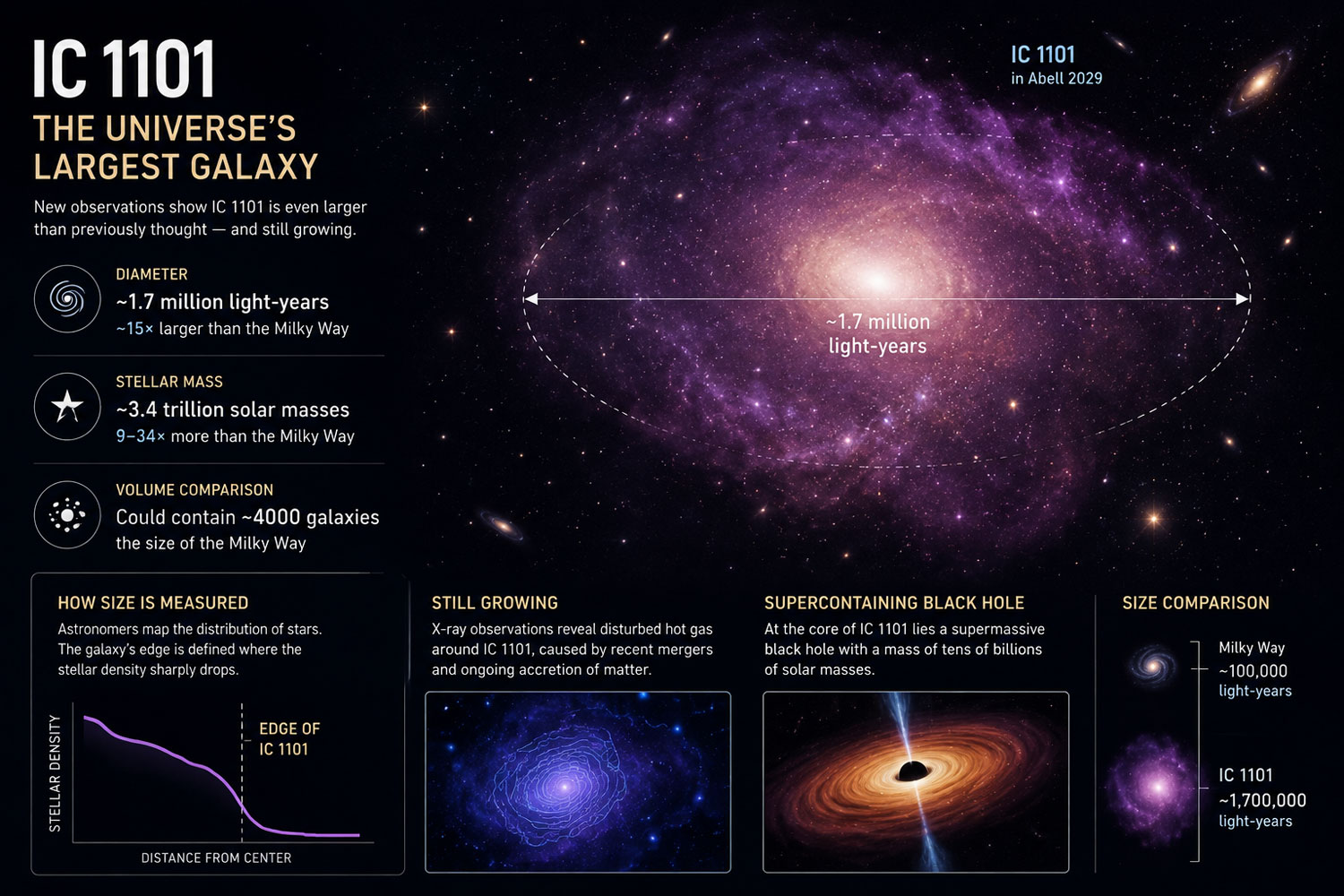
IC 1101, the largest known galaxy, sits at the center of galaxy cluster Abell 2029, roughly one billion light-years from Earth.
Pinning down the boundary of a structure this large is genuinely hard. Galaxies don't have clean edges. The team analyzed stellar distribution, surface brightness, and mass density to determine where IC 1101's main body ends and the surrounding void begins — resolving the outer edge clearly for the first time.
Still eating
IC 1101 sits at the center of the Abell 2029 galaxy cluster, and it has not stopped growing. X-ray data from NASA's Chandra observatory show disturbed gas around the galaxy — evidence of recent accretion events, meaning it has absorbed nearby material or smaller galaxies relatively recently, according to Phys.org. Eight faint asymmetric structures around the galaxy point to ongoing mergers.
This is galactic cannibalism at scale. In dense clusters like Abell 2029, the most massive object gradually pulls in everything that strays too close. IC 1101 has been doing this for billions of years, and the Chandra data suggest it is still doing it now.
The revised size figures make IC 1101 not just a record-breaker but a live case study in how the universe's largest structures form — one merger at a time.


