Amazon bets on Nobel Prize-winning chemistry to slash warehouse cooling costs

Amazon has signed a multi-year commercial deal with HVAC startup Transaera after a successful six-month trial at a Houston logistics facility. The system uses a Nobel Prize-winning material to separate dehumidification from cooling, cutting energy use by 40% compared to conventional air conditioning. For a company spending billions to hit net-zero by 2040, this is the kind of efficiency gain that moves the needle.
The problem with standard air conditioning
Most commercial HVAC systems try to cool air and strip moisture from it at the same time. In humid climates — Houston being a prime example — that creates an expensive feedback loop: the system overcools the air to wring out moisture, then reheats it before pumping it into the building. Transaera CEO Sorin Grama calls this the core inefficiency of modern buildings, and he's not wrong. HVAC accounts for roughly one-third of all commercial building energy use in the US.
How the sorbent wheel works
Transaera's Dedicated Outdoor Air System (DOAS) breaks that loop. A rotating wheel coated in a high-performance sorbent — a material called a Metal Organic Framework, or MOF — pulls moisture directly out of incoming air before it ever reaches the cooling stage. The dry air then passes through a heat exchanger and into the building.
The numbers are concrete: the system removes up to 45 kg of water per hour from the air, more than double the federal minimum efficiency standard. Transaera was founded in 2018 by MIT engineers, and the MOF research underpinning its sorbent material was awarded the 2025 Nobel Prize in Chemistry to Omar Yaghi, Susumu Kitagawa, and Richard Robson.
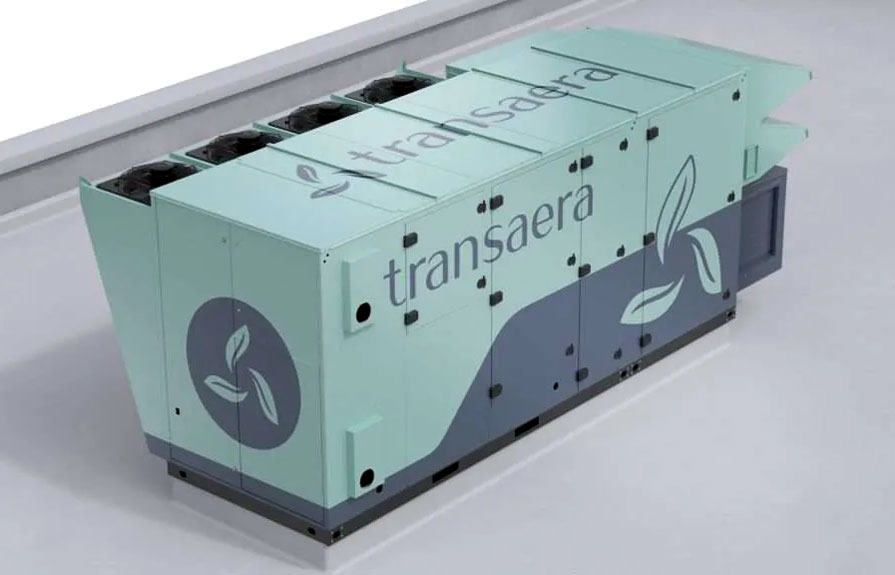
Transaera's Dedicated Outdoor Air System (DOAS). Illustration: Transaera
Amazon's scale play
The Houston trial results were strong enough that Amazon has committed to purchasing the systems for the next three years, per the Amazon–Transaera PRNewswire announcement. Transaera will dedicate US-based manufacturing capacity to meet that demand. The company's CEO has pointed to nine-figure purchasing targets from other customers as well, suggesting the Houston pilot is the start of a much larger rollout, reports TechCrunch.
One practical advantage: the DOAS unit is designed as a drop-in replacement for existing ventilation components. That sidesteps the full infrastructure overhaul that usually kills retrofit projects in large commercial buildings. Amazon's plan is to standardize the design across its portfolio — warehouses, data centers, and beyond — which could make it a template for other Fortune 500 operators facing the same energy bills.


