Humanoid robots nearly matched human workers in a 10-hour warehouse test

Figure AI has run one of the most concrete real-world comparisons yet between humanoid robots and human workers—and the machines nearly won. In a 10-hour warehouse sorting marathon, three Figure 03 robots processed 12,732 packages while a team of human interns handled 12,924. That's a gap of just 192 packages, or 1.3%, and the robots worked the entire shift without stopping.
The test
The setup was straightforward. Workers—human and robot—had to pick a package, scan its barcode, and place it face-down on a conveyor belt. The human interns followed California labor law: a 30-minute lunch break and two paid 10-minute breaks, totalling around 50 minutes of downtime. The robots took none. Average processing time was 2.79 seconds per package for humans, 2.83 seconds for the robots. On raw pace, the humans were faster; over a full shift including mandatory rest, the gap effectively vanished.
Figure AI CEO Brett Adcock framed the result as a milestone rather than a loss: "Although the robot didn't win, it significantly exceeded expectations, marking an important milestone in the commercialization of humanoid robots."
We're live Man vs. Machine https://t.co/ovr2sm3Iof
— Figure (@Figure_robot) May 17, 2026
From test to factory floor
This wasn't a one-off stunt. Figure 03's predecessor, the Figure 02, already has 11 months of production time at BMW Spartanburg under its belt—1,250-plus hours of runtime, more than 90,000 parts loaded across 30,000 vehicles. Figure 03 launched in October 2025, and the company's BotQ manufacturing facility has since ramped from one robot per day to one robot per hour, a 24-fold increase in under four months, with a target of 12,000 units annually.
The warehouse test was also extended well beyond the original plan. Per Interesting Engineering, Figure 03 ran for more than 30 consecutive hours without failure, with robots independently managing maintenance and swaps—a detail that matters more for commercial deployment than any single-shift comparison.
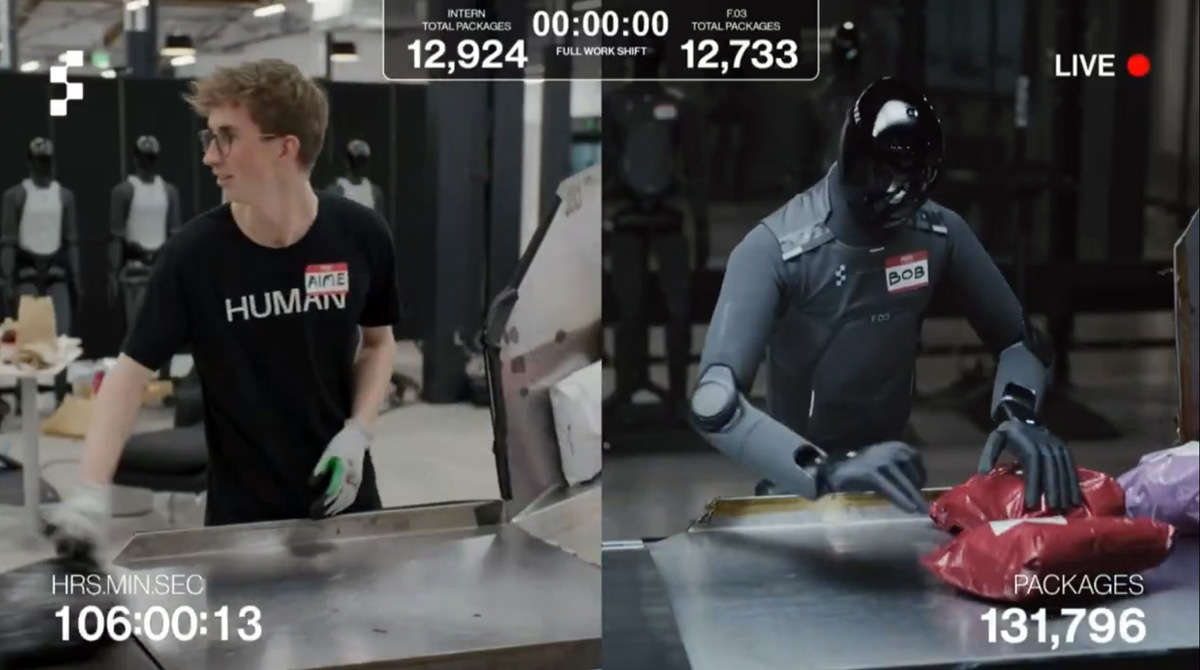
Final results: Figure 03 — 12,732 packages | Intern Aimee — 12,924 packages. Illustration: @adcock_brett
What comes next
Figure AI is valued at $39 billion after a Series C round backed by Brookfield, Macquarie, and LG. BMW has also launched a Figure 03 pilot at its Leipzig plant in Germany, the robot's first European deployment, focused on high-voltage battery components and exterior parts. Tesla Optimus and Boston Dynamics Atlas are pursuing the same logistics and manufacturing market, but with no federal US law yet governing humanoid robots, the path to scale remains relatively open.
The 1.3% gap is the headline number, but the more meaningful data point is reliability: a robot that can run a full shift, then keep going for another 20 hours, changes the economics of warehouse staffing in ways that speed alone never could.


