Nvidia DLSS 4.5 Ray Reconstruction: Better ray tracing for every RTX GPU

Nvidia is updating its DLSS ray-tracing tech in August 2026 with a new version called Ray Reconstruction 4.5, and it works on every GeForce RTX GPU — including RTX 20 and 30 series cards that are now several years old. The update uses a second-generation transformer model that is 35% more compute-capable and processes 20% more parameters than the current version, per Nvidia's official announcement. Nvidia says performance stays roughly the same despite those gains, meaning you get a better-looking image without sacrificing frame rates.
The technology
Ray tracing calculates how light bounces around a scene to produce realistic reflections, shadows, and global illumination. The problem is that it's computationally expensive, and traditional "denoising" algorithms — which clean up the noisy, incomplete image the GPU renders — often introduce blurring or ghosting artifacts, especially on moving objects. DLSS 4.5 Ray Reconstruction replaces those hand-tuned denoisers with a single neural network that handles both denoising and image reconstruction simultaneously. The result, Nvidia claims, is better temporal stability (less flickering between frames), more accurate lighting, and fewer ghosting artifacts in reflections. Game developers also get more granular controls over how data is accumulated, letting them tune the look to match their artistic intent.
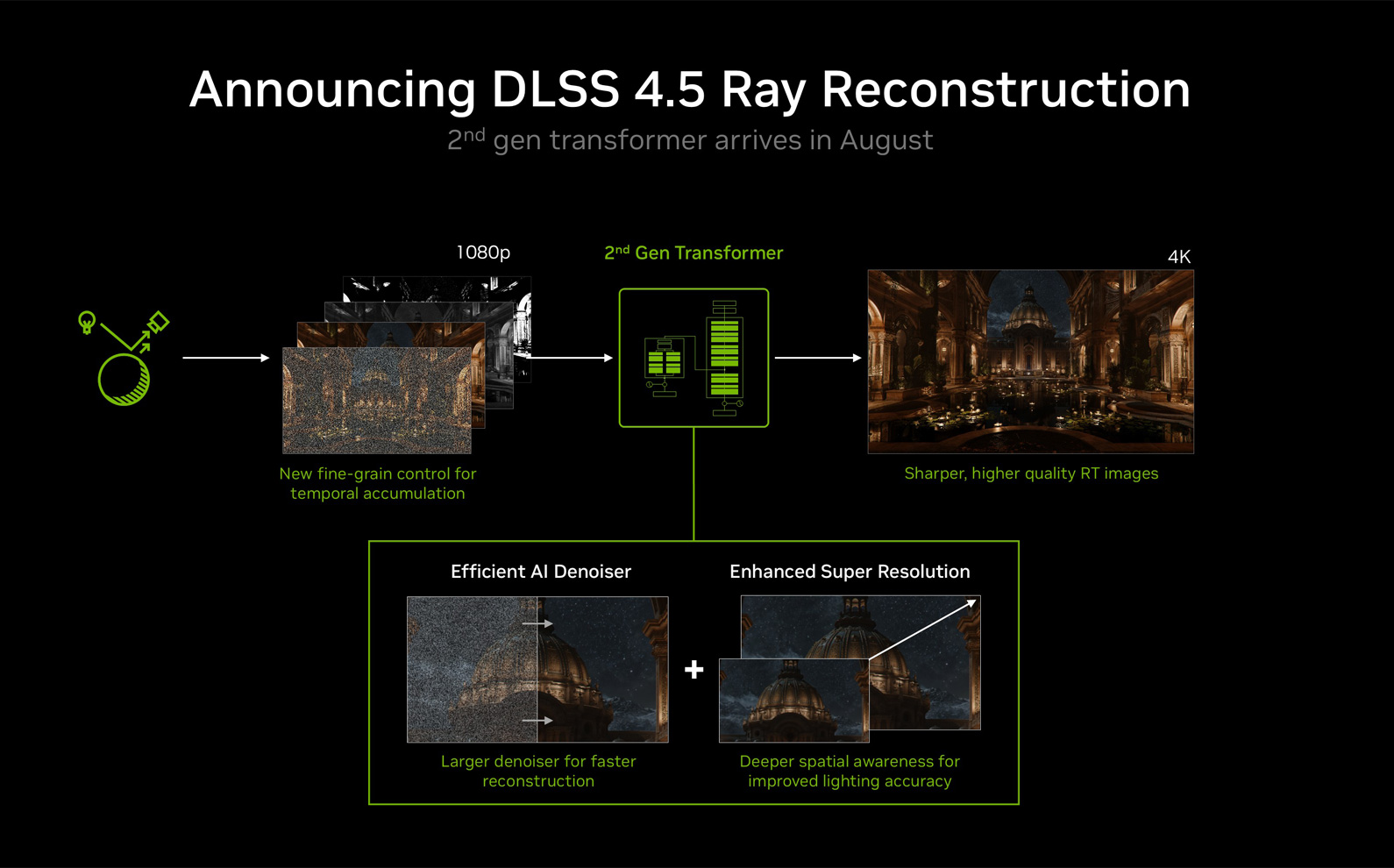
The transformer model is the same architecture Nvidia introduced with DLSS 4, but this second generation is trained on a broader dataset. For owners of RTX 20 and 30 cards, there is a caveat worth noting: those GPUs lack native FP8 (8-bit floating point) support found in RTX 40 and 50 hardware, which TechSpot flags as a potential source of efficiency overhead compared to newer cards.
Twenty-seven games at launch
Ray Reconstruction 4.5 arrives in August 2026 via the Nvidia App — the replacement for the older GeForce Experience and Control Panel software. Twenty-seven games support it from day one, including some of the most visually demanding titles available:
- Cyberpunk 2077 - Alan Wake 2 - DOOM: The Dark Ages - Half-Life 2 RTX - Hogwarts Legacy - Indiana Jones and the Great Circle - Star Wars Outlaws
The broader RTX ecosystem has now crossed 1,000 supported games and applications. Blender 5.3 is also integrating Ray Reconstruction as a denoiser for its interactive viewport, which matters for 3D artists and VFX professionals who use Nvidia hardware.
Worth keeping your old card?
For anyone sitting on an RTX 20 or 30 series GPU and weighing an upgrade, this update buys more time. Ray tracing still demands a lot from older hardware, and no AI denoiser changes that fundamental constraint. But if you already have an RTX card and play any of the supported titles, the improvement arrives as a free software patch — no new hardware required. AMD's FSR works across any GPU without a vendor lock-in, and Intel's XeSS runs on Arc cards, but neither matches Nvidia's Ray Reconstruction in outright image quality for ray-traced scenes, at least by Nvidia's own benchmarks.


