Korean Scientists Revolutionize Battery Tech with Eco-Friendly, Cost-Effective Dry Anode Process

While the world waits for solid-state batteries like a second coming, Korean scientists decided not to wait for a miracle but simply "dry out" what we already have. Experts from the Korean Institute of Materials Science (KIMS) and their colleagues from the Korean Electrical Research Institute (KERI) presented a new anode manufacturing technology that promises to change the game in the traction battery industry.
Less Toxicity, More Profit
Traditional battery production is a dirty and energy-intensive business. It usually requires the use of toxic solvents, which then need to be evaporated in huge ovens. This not only harms the environment but also significantly inflates electricity bills. Koreans propose switching to a "dry" method. Instead of cooking a "chemical soup," they form electrodes directly from powder mixtures. This eliminates the most expensive stages of drying and solvent recovery from the production chain.
Farewell to Teflon
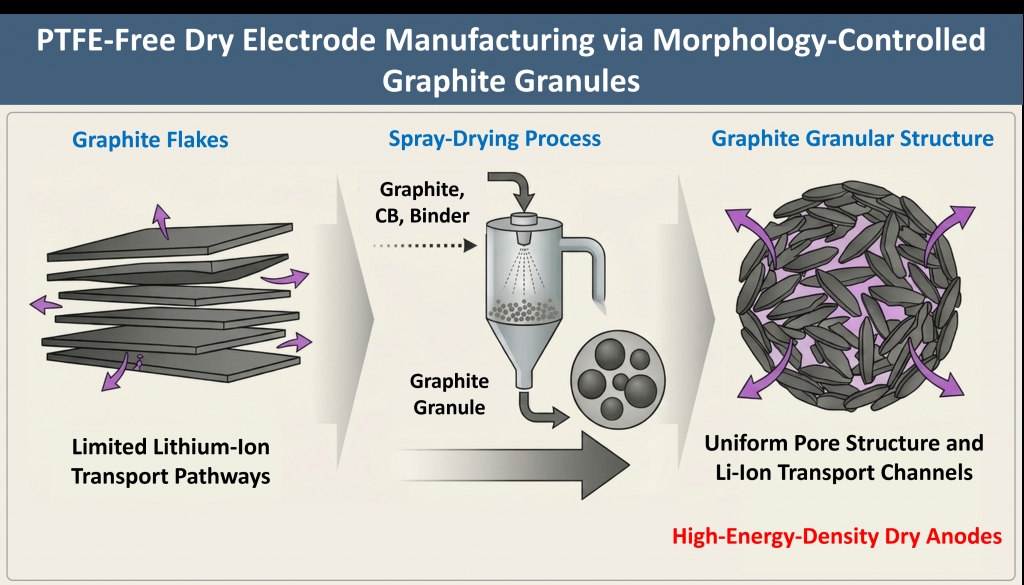
Interestingly, scientists decided to abandon polytetrafluoroethylene (PTFE), known to us as Teflon. Usually, it acts as the "glue" in dry manufacturing methods, but it is fickle and expensive. Instead, the researchers adapted an eco-friendly binder system that was previously used only in "wet" processes. This not only simplifies logistics but also makes production cheaper, as it does not require the search for specific components that were previously considered indispensable for the "dry" technology.

The Geometry of Ions and Fast Charging
The main technical "feature" of the development lies in the structure of the anode itself. Instead of the usual flat graphite flakes, the scientists created rounded granules with a random layer arrangement. If lithium ions previously had to find complex paths between flat plates, now they move much more freely. In practice, this means that the device can accept a large current without the risk of degradation.
Tests confirmed: such a structure allows for the creation of thicker anodes with higher energy density. This is a direct path to increasing the range of electric cars without increasing the physical size of the battery pack. Moreover, the technology is compatible with existing production lines. This means that car manufacturers will not have to demolish old factories and build new ones — just a point upgrade of the equipment is sufficient.
While scientists conjure over battery capacities, some manufacturers are betting on the raw power of internal combustion engines. For example, Hennessey Venom F5-M offers a crazy 2031 hp and a manual transmission for those who appreciate classic driving.


