NASA's telescope rescue mission delayed after rocket anomaly scrubs launch

NASA's $30 million mission to save a 22-year-old space telescope hit an immediate obstacle on July 2, when a launch vehicle anomaly prevented the Pegasus XL rocket from safely igniting its engines. The spacecraft meant to rescue the Neil Gehrels Swift Observatory never left the carrier plane — and engineers are now racing the clock to reschedule before Swift falls out of orbit entirely.
The telescope running out of time
Swift launched in 2004 to detect gamma-ray bursts and has far outlasted its original mission. The problem: atmospheric drag has been slowly pulling it down from its original 600 km orbit to around 400 km, and without intervention it will reenter Earth's atmosphere by October 2026. NASA contracted Arizona startup Katalyst Space in September 2025 to build a robotic spacecraft — LINK — that would dock with Swift, grab it using three mechanical arms, and boost it back up to 600 km. That would buy the observatory another decade of science. The total bill: $30 million, a fraction of what it would cost to replace the telescope.
What makes this notable is what LINK represents beyond the Swift mission itself. This would be the first commercial robotic docking with a government satellite that was never designed to be serviced. If it works, the playbook changes: instead of retiring aging satellites, operators could send up robotic tugs to refuel or reposition them. Katalyst beat out Starfish Space and a joint Cambrian Works/Astroscale bid to win the contract, per Wikipedia Swift Rescue Mission, compressing what typically takes 24 months of development into roughly nine months.
A rocket with one launch left
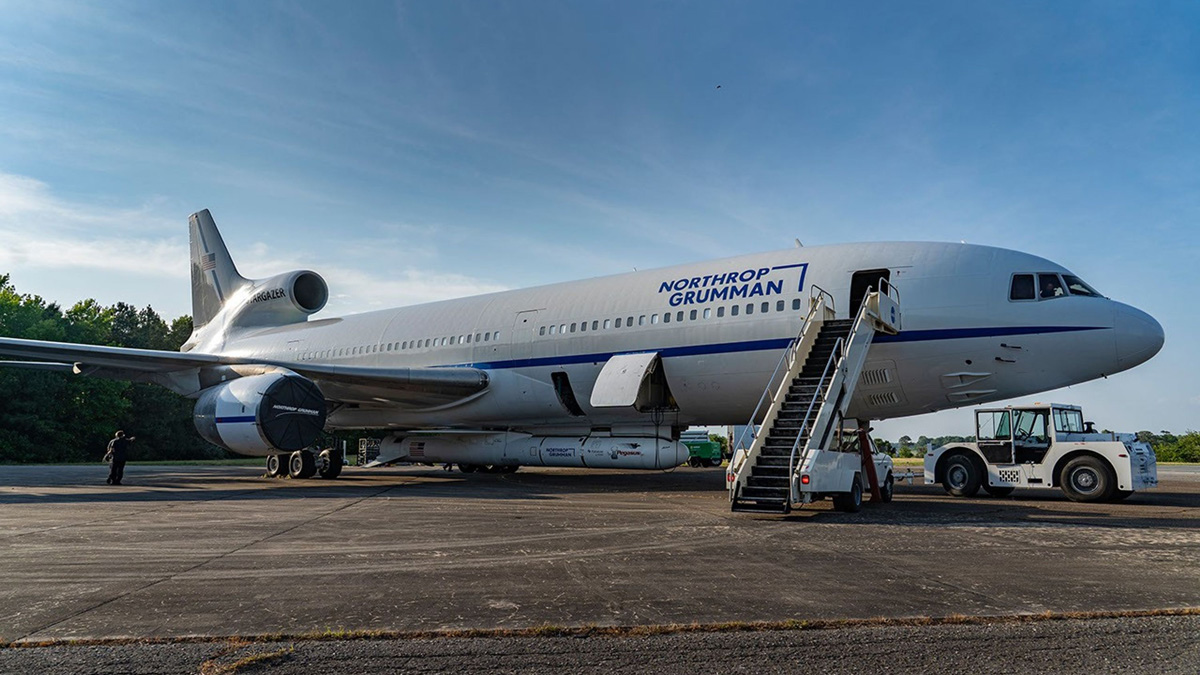
The launch method was unusual. Pegasus XL — built by Northrop Grumman — doesn't lift off from a pad. It hangs under the belly of a modified L-1011 aircraft called Stargazer, which carries it to about 12 km altitude before dropping it. The rocket then ignites and continues to orbit. This air-launch approach was chosen specifically because Swift sits in a 20.6-degree orbital inclination that's difficult and expensive to reach from a conventional ground site on the compressed timeline and budget.
Stargazer took off from Kwajalein Atoll in the Pacific on July 2, but the drop never happened. Telemetry flagged an anomaly in the Pegasus XL's systems that made engine ignition unsafe. The plane returned to base with the rocket still attached. According to the NASA Swift Blog (Jul 2, 2026), a new launch date will only be set after engineers complete a full review of the flight data.
The stakes extend beyond the telescope itself. Pegasus XL is making its final ever flight on this mission — the previous launch was in 2021 — meaning there is no fallback option if the vehicle is grounded permanently. Katalyst and Northrop Grumman teams are reportedly working around the clock. Every day on the ground tightens the window before Swift makes an uncontrolled reentry.


