Cars are still built around an average man — and women pay the price

Women are 1.6 times more likely to be injured in a car crash than a male occupant in the same vehicle, according to a new study from the TU Graz Vehicle Safety Institute. Researchers analyzed Austrian accident data spanning 2012 to 2024. At low speeds — the kind of collision most drivers will actually experience — the injury risk for women more than doubles.
The finding lands as regulators on both sides of the Atlantic face mounting pressure to modernize crash test standards that haven't fundamentally changed in decades.
The male-default problem
Every car on sale today is designed and tested around the "50th percentile male" — a dummy modeled on the average adult man. A smaller "female" dummy has existed since 1988, but it is not anatomically female. It is a scaled-down male model with rubber prosthetics. Critically, 95% of real women are taller and heavier than this dummy, and key anatomical differences — pelvic width, chest structure, shoulder geometry — go untested in both frontal and side-impact scenarios, per research documented by Stanford's Gendered Innovations project.
TU Graz project lead Corina Klug notes that women suffer disproportionately higher rates of chest, spine, and limb injuries. The gap widens significantly for occupants over 50.
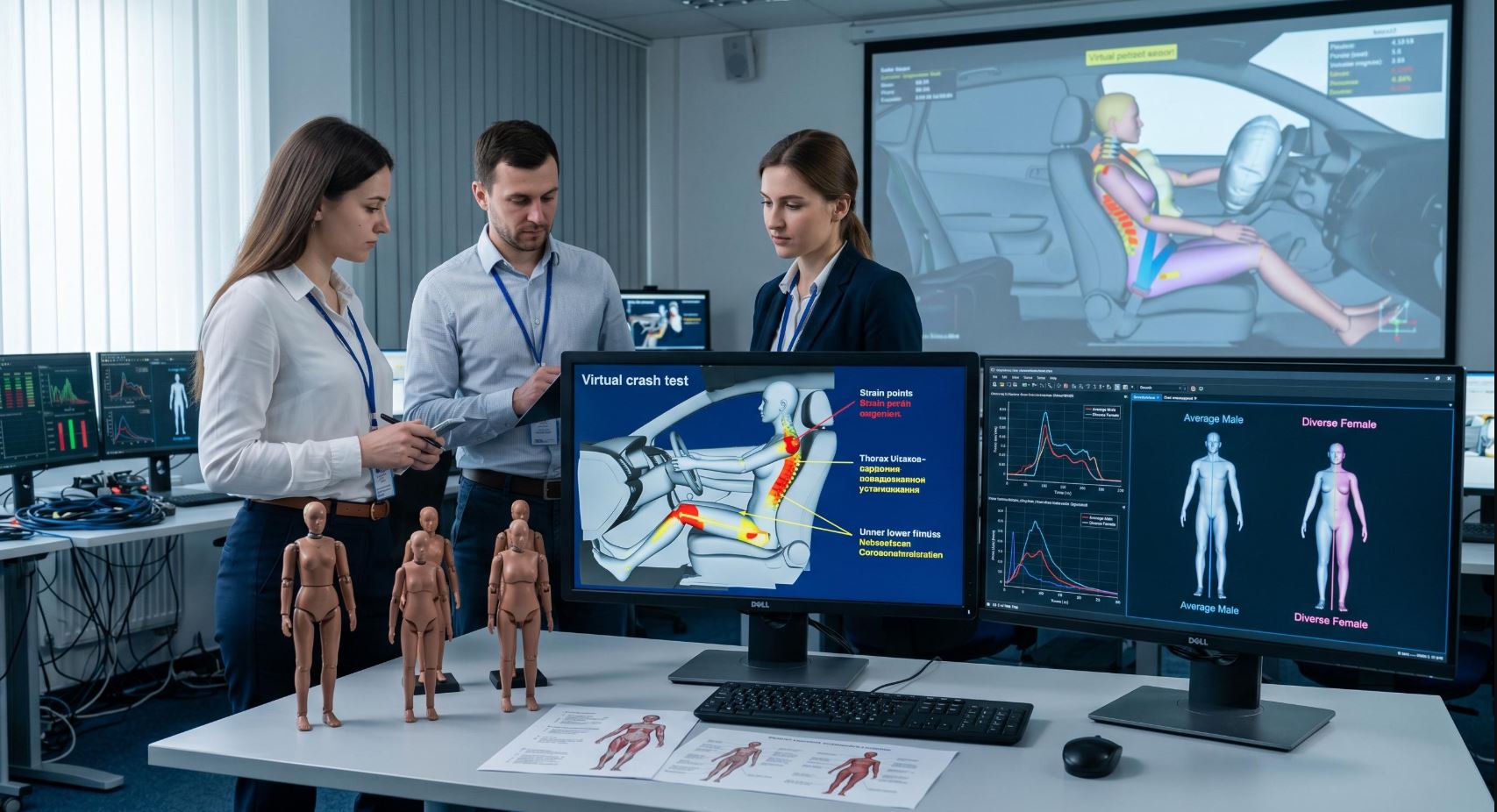
Current female crash test dummies are scaled-down male models that don't reflect the anatomy of 95% of real women.
Seat position and submarining
The research also flagged two under-discussed risk factors. First, seating position: women more often occupy the passenger seat and tend to sit with the backrest reclined or the seat pushed further back. Standard seatbelts and airbags are not calibrated for those postures.
Second, a phenomenon called submarining — where the body slides under the lap belt on impact due to a reclined seat, bulky winter clothing, or a blanket. The result is severe internal injury. Researchers are clear: the lap belt must sit across the pelvic bone, and the shoulder strap across the collarbone. Any "comfortable" deviation eliminates the belt's protective function.
UK Department for Transport data shows women account for 55.9% of killed or seriously injured car passengers (2022), a figure that aligns with the 1.6× multiplier from Graz and with US findings that women are 73% more likely to be injured in head-on collisions.
What's changing — and how slowly
Euro NCAP's 2026 protocols will introduce virtual simulations and sled testing to account for a wider range of body types and statures. In the US, NHTSA approved a new anatomically female dummy — the THOR-05F — in November 2025, but a mandate requiring its use in safety ratings is not expected before 2027–28.
TU Graz argues the real solution is adaptive restraint systems: seatbelt load limiters that automatically adjust to a passenger's weight, build, and seating position. Virtual biomechanical modeling makes it possible to test thousands of body configurations without running costly physical crash tests. The researchers are explicit that women are not small men, and that using a universal model distorts real injury risk assessments for half the population.


