Smartphone shipments hit a 13-year low — and cheap phones are paying the price

Global smartphone shipments dropped 11% year-over-year in Q2 2026 — the weakest second quarter since 2013, according to the Counterpoint Q2 2026 report. The culprit is a shortage of DRAM and NAND flash memory, as chip manufacturers redirected supply toward AI data centres and away from consumer devices. If you're shopping for a new phone right now, expect fewer choices and higher prices at the affordable end of the market.
The memory squeeze
Chip makers have been shifting production capacity toward High Bandwidth Memory (HBM) — the specialist chips that power AI servers at companies like Microsoft and Google. That reallocation has cut into the supply of standard DRAM and NAND used in everyday smartphones. As component costs rise, phone makers pass those increases on to buyers.
The impact is sharpest in the budget and mid-range tiers. Memory accounts for roughly 60% of a budget phone's total component cost, versus around 30% for premium models. According to the Gartner price/demand forecast, smartphones under $100 are set to disappear entirely in 2026, and the average selling price across all phones is on track to hit a record $523. Analysts expect memory supply to remain tight into 2027.
Winners and losers
Samsung reclaimed the top spot globally with 24% market share, helped by strong performance in India and the Middle East, aggressive summer promotions, and its own in-house memory manufacturing — which lets it absorb cost increases that rivals cannot. Apple hit a record 20% share for a Q2, with iPhone 17 remaining the single best-selling smartphone on the planet. Apple was the only major manufacturer to avoid raising prices this quarter.
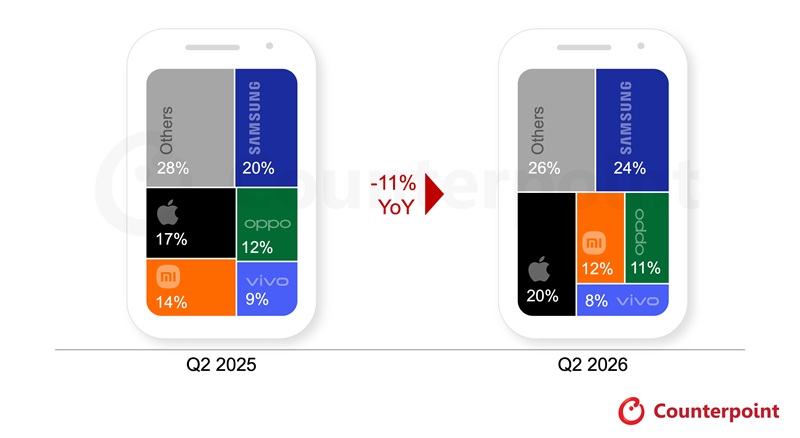
Global smartphone market share, Q2 2026: Samsung leads at 24%, Apple at a record 20%, followed by Xiaomi, OPPO, and vivo.
The picture looks very different for Chinese brands. Xiaomi (12%), OPPO (11%), and vivo (8%) all posted double-digit shipment declines year-over-year. Focused on price-sensitive buyers, they've had to pass memory cost hikes directly to consumers — or cut storage configurations — pushing entry-level models out of the ranges shoppers expect. Many buyers are simply holding onto their current phones longer, or choosing a previous-generation device instead.
Outside the top five, Google stood out with 16% growth on the strength of Pixel 10 and Pixel 10a. Huawei grew 6%, driven by new Mate and Nova launches.
What comes next
Counterpoint analysts don't expect a meaningful market recovery until memory chip supply stabilises — which won't happen before late 2027 at the earliest. Manufacturers are expected to keep trimming low-margin models, adjust storage tiers downward, and push certified refurbished devices as an alternative. Premium phones, backed by trade-in programmes and ecosystem loyalty, will continue to hold up. For anyone on a tight budget, the next year or two looks like a rough time to be shopping for a new smartphone.


